


A worker lifts a box they have handled many times before. It feels routine. No warning, no sign of danger. Then a sharp pull hits the lower back. Work stops. Recovery begins. This is how most manual handling injuries happen. Not during extreme tasks, but during everyday actions done without enough care. Manual handling remains one of the leading causes of workplace injuries across the UK. What makes it serious is how preventable it is. With the right knowledge, simple adjustments, and consistent habits, many injuries never need to happen.
This guide explains manual handling in a clear and practical way. You will understand what it is, why it matters, what the law requires, and how to apply safe practices in real work situations.
Table of Contents
Manual Handling at Work: Complete Guide to UK Law, Risks, and Safe Practices
Manual Handling at Work: Complete Guide to UK Law, Risks, and Safe Practices explains the legal requirements, common risks, and safe techniques involved in manual handling in the workplace. It covers UK regulations, risk assessments, proper lifting methods, employer and employee responsibilities, and practical steps to reduce injuries and create a safer working environment.
What is Manual Handling and Why Does It Matter?
Manual handling refers to any activity where a person lifts, lowers, pushes, pulls, carries, or moves a load using physical effort. The load can be anything. Boxes, tools, equipment, or even people in care settings.
It is not limited to heavy lifting. Even light items can cause harm when handled repeatedly or in poor positions.
What Counts as Manual Handling in Packaging and Daily Tasks
In packaging environments, manual handling often includes stacking boxes, loading goods, wrapping items, and moving products across short distances. These actions may seem simple, but repetition increases strain over time.
A worker moving small packages all day may face more risk than someone lifting a heavy object once.
The Hidden Risks Behind Everyday Movements
The most common injuries linked to manual handling are musculoskeletal disorders, often called MSDs. These include back pain, joint strain, and soft tissue injuries. Some injuries happen instantly. Others build slowly. A slight discomfort ignored today can become a long-term problem later.
Why Manual Handling is a Major Workplace Concern
Manual handling injuries affect both workers and businesses. Workers face pain, lost income, and reduced mobility. Employers deal with lost productivity, legal risks, and increased costs. This is why manual handling is not just a safety topic. It is a business priority.
What is the Manual Handling Law in the UK?
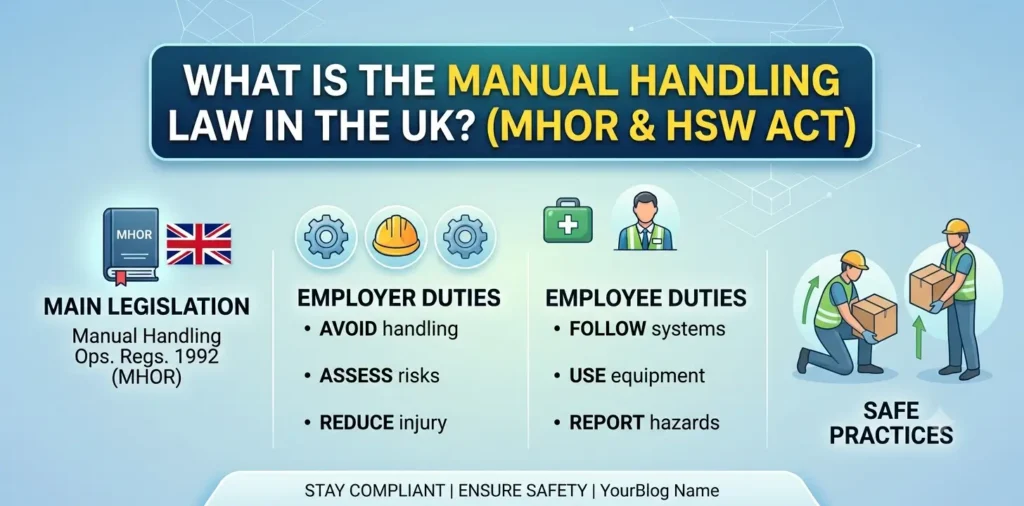
Manual handling in the UK is regulated under the Manual Handling Operations Regulations 1992 (MHOR), supported by the broader framework of the Health and Safety at Work etc. Act 1974.
These laws set out clear duties for employers to protect workers from injury caused by lifting, carrying, pushing, or pulling loads.
At its core, the law follows a simple hierarchy:
- Avoid hazardous manual handling where possible
- Assess unavoidable tasks for risk
- Reduce those risks to the lowest level reasonably practicable
This structure is not optional guidance. It is a legal requirement enforced by the Health and Safety Executive (HSE).
Overview of UK Manual Handling Regulations
The MHOR regulations focus on prevention rather than reaction. Employers are expected to think ahead and design work in a way that reduces physical strain.
For example, instead of training workers to lift heavy loads safely, the first question should be whether the load needs to be lifted at all. Could it be moved mechanically? Could the process be redesigned?
If manual handling cannot be avoided, the law requires a structured risk assessment. This involves analysing:
- The task being performed
- The load being handled
- The working environment
- The capability of the individual worker
This approach ensures that risk is addressed from multiple angles, not just through technique alone.
Employer Responsibilities
Employers carry the primary legal duty under manual handling law. Their responsibility goes beyond providing instructions. They must actively create a safer system of work.
This includes:
- Conducting detailed risk assessments before tasks are assigned
- Eliminating hazardous tasks where possible through redesign or automation
- Providing mechanical aids such as trolleys, hoists, or conveyors
- Delivering effective training that focuses on real workplace scenarios
- Ensuring work is organised to avoid repetitive strain and fatigue
A common failure in many workplaces is treating training as a one-time activity. In reality, the law expects continuous review, especially when tasks, environments, or equipment change.
Employer Responsibilities in Manual Handling Safety
While employers lead, employees are legally required to support safe practices. Workers must:
- Follow all manual handling procedures and training
- Use equipment correctly and consistently
- Avoid unsafe shortcuts, even under time pressure
- Report hazards, defects, or early signs of injury
An important point often overlooked is that employees can also face consequences if they knowingly ignore safety procedures. Responsibility is shared, even if accountability is weighted toward the employer.
What Happens When Rules Are Ignored

Failing to follow manual handling regulations has both immediate and long-term consequences.
At the workplace level:
- Injuries increase, especially back injuries and musculoskeletal disorders
- Absenteeism rises, reducing productivity
- Staff morale drops as safety concerns grow
At the legal level:
- Employers may face investigations by the HSE
- Fines can be significant, especially in cases of negligence
- Serious breaches can lead to prosecution
More importantly, the human cost is often underestimated. A single preventable injury can lead to chronic pain, reduced mobility, or even the end of a career.
What are the Main Principles of Manual Handling?
The Core Principles Explained Simply
Safe manual handling starts with a few key principles. Plan the task before lifting. Keep the load close to the body. Maintain a stable posture. Avoid twisting during movement. Each principle reduces strain on the body and lowers the chance of injury.
The 8 Principles of Manual Handling
The eight widely accepted principles include planning the lift, positioning the feet for balance, bending the knees, keeping the back straight, holding the load close, lifting smoothly, avoiding twisting, and setting the load down safely. These are not abstract rules. They are practical actions that protect the body during movement.
How Principles Reduce Injury Risk
Each principle targets a specific risk. Keeping the load close reduces pressure on the spine. Bending the knees shifts the effort to stronger leg muscles. Avoiding twisting prevents joint strain. Small adjustments create large safety gains.
Applying Principles in Real Work Environments
In a warehouse, a worker lifting boxes close to the body reduces strain across a full shift. In healthcare, proper positioning when assisting a patient prevents injury for both worker and patient. The principles remain the same. Only the context changes.
How to Avoid Hazardous Manual Handling
Identifying Hazardous Manual Tasks
Hazardous tasks often involve heavy loads, awkward shapes, or repetitive actions. Poor lighting, tight spaces, and uneven surfaces increase risk. Recognising these factors early allows action before injury occurs.
Eliminating Risk at the Source
The best approach is to remove the need for manual handling altogether. This may involve redesigning tasks or using automated systems. For example, using conveyor belts instead of manual carrying reduces strain completely.
Reducing Risk When Elimination Isn’t Possible
When tasks cannot be removed, risks must be reduced. This can include lowering load weight, improving workflow, or adjusting task frequency. Even small changes can reduce cumulative strain.
Practical Workplace Adjustments That Work
Simple changes often have strong impact. Rearranging storage to reduce reaching. Using team lifting for heavier items. Adjusting work height to avoid bending. These are practical solutions that deliver real results.
How Do You Manage Manual Handling in the Workplace?
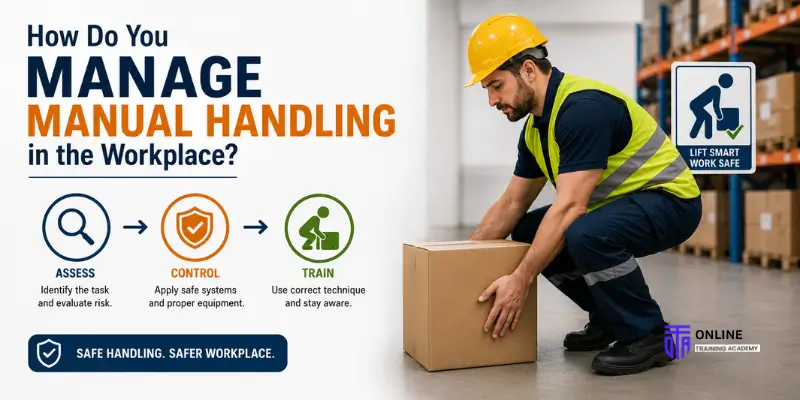
Step-by-Step Risk Assessment Process
Managing manual handling begins with risk assessment. Identify the task. Evaluate the risk. Apply control measures. This process should be continuous, not a one-time activity.
Assessment of Workplace Manual Handling Risks
Risk assessment looks at several factors. How often the task is done. The weight and shape of the load. The posture required. The capability of the worker. Each factor contributes to overall risk.
Control Measures That Actually Work
Control measures include engineering solutions such as lifting equipment and administrative controls such as training and job rotation.The most effective approach combines both.
Building a Safety Culture Around Manual Handling
Policies alone do not create safety. Culture does. Workers must feel responsible and supported. Managers must lead by example. Consistency builds safe habits over time.
How to Reduce the Risk of Injury in Manual Handling
Common Causes of Manual Handling Injuries
Most injuries come from poor posture, lifting loads that are too heavy, or working while fatigued. These causes are predictable. That makes them preventable.
Early Warning Signs Workers Ignore
Discomfort, stiffness, and mild pain are often ignored. These are early signals. Acting early can prevent more serious injury. Ignoring them increases long-term risk.
Preventive Measures That Make a Difference
Regular breaks allow the body to recover. Proper training improves technique. Using equipment reduces strain. Prevention is always easier than recovery.
Real-Life Injury Scenario and Lessons Learned
A worker repeatedly lifts medium-weight boxes without adjusting posture. Over time, strain builds. Eventually, injury occurs. The lesson is clear. Repetition without proper technique creates risk, even when tasks seem manageable.
Conclusion
Manual handling rarely feels dangerous in the moment. It feels normal, routine, and easy to overlook. Yet most injuries do not come from rare events. They come from repeated small actions done without care. The difference lies in awareness and discipline. Knowing how to lift, when to adjust, and when to stop changes outcomes. A safer workplace does not depend on luck. It depends on decisions made every day. One better lift. One safer habit. One informed worker. That is where prevention begins.
FAQs
Manual handling includes lifting, lowering, pushing, pulling, carrying, or moving objects using physical effort.
They include planning the task, maintaining posture, keeping loads close, bending knees, avoiding twisting, and lifting smoothly.
Task, Individual, Load, Environment, and Other factors such as equipment or time pressure.
Lifting boxes, pushing carts, pulling loads, carrying materials, and repetitive stacking.
To prevent injury by reducing or eliminating hazardous manual handling tasks.
By conducting risk assessments, providing training, and using proper equipment.
It helps workers perform tasks safely and reduces injury risk.
Learn More





Get a FREE Course
- Learn useful skills online free
- Get CPD accredited certificate
- Add it to your CV today!