

Most workplace incidents don’t begin with danger. They begin with normal work.
A chair slightly too low. A cable across a walkway. A task repeated the same way every day without question. Nothing appears unsafe in the moment, yet over time these small conditions build into real harm, lost time, and avoidable disruption.
This is where workplace health, safety, security, and hazards truly sit. Not in dramatic emergencies, but in everyday decisions.
In the UK, this responsibility is not optional. It is embedded in the Health and Safety at Work etc. Act 1974, requiring employers to actively identify, control, and reduce risks before they turn into incidents.
This guide breaks down what these terms actually mean in practice, how risks develop in real workplaces, and how to manage them in a structured and effective way.
What Is Workplace Health, Safety, Security, and Hazards?
These four elements are often treated as separate topics. In reality, they operate as a single system that determines how well an organisation protects its people and maintains operational stability.
Workplace Health – Beyond Injury Prevention
Workplace health is not limited to avoiding physical harm. It includes the full spectrum of employee wellbeing, including mental and long-term health conditions.
In many UK workplaces, the most significant risks are no longer immediate injuries but chronic issues. Poor workload management, lack of support, and high-pressure environments contribute to psychosocial risks, which can be just as damaging as physical hazards.
A high-performing team can quietly deteriorate when stress is unmanaged. Absence rises, engagement drops, and performance becomes inconsistent. These are not isolated issues. They are indicators of weak health management systems.
Workplace Safety – Controlling Immediate Risk
Safety focuses on preventing incidents that cause immediate harm. This includes unsafe equipment, poor procedures, or gaps in supervision.
In practice, most safety failures come from one of two sources:
- Unsafe conditions, such as defective equipment or poor layout
- Unsafe behaviours, often driven by time pressure or lack of awareness
A machine without proper guarding is an obvious hazard. However, a trained worker bypassing safety procedures to save time presents an equally serious risk. Effective safety management addresses both.
Workplace Security – The Overlooked Layer
Security protects the workplace from intentional threats, but it also plays a critical role in safety.
Unauthorised access, poor visitor control, or weak information security can quickly create safety risks. For example, an untrained individual entering a restricted area may expose themselves and others to harm.
Security and safety are interconnected. When one fails, the other is often compromised.
Hazards and Risks – The Foundation of Decision-Making
A common weakness in many organisations is misunderstanding the difference between hazards and risks.
A hazard is the source of harm. A risk is the likelihood and severity of that harm occurring.
A chemical substance stored incorrectly is a hazard. The probability of exposure and the severity of its effects define the risk. Without this distinction, organisations either overreact or underestimate danger.
Workplace Health, Safety, Security, and Hazards Explained: A Complete Guide
"This guide explains the key aspects of workplace health, safety, security, and hazards. It covers common workplace risks, safety practices, employee and employer responsibilities, and effective measures to create a safe, secure, and healthy working environment."
Table of Contents
What Are the Main Types of Workplace Hazards?
Workplace hazards are typically grouped into four main categories. Each one behaves differently and requires specific control measures.
Chemical Hazards – Often Hidden in Plain Sight
Chemical hazards are not limited to industrial settings. They exist in offices, retail environments, and healthcare facilities.
Cleaning products, solvents, and fumes are common examples. When these substances are poorly stored or handled, they can lead to respiratory issues, skin irritation, or long-term health conditions.
The real challenge is that exposure is often gradual. Employees may not notice the impact until symptoms develop over time.
Biological Hazards – Risk Through Exposure
Biological hazards involve exposure to living organisms or biological materials.
These are most visible in healthcare, but they are also present in everyday environments. Shared workspaces, poor hygiene practices, and contact with organic materials can all introduce risk.
Infections, allergic reactions, and long-term illness are common outcomes when these hazards are not properly controlled.
Ergonomic Hazards – The Slow-Build Risk
Ergonomic hazards develop through poor workplace design and repetitive activity.
Unlike physical hazards, they rarely cause immediate injury. Instead, they lead to musculoskeletal disorders over time.
Poor posture, repetitive movements, and incorrect lifting techniques gradually place strain on the body. The impact becomes visible only after damage has already occurred.
Physical Hazards – Environmental and Mechanical Risks
Physical hazards come directly from the working environment.
These include noise, temperature extremes, radiation, and machinery-related risks. Some cause immediate harm, while others build up gradually.
For example, prolonged exposure to high noise levels may not cause instant damage, but over time it can lead to permanent hearing loss.
Why Workplace Health and Safety Matters More Than Compliance
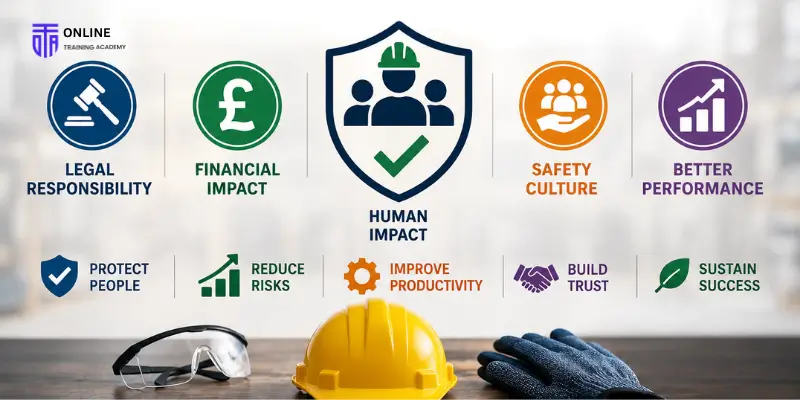
Many organisations treat health and safety as a regulatory requirement. This is a strategic mistake.
Legal Responsibility in the UK
UK law places clear obligations on employers. Failure to comply can lead to prosecution, fines, and operational shutdowns.
However, compliance alone does not guarantee safety. It only sets the minimum standard.
Financial Impact of Poor Safety Management
Incidents carry both direct and indirect costs.
Direct costs include compensation, medical expenses, and downtime. Indirect costs often have a greater impact. These include:
- Loss of productivity
- Increased staff turnover
- Reputational damage
A single incident can disrupt operations far beyond the immediate event.
Human Impact – The Real Cost
Behind every statistic is a person.
An injury affects not just the individual, but their family, team, and organisation. Long-term health conditions can permanently change someone’s ability to work.
This is where safety moves beyond compliance and becomes a moral responsibility.
Safety Culture and Performance
Organisations with strong safety cultures consistently perform better.
When employees feel safe, they work with greater confidence and focus. Errors reduce, communication improves, and productivity increases.
Safety is not separate from performance. It supports it.
How to Identify Hazards in the Workplace
Hazard identification is not a one-time activity. It is an ongoing process.
Risk Assessments as a Core Tool
A risk assessment is the foundation of workplace safety in the UK.
It involves identifying hazards, evaluating risks, and implementing control measures. The key is not just completing the assessment, but ensuring it reflects real working conditions.
Observation and Real-Time Awareness
Many hazards are visible during normal operations.
Walking through a workplace with a critical eye often reveals issues such as poor layout, blocked exits, or unsafe practices. These are not always documented but are immediately actionable.
Employee Insight and Reporting
Employees are often the first to notice risks.
A strong reporting culture allows issues to be identified early. When workers feel safe to speak up without blame, hazard detection improves significantly.
Learning from Near Misses
Near misses provide valuable insight.
They reveal weaknesses in systems before harm occurs. Ignoring them removes an opportunity to prevent future incidents.
How to Manage Workplace Health and Safety Effectively

Managing safety requires more than policies. It requires structured action.
Applying the Hierarchy of Control
Effective risk management follows a clear order:
- Eliminate the hazard where possible
- Replace it with a safer alternative
- Introduce control measures to reduce exposure
Relying only on personal protective equipment is a weak strategy if higher-level controls are possible.
Training and Competence
Training must be relevant and practical.
Generic safety training has limited impact. Employees need to understand risks specific to their role and how to manage them effectively.
Emergency Planning and First Aid
Every workplace must be prepared for unexpected events.
Clear evacuation procedures, accessible first aid, and defined responsibilities ensure that responses are fast and effective when incidents occur.
Continuous Improvement
Workplace risks evolve.
Regular reviews, audits, and updates ensure that safety systems remain effective. Static systems quickly become outdated.
Common Workplace Risks and How They Develop
Most risks develop gradually rather than appearing suddenly.
The Build-Up of Small Failures
Major incidents often result from a series of minor issues.
A missed inspection, a delayed repair, or a shortcut taken under pressure. Each step increases risk until a tipping point is reached.
Psychosocial Risks and Mental Health
Mental health risks are often overlooked.
Workload, poor communication, and lack of support create pressure that affects both wellbeing and performance. These risks require active management, not passive awareness.
Human Behaviour and Error
People do not always follow procedures.
Fatigue, stress, and time pressure influence decision-making. Safety systems must account for real human behaviour, not ideal behaviour.
Weak Systems and Poor Implementation
Having policies is not enough.
If procedures are not followed or understood, they provide no real protection. The gap between written rules and actual practice is where many risks exist.
Conclusion
Workplace safety rarely fails because of one major oversight. It fails because of small issues that were never addressed.
A loose cable. A missed report. A process followed without question.
Each one seems minor. Together, they create risk.
Understanding workplace health, safety, security, and hazards is not about memorising definitions. It is about recognising how everyday actions shape outcomes.
The organisations that stay safe are not the ones with the most policies. They are the ones where people notice problems early, act on them quickly, and treat safety as part of how work gets done.
That is where real protection begins.
FAQs
A hazard is something that can cause harm, while risk measures how likely that harm is and how severe it could be.
Employers hold primary responsibility, but employees must follow procedures and report hazards.
Physical, chemical, biological, and ergonomic hazards are the most common across industries.
They should be reviewed regularly and whenever there are changes in processes, equipment, or environment.
These include stress, workload pressure, poor management practices, and workplace conflict.
It provides a structured approach to reducing risk, prioritising elimination over less effective measures.
They highlight weaknesses in systems before actual harm occurs, allowing preventive action.
Learn More





Get a FREE Course
- Learn useful skills online free
- Get CPD accredited certificate
- Add it to your CV today!