
Introduction
The early years of a child’s life are often described as the “foundation stage” for everything that follows—and with good reason. From birth to the age of five, children experience rapid physical, cognitive, social, emotional, and language development that shapes how they learn, build relationships, and respond to the world around them. Long before formal schooling begins, they are developing essential skills through everyday experiences, play, and interactions with the people and environments around them.
The Early Years Foundation Stage (EYFS) is the statutory framework that supports this crucial stage of development in England. Rather than focusing solely on academic achievement, EYFS promotes a balanced approach that combines learning, play, care, and wellbeing. It provides educators and childcare professionals with clear guidance to help every child develop at their own pace in a safe, inclusive, and nurturing environment.
But why does EYFS matter so much, and what makes it one of the most influential frameworks in early childhood education? This guide explores the importance of EYFS, its core objectives, and the lasting impact it has on children’s development, school readiness, and future learning.
Why the EYFS Matters in Early Childhood
EYFS is important because it focuses on the most critical stage of human development—birth to age five. During this time, a child’s brain develops at a rapid pace, forming connections that influence future learning, behaviour, and emotional wellbeing.
Rather than rushing children into formal education, EYFS ensures they learn through play, exploration, and guided experiences. This approach respects how young children naturally develop and prevents unnecessary pressure at an early age.
EYFS also ensures consistency in early education settings, meaning every child—regardless of background—receives a similar standard of care and learning opportunities.
Most importantly, it helps children build:
- Confidence in learning
- Early communication skills
- Emotional stability
- Social awareness
These foundations are essential for long-term success in school and life.
Early Years Foundation Stage (EYFS) Teaching Diploma
Learn the fundamentals of the Early Years Foundation Stage (EYFS) and explore how it supports children's learning, development, and wellbeing. This online course covers key EYFS principles, areas of learning, safeguarding awareness, observation, assessment, and creating positive early years environments through structured and accessible learning.
Table of Contents
Early Years Foundation Stage Outcomes
The EYFS framework is not just about activities—it is about meaningful outcomes that prepare children for the future.
By the end of the EYFS stage, children are expected to develop key skills in communication, physical development, emotional regulation, and early academic understanding.
Some of the most important outcomes include school readiness, where children are able to:
- Follow simple instructions
- Communicate their needs clearly
- Interact positively with peers
- Begin early literacy and numeracy skills
EYFS also focuses on emotional resilience, helping children manage feelings, build confidence, and adapt to new environments.
These outcomes ensure that children transition smoothly into primary education without feeling overwhelmed or unprepared.
What Does EYFS Do in Practice?
EYFS creates a structured yet flexible learning environment where children learn through everyday experiences.
Instead of traditional classroom lessons, children engage in activities such as storytelling, role-play, outdoor exploration, and creative play. Each activity is designed to support multiple areas of development at the same time.
Educators observe children closely during these activities to understand their progress and identify their strengths or learning needs. Based on these observations, they plan future learning experiences that support continuous development.
In this way, EYFS acts as both a learning framework and a developmental guide, ensuring every child receives personalised support.
What to Do If You Are Concerned About Development
One of the strengths of EYFS is that it helps identify developmental concerns early. If a child is not meeting expected milestones, educators and parents can work together to provide additional support.
Early intervention is extremely important because it can significantly improve long-term outcomes. Support may include:
- Additional learning activities
- Speech and language support
- Special educational needs assessment
- Parental guidance and home-based strategies
The goal is never to label or compare children, but to ensure every child receives the help they need at the right time.
Can a Child Go to Nursery While on Antibiotics?
One of the most common concerns for parents is whether their child can continue attending nursery while taking antibiotics. In many situations, the answer is yes, but it depends on the child’s overall condition rather than just the medication itself.
Antibiotics are often prescribed to treat bacterial infections, and once a child has started treatment, they may begin to feel better quite quickly. If the child is alert, comfortable, and able to take part in normal nursery activities, they are usually able to attend.
However, the decision is not based only on medication—it is based on wellbeing, safety, and the risk of infection to others, which is a key part of the EYFS health and welfare approach.
When a Child Can Safely Attend Nursery
A child may be able to go to nursery while on antibiotics if they are generally well and showing signs of recovery. This includes being able to eat, drink, and engage in simple play activities without discomfort.
In these cases, attending nursery can actually be beneficial because children continue their normal routine, maintain social interaction, and avoid unnecessary disruption to their learning and development.
EYFS settings understand that illness is a normal part of early childhood, and they aim to support continuity in learning wherever it is safe to do so.
When a Child Should Stay at Home
Even if a child has started antibiotics, there are situations where staying at home is the better option. If a child has a high temperature, appears unusually tired, or is unable to participate in normal activities, they should rest until they feel better.
Children who are still in the early contagious stage of an illness may also need to remain at home to prevent spreading infection to others. This is especially important in group settings where young children interact closely.
EYFS guidance always prioritises health, comfort, and recovery over attendance, ensuring that children are not pushed back into learning too early.
Nursery Policies and EYFS Health Guidance
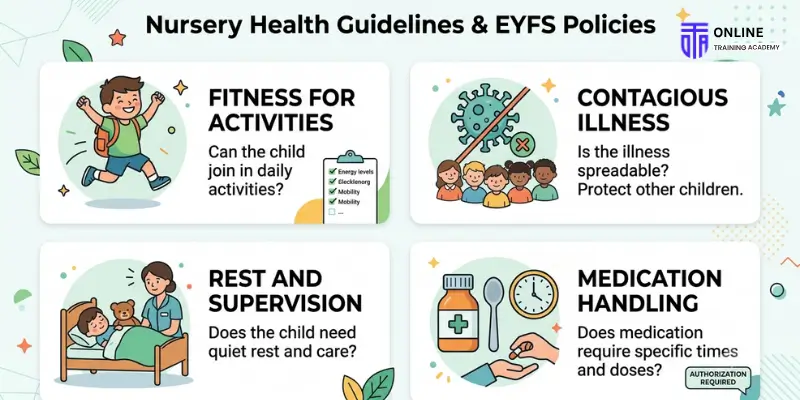
Each nursery or early years setting may have its own specific rules regarding illness and medication. These policies are designed in line with EYFS welfare requirements to ensure the safety of all children and staff.
In general, nurseries will consider:
- Whether the child is fit to take part in daily activities
- Whether the illness is contagious
- Whether the child needs rest and supervision
- Whether medication requires special handling during the day
Staff are trained to assess each situation carefully and communicate with parents to make the best decision for the child’s wellbeing.
Balancing Health, Learning, and Care
The EYFS framework recognises that early childhood development does not stop during short periods of illness. However, it also understands that children learn best when they feel healthy and comfortable.
That is why decisions about nursery attendance while on antibiotics are always made on a case-by-case basis, balancing:
- The child’s physical health
- Their ability to participate in learning
- The risk of spreading illness
- The need for rest and recovery
Ultimately, the goal is to support both the child’s recovery and their continued development in a safe and caring environment.
What Happens Early Matters for a Lifetime
One of the most important ideas behind EYFS is that early experiences shape lifelong development.
The skills children develop in their early years influence:
- Academic success in school
- Social relationships
- Emotional wellbeing
- Confidence and independence
A strong early foundation makes future learning easier and more successful. On the other hand, missed opportunities in early development can be harder to recover later in life.
This is why EYFS places such strong emphasis on high-quality early education and care.
Whose Knowledge Shapes EYFS Policy and Practice?
The Early Years Foundation Stage (EYFS) is not a randomly designed framework or a set of simple classroom rules. Instead, it is built on a strong foundation of research, professional expertise, and scientific understanding of child development. Every principle, requirement, and learning outcome within EYFS is carefully shaped to reflect how young children actually grow, learn, and respond to their environment.
This evidence-based approach is what makes EYFS a trusted and widely used framework in early childhood education.
A Framework Built on Research and Evidence
EYFS is developed using knowledge gathered over decades from multiple fields, including child development studies, education research, psychology, and neuroscience.
Researchers study how children develop physically, emotionally, socially, and cognitively from birth onwards. These studies help identify what children are capable of at different ages and what type of learning experiences support healthy development.
For example, research shows that young children learn best through play and interaction rather than formal instruction. This understanding directly influences how EYFS promotes play-based learning instead of traditional classroom teaching.
By relying on scientific evidence rather than assumptions, EYFS ensures that its guidance is both practical and developmentally appropriate.
The Role of Child Development Experts
Child development specialists play a key role in shaping EYFS. These experts study how children think, behave, and respond to different learning environments.
Their insights help define:
- Developmental milestones
- Appropriate learning expectations for different age groups
- Emotional and social development stages
- Effective teaching strategies for early years settings
These professionals ensure that EYFS is aligned with how children naturally develop, rather than forcing them into rigid academic expectations too early.
Education Policymakers and Government Input
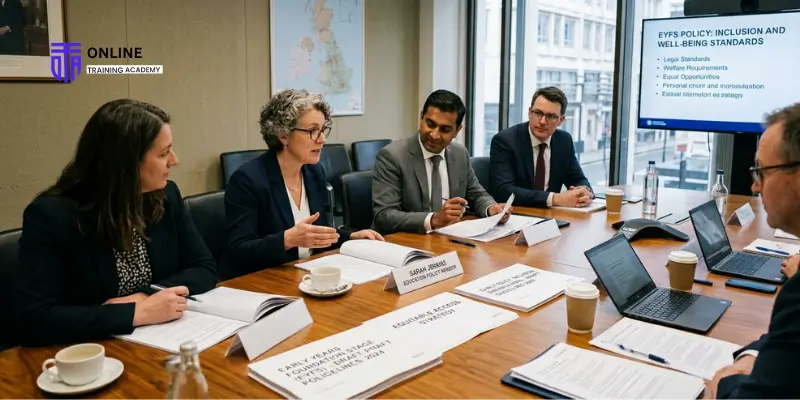
Education policymakers are responsible for turning research findings into structured national guidelines. They ensure that EYFS is applied consistently across all early years settings, including nurseries, preschools, and reception classes.
Their role includes:
- Setting legal standards for early years education
- Defining welfare and safeguarding requirements
- Ensuring equal learning opportunities for all children
- Updating the framework based on new research and societal needs
This ensures that EYFS is not only educationally sound but also fair, inclusive, and accessible to every child.
Psychologists and Neuroscience Contributions
Child psychologists and neuroscientists contribute valuable insights into how a child’s brain develops during the early years.
Research in neuroscience shows that the first five years of life are a period of rapid brain development. During this time, experiences significantly shape memory, behaviour, language, and emotional regulation.
Because of this, EYFS places strong emphasis on:
- Emotional security
- Positive relationships
- Stimulating environments
- Early communication development
Psychologists also help identify how stress, trauma, or lack of stimulation can affect learning, which is why EYFS includes strong safeguarding and wellbeing requirements.
Why Evidence-Based Practice Matters in EYFS
The combination of research, expert knowledge, and policy development ensures that EYFS remains effective and reliable.
This evidence-based approach means that:
- Teaching methods are grounded in real child development science
- Learning expectations are realistic and age-appropriate
- Children are not pressured beyond their developmental stage
- Education systems remain updated with modern research
As a result, EYFS continues to evolve, improving the quality of early childhood education over time.
Conclusion
The Early Years Foundation Stage is more than an education framework—it is a system that shapes the earliest and most important phase of human development.
By focusing on learning through play, emotional security, and personalised development, EYFS ensures that children are not just prepared for school, but prepared for life.
Its impact goes far beyond the classroom. It influences confidence, behaviour, relationships, and lifelong learning ability.
Ultimately, EYFS reminds us of a simple but powerful truth: what happens in early childhood doesn’t just affect the early years—it shapes the entire future.
FAQs
The Early Years Foundation Stage (EYFS) is important because it provides a structured framework that supports children’s learning, development, and wellbeing from birth to five years old. It helps children develop essential communication, social, emotional, physical, and cognitive skills while preparing them for primary school and lifelong learning.
The main aim of EYFS is to ensure every child has the best possible start in life by providing high-quality early education and care. It promotes learning through play, supports individual development, and creates safe, inclusive environments where children can thrive.
EYFS supports all areas of child development by encouraging communication, confidence, independence, problem-solving, creativity, physical coordination, and emotional wellbeing. It recognises that every child develops at their own pace and provides opportunities for personalised learning.
EYFS helps children develop the skills they need for a successful transition to primary school. These include early literacy and numeracy, communication, social interaction, emotional resilience, independence, and the ability to follow routines and instructions.
Play is central to the EYFS framework because it is one of the most effective ways young children learn. Through play, children explore ideas, solve problems, develop language, build relationships, improve motor skills, and gain confidence in a natural and engaging way.
The EYFS framework is effective because it combines child-centred learning, play-based education, high welfare standards, skilled teaching, and strong partnerships with families. Together, these elements help every child reach their full potential during the most important stage of early development.
Learn More



Get a FREE Course
- Learn useful skills online free
- Get CPD accredited certificate
- Add it to your CV today!