




Walk into two workplaces that look identical on the surface. Same equipment, same number of staff, same type of work. Yet one runs smoothly, while the other experiences frequent disruptions, near misses, and rising absence.
The difference is not luck. It is how risks are managed.
Workplace health and safety management is the structured process of identifying hazards, assessing risks, and putting controls in place to protect people. It is not a one-time task or a box-ticking exercise. It is an ongoing system that shapes how work is planned, carried out, and improved.
In the UK, this approach is grounded in the Health and Safety at Work etc. Act 1974, which places clear duties on employers to prevent harm rather than respond to it.
This guide breaks down what managing workplace health and safety involves, why it matters, and how organisations can apply it effectively in real working environments.
Table of Contents
Why Managing Workplace Health and Safety Is Essential for Every Organisation
"Managing workplace health and safety is essential for protecting employees, reducing risks, and ensuring legal compliance. This blog explores why effective health and safety practices are vital for every organisation, helping to prevent accidents, improve productivity, and create a safe and positive working environment."
What Does Managing Workplace Health and Safety Mean?
Managing workplace health and safety means taking a proactive and structured approach to controlling risks before they cause harm.
At its core, it comes down to three connected actions:
- Identifying hazards that could cause injury or ill health
- Assessing the level of risk based on likelihood and severity
- Implementing control measures to eliminate or reduce that risk
These steps form the foundation of every effective safety system.
However, this process is not static. Workplaces evolve. New equipment is introduced, roles change, and risks shift over time. A system that is not regularly reviewed quickly becomes outdated.
In practical terms, effective management means building safety into everyday operations. This includes designing work processes that are safe from the outset, ensuring employees understand the risks linked to their roles, and maintaining systems that continuously monitor and improve safety performance.
When this structure is weak, risks remain hidden until something goes wrong. When it is strong, issues are identified early and controlled before they escalate.
Why Managing Workplace Health and Safety Is Important
Legal and Regulatory Importance
In the UK, employers have a legal duty of care to protect employees and others affected by their activities.
Failure to manage health and safety properly can result in:
- Enforcement action from regulators
- Significant financial penalties
- Legal liability and prosecution
However, compliance alone is not the goal. It is the baseline.
Operational Stability and Business Continuity
Unmanaged risks disrupt operations.
A single incident can lead to downtime, investigation, and loss of productivity. Over time, repeated issues create instability that affects overall performance.
Organisations that manage risks effectively operate with greater consistency and fewer interruptions.
Protecting People and Wellbeing
The most important impact is human.
Injuries, illnesses, and long-term health conditions affect individuals beyond the workplace. Effective management prevents harm before it occurs, rather than responding after damage has been done.
Reputation and Organisational Trust
A strong safety record builds trust with employees, clients, and stakeholders.
Poor safety practices, on the other hand, can damage reputation quickly and reduce confidence in the organisation.
Who Has Duties for Managing Workplace Health and Safety Risks?
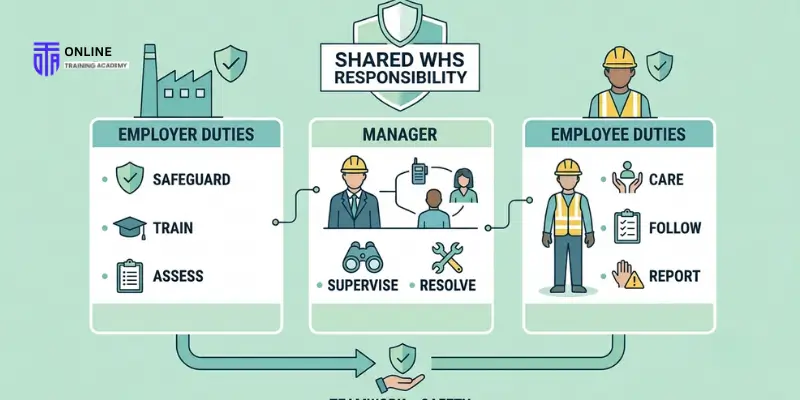
Responsibility for health and safety is shared, but it is not equal.
Employer Responsibilities
Employers hold the primary responsibility for managing risks.
They must ensure that:
- The workplace is safe and without risk to health
- Equipment is properly maintained
- Employees receive adequate information, instruction, and training
- Risk assessments are carried out and reviewed
This responsibility cannot be delegated away, even if tasks are assigned to others.
Employee Responsibilities
Employees also have legal duties.
They must:
- Take reasonable care of their own health and safety
- Follow safety procedures and instructions
- Report hazards, risks, and unsafe conditions
Safety systems fail when employees are not engaged or informed.
Role of Managers and Supervisors
Managers act as the link between policy and practice.
They are responsible for:
- Implementing safety procedures on the ground
- Monitoring behaviour and conditions
- Addressing issues before they escalate
Without active supervision, even well-designed systems break down.
What Is Involved in Managing Risks?
Managing risks requires more than simply identifying hazards. It involves a structured and ongoing approach to understanding how harm could occur and putting the right controls in place to prevent it.
In practice, this means looking at how work is actually done, not just how it is described in procedures. Many risks develop in the gap between written processes and real behaviour on the ground.
At a practical level, effective risk management focuses on three core actions:
- Understanding how work is carried out, including tasks, environments, and human factors
- Identifying where harm could occur, whether from equipment, substances, or working conditions
- Evaluating how serious the risk is, based on likelihood and potential impact
Once this is clear, the next step is to apply proportionate control measures. The goal is not just to reduce risk, but to do so in a way that is realistic and consistently followed in daily work. This is where many organisations struggle. Controls may exist, but if they are not practical or understood, they fail in real situations. Another important aspect is recognising that risk is not limited to routine tasks. Activities such as maintenance, equipment changes, or emergency situations often introduce higher and less predictable risks. These require additional planning and closer supervision. Effective risk management, therefore, is not a one-time exercise. It is a continuous process of understanding, controlling, and reviewing risks as work evolves.
The Risk Management Process
The risk management process follows a logical sequence that ensures risks are controlled effectively.
Step 1: Identify Hazards
Recognise anything that could cause harm.
This includes physical conditions, equipment, substances, and even organisational factors such as workload or communication gaps.
Step 2: Assess Risks
Evaluate how likely harm is to occur and how severe the outcome could be.
This step helps prioritise which risks require immediate attention.
Step 3: Implement Control Measures
Introduce actions to eliminate or reduce risk.
This may involve redesigning processes, improving equipment, or changing how tasks are performed.
Step 4: Monitor and Review
Risk management is continuous.
Controls must be reviewed regularly to ensure they remain effective as conditions change.
When Should a Risk Management Approach Be Used?
Risk management is not limited to high-risk industries. It should be applied whenever work activities involve potential harm.
This includes:
- Introducing new equipment or processes
- Changing workplace layouts or procedures
- Investigating incidents or near misses
- Planning non-routine tasks
In practice, risk management should be embedded into everyday decision-making, not treated as a separate activity.
How to Identify Hazards
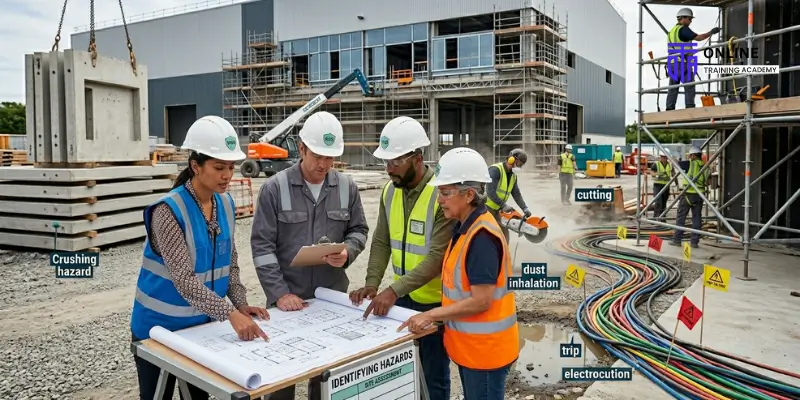
Effective hazard identification requires a combination of structured methods, not random checks or assumptions. In strong UK workplaces, hazard identification is part of daily operations, ensuring risks are recognised early and controlled before they escalate.
Observation of Work Activities
Observing how tasks are actually performed is one of the most effective ways to identify hazards. Written procedures often describe ideal conditions, but real work can differ due to time pressure, workload, or human behaviour. By watching how employees carry out tasks, organisations can identify unsafe practices, poor workspace layout, and equipment misuse that may not be formally reported. These small deviations are often the starting point of larger risks.
Consultation with Employees
Employees have direct, hands-on experience of their work, making them a critical source of hazard information. They are often the first to notice issues such as recurring problems, discomfort, or unsafe conditions. When organisations encourage open communication and reporting without blame, employees are more likely to share concerns. This improves early detection and prevents risks from remaining hidden.
Review of Past Incidents
Reviewing past incidents and near misses provides valuable insight into where systems have failed. These events rarely occur in isolation. Instead, they often reveal patterns that point to underlying weaknesses in processes, training, or supervision. Analysing these patterns allows organisations to address root causes rather than repeatedly dealing with the same issues.
Inspection and Audits
Regular inspections and audits ensure that hazard identification is systematic and consistent. Inspections focus on day-to-day conditions, helping to identify immediate risks in the working environment. Audits take a broader view, assessing whether safety systems are functioning effectively. Together, they provide a structured approach to identifying hazards rather than relying on chance observations.
How to Assess Risks
Risk assessment involves evaluating both likelihood and severity.
A low-likelihood event with severe consequences may still require strong controls. Similarly, frequent low-level risks can accumulate into significant issues.
Effective assessment considers:
- Who might be harmed
- How they might be harmed
- Existing control measures
- Whether additional controls are needed
This ensures that decisions are based on evidence rather than assumptions.
Why Does the Management of Health and Safety at Work Matter?
Managing health and safety at work matters because it directly shapes how well an organisation protects its people, maintains stability, and operates under pressure. It is not just about preventing accidents. It is about creating a working environment where risks are understood, controlled, and continuously monitored.
At a fundamental level, effective management reduces the likelihood of incidents that can cause injury, illness, or long-term harm. In the UK, this is reinforced by legal duties placed on employers, requiring them to take reasonable and practical steps to safeguard employees and others affected by their activities. Failing to do so can result in enforcement action, financial penalties, and serious operational consequences.
Beyond legal compliance, the impact is operational. Poorly managed risks lead to disruptions such as downtime, investigations, and loss of productivity. Over time, these issues affect performance, increase costs, and create instability within the organisation. In contrast, workplaces that manage health and safety effectively tend to operate more consistently, with fewer interruptions and stronger overall performance.
There is also a clear human dimension. Every incident affects more than just the immediate situation. Injuries and health conditions can have lasting consequences for individuals and their families. Effective management helps prevent these outcomes, shifting the focus from reacting to harm to preventing it altogether.
Finally, strong health and safety management supports a positive workplace culture. When employees feel that risks are taken seriously and addressed properly, trust increases. Communication improves, and people are more likely to engage with safety processes. This creates an environment where issues are identified early and resolved before they escalate.
In practice, managing health and safety matters because it connects legal responsibility, operational performance, and human wellbeing into a single system that determines how safely and effectively work is carried out.
You have not enough Humanizer words left. Upgrade your Surfer plan.
Conclusion
Every organisation faces risks. That part is unavoidable.
What separates safe workplaces from unsafe ones is not the absence of hazards, but the ability to recognise and manage them early.
A system that identifies risks, evaluates them clearly, and controls them effectively creates more than compliance. It creates stability.
When safety is managed properly, work becomes predictable, people feel protected, and problems are addressed before they grow.
That is what makes workplace health and safety management essential.
Learn More




Get a FREE Course
- Learn useful skills online free
- Get CPD accredited certificate
- Add it to your CV today!