

A family meeting can change direction quickly. A parent may arrive frustrated, a child may be struggling with behaviour, or a situation that seemed manageable may reveal deeper concerns. These moments show what it really takes to be an effective Family Support Worker.
The role goes beyond being caring or patient. Family Support Workers support people through personal and social challenges, using communication, active listening, judgement, coordination and the ability to stay calm under pressure.
Difficult cases bring these skills together. A great Family Support Worker listens carefully, communicates without escalating tension, maintains clear boundaries and knows when additional support may be needed.
Table of Contents
Family Support Worker
The Family Support Worker course develops practical knowledge of supporting families, safeguarding children, child development, health and safety, legislation, family issues, and child protection, including awareness of coronavirus prevention and care.
What Makes a Great Family Support Worker in Difficult Cases?

A great Family Support Worker combines empathy, communication, patience, self-awareness, adaptability, boundaries and sound judgement. The real difference is knowing how to apply these qualities when a family is under stress.
Empathy does not mean agreeing with everything, just as patience does not mean ignoring concerns. Effective workers consider what the family is experiencing, what is already working, what needs attention and what falls within their role.
Canadian occupational information also highlights skills such as active listening, collaboration, adaptability, stress tolerance and analytical thinking. These abilities matter because difficult family situations rarely have one simple answer.
Empathy Without Losing Professional Boundaries
Empathy helps a worker understand a family’s experience without immediately judging it.
Imagine a parent who becomes frustrated because they feel that several services have offered advice but nobody has actually listened to what their family needs. Responding with another list of instructions may make the situation worse.
A more thoughtful response begins by listening.
That does not mean the worker has to agree with every decision or remove every expectation. It means recognising the person’s feelings and perspective before deciding how best to move forward.
Boundaries are equally important. A Family Support Worker can be warm and approachable while still being clear about their responsibilities, confidentiality, communication and limitations.
Good Judgement When There Is No Easy Answer
Difficult cases often involve competing needs.
A family may want one form of support while another option appears more suitable. A parent may disagree with an observation. A worker may notice a concern but need more information before deciding what action is appropriate.
Good judgement means slowing down enough to consider the available information rather than reacting to the strongest emotion in the room.
It also means knowing the limits of the role. Depending on the setting and situation, a Family Support Worker may need to seek guidance, make a referral or follow specific workplace procedures rather than trying to solve everything independently.
Staying Effective When Emotions Run High
A worker’s response can influence the direction of a difficult conversation.
If a parent raises their voice and the worker responds defensively, tension can increase. If the worker remains calm, listens carefully and establishes respectful boundaries, there is a better opportunity for the conversation to become productive.
Canada’s Skills for Success framework also recognises the ability to manage difficult interactions, address interpersonal barriers and resolve conflict sensitively as part of effective collaboration.
The goal is not to avoid difficult conversations. It is to handle them without losing focus.
Which Skills Help a Family Support Worker Handle Challenging Behaviour?
Challenging behaviour is easy to describe and much harder to understand.
A child who refuses to participate, a parent who repeatedly misses appointments or a family member who becomes confrontational may all be labelled “difficult.” But that label does not tell the worker what is actually happening.
Behaviour can be influenced by stress, frustration, fear, communication difficulties, previous experiences with services, unmet needs or changing circumstances.
That is why effective support starts with observation and curiosity rather than assumptions.
Look Beyond the Behaviour
A worker might ask:
- What happened immediately before the behaviour?
- Is this a new pattern or something that happens regularly?
- How is the person communicating their needs?
- Is there a barrier that has not yet been identified?
- What has helped in the past?
This does not mean excusing unsafe or inappropriate behaviour. It means trying to understand the situation before choosing a response.
For example, if a parent repeatedly misses appointments, it may be tempting to assume they are uninterested. But transportation problems, work schedules, childcare, housing instability or previous negative experiences with services could be affecting their ability to attend.
Understanding the barrier can change the next step.
Respond Rather Than React
When behaviour becomes challenging, the worker needs to manage their own response first.
A calm tone, simple language and clear expectations can help prevent a difficult interaction from becoming a confrontation. Sometimes the most useful response is to pause rather than fill the silence with more instructions.
A worker may also need to acknowledge frustration:
“I can see that this has been frustrating. Let’s work out what is making this difficult.”
That does not surrender the worker’s role. It creates space for the family to explain what is happening.
When Challenging Behaviour Signals a Bigger Concern
Not every difficult interaction represents a serious risk. At the same time, a worker should not dismiss repeated or concerning behaviour simply because it is uncomfortable to discuss.
The ability to notice patterns matters.
A Family Support Worker may need to record observations, discuss concerns with an appropriate supervisor or follow established procedures when a situation goes beyond routine support. Canadian social and community service roles can include assessing client needs and strengths, preparing reports and conducting follow-up assessments.
The key is to stay within the responsibilities and procedures of the specific workplace.
How Does Self-Awareness Make a Family Support Worker Better?
One of the most overlooked qualities in family support is self-awareness.
A worker brings their own experiences, expectations and emotional reactions into every interaction. That does not make them unsuitable for the role. It means they need to recognise how those reactions could influence their work.
A difficult case may test this more than any training manual can.
Recognising Your Own Triggers and Assumptions
Suppose a worker becomes particularly frustrated when a parent repeatedly ignores agreed recommendations.
The useful question is not simply, “Why won’t this parent cooperate?”
It may be:
“Why am I becoming frustrated, and could that frustration be affecting how I am interpreting this situation?”
Perhaps the family has a different priority. Perhaps the recommendation was unrealistic. Perhaps the parent understood the conversation differently.
Self-awareness encourages the worker to check their assumptions before acting on them.
This connects closely with Canada’s broader Skills for Success approach, which encourages people to reflect on their abilities, learn from setbacks and seek self-improvement.
Staying Open to Feedback
A difficult case does not always go perfectly.
A colleague may suggest a different way of communicating. A supervisor may identify an issue in documentation. A family may explain that something the worker said felt dismissive.
A strong worker does not automatically become defensive.
Feedback can reveal something that was difficult to see from inside the interaction. Being willing to reflect, adjust and try again is part of becoming more effective.
Knowing When You Need Support Too
Resilience does not mean handling every difficult situation alone.
Family support can involve emotionally demanding conversations, complex circumstances and competing priorities. Knowing when to consult a supervisor, colleague or other appropriate resource is a strength, not a weakness.
It also helps protect the quality of support being provided.
How Can a Family Support Worker Build Trust When a Family Resists Help?

Not every family will welcome support immediately.
A parent may feel judged. Someone may have had poor experiences with services in the past. A family may not understand why a particular recommendation has been made. They may simply feel overwhelmed and unable to take on another appointment or plan.
Resistance is information.
It gives the worker an opportunity to understand what is getting in the way.
Listen Before Trying to Solve the Problem
One of the easiest mistakes is moving into solution mode too quickly.
A worker may hear a problem and immediately offer three resources, two recommendations and a plan of action. From the worker’s perspective, that can feel helpful. From the family’s perspective, it can feel like another person telling them what to do.
Active listening creates a different starting point.
Questions such as these can help:
- “What feels most difficult right now?”
- “What have you already tried?”
- “What would make this support easier for your family?”
- “What would you like to work on first?”
The answers can reveal priorities that were not obvious at the beginning.
Use a Strengths-Based Approach
Family support should not be built entirely around problems.
Even when a family is struggling, something is usually working. A parent may already have a strong relationship with their child. A teenager may have one trusted adult. A family may have a supportive relative, community connection or routine that provides stability.
A strengths-based approach identifies those resources and builds from them.
Instead of asking only, “What needs fixing?”, the worker can also ask, “What is already helping this family cope?”
This can make support feel more collaborative and less judgemental.
Respect a Family's Voice Without Abandoning Your Role
Family-centred support does not mean that the worker has to agree with every choice.
It means giving people an opportunity to understand the situation, express their concerns and participate appropriately in decisions about support.
At the same time, the worker must remain honest about their responsibilities and limitations.
Making promises simply to keep a family happy can damage trust later. Clear expectations may be uncomfortable in the short term, but they are often healthier for the working relationship.
How Should a Family Support Worker Balance Support, Boundaries and Safety?
One of the hardest parts of the role is finding the line between helping someone and taking over for them.
A worker might be tempted to solve every immediate problem because they can see how overwhelmed the family is. But long-term support should also help families develop confidence, skills and access to appropriate resources.
Supporting Without Creating Dependence
Good support should not make a family feel that they cannot manage without the worker.
For example, rather than always making every appointment or contacting every service on a parent’s behalf, the worker may sometimes help the parent understand the process and develop the confidence to do it themselves.
The appropriate approach depends on the family’s circumstances and the worker’s role, but the underlying principle is valuable:
Support should build capacity, not quietly replace it.
Recognising When a Situation Needs More Than Support
Some situations require more than a Family Support Worker’s usual support. A worker needs to recognise when a concern falls outside their role or requires another service, professional or workplace process.
Good judgement means knowing when to act, when to seek guidance and when to make an appropriate referral. The worker does not need to diagnose a problem or work beyond their authority.
Responsibilities can vary by employer, position and province in Canada, so Family Support Workers should always follow the procedures and guidelines that apply to their specific setting.
Why Accurate Documentation Matters
Documentation may not be the first thing people associate with being a great Family Support Worker, but it matters.
A worker needs to be able to record what was observed, what was discussed, what action was taken and what follow-up may be required.
Good notes should distinguish facts from assumptions.
For example:
Less useful:
“Parent was careless and did not seem interested.”
More useful:
“Parent stated that they were unable to attend the scheduled appointment because of a change in work hours.”
The second version records information that another worker can understand and act on.
Accurate writing also supports continuity when more than one person is involved in a family’s support. Canadian job information for social and community service workers includes writing, monitoring and coordinating among the competencies associated with the occupation.
What Does Effective Family Support Look Like in a Difficult Case?
The qualities discussed above become much easier to understand when they are placed into realistic situations.
When a Parent Becomes Angry During a Meeting
The first instinct might be to defend the service or explain why the worker is right.
That may not help.
A stronger response is to remain calm, acknowledge the person’s frustration and give them an opportunity to explain what has caused it.
The worker can then clarify expectations and boundaries without turning the conversation into an argument.
Skills at work: active listening, empathy, emotional regulation, communication and boundaries.
When a Family Rejects a Suggested Service
A refusal does not automatically mean a family does not want support.
The worker can ask why the recommendation does not feel appropriate. Perhaps the family does not understand the service. Perhaps there is a practical barrier. Perhaps they had a previous negative experience.
Understanding the reason creates more options.
The worker can then explain available choices without pretending that every option will suit the family.
Skills at work: listening, respect, adaptability, negotiation and strengths-based support.
When Challenging Behaviour Keeps Repeating
Repeated behaviour deserves attention rather than repeated criticism.
The worker can look for patterns, document observations and consider what happens before and after the behaviour. If appropriate, they can discuss the situation with colleagues or supervisors and consider whether additional support is needed.
The goal is not simply to stop a behaviour for the sake of making the situation easier for the worker.
The goal is to understand what the behaviour may be communicating and identify an appropriate response.
Skills at work: observation, patience, problem-solving, documentation and judgement.
When the Worker Is Unsure What to Do Next
This may be one of the most important situations of all.
A worker who knows everything is unlikely to exist. Family circumstances can be complicated, and a situation may not fit neatly into a familiar pattern. The correct response is not to guess.
Review the information available. Consider the responsibilities of the role. Follow workplace procedures. Ask for appropriate guidance. Make a referral or escalate the concern when required. Knowing when to ask for help is part of good practice.
The Qualities That Matter Most When Family Support Gets Difficult
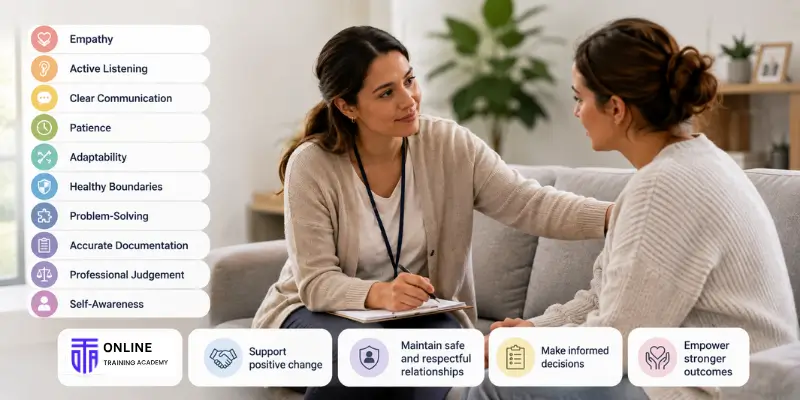
A great Family Support Worker is not defined by one quality alone. Difficult family situations often require several skills at the same time, and knowing how they work together is what makes support more effective.
➽ Empathy helps the worker understand what a family may be experiencing without making quick judgements.
➽ Active listening helps uncover concerns, needs or barriers that may not be obvious at first.
➽ Self-awareness allows the worker to recognise personal assumptions, emotions and reactions before they affect the interaction.
➽ Patience gives families time to build trust and make progress without feeling pressured.
➽ Clear communication helps workers discuss sensitive issues respectfully and make expectations easier to understand.
➽ Adaptability allows the worker to adjust their approach when a family’s needs or circumstances change.
➽ Healthy boundaries keep the relationship supportive and appropriate while protecting both the family and the worker.
➽ Problem-solving and critical thinking help workers look at the situation carefully instead of reacting to the first problem they see.
➽ Accurate documentation creates a clear record of important observations, conversations, actions and follow-up.
➽ Professional judgement helps the worker decide when to continue providing support, seek guidance, make a referral or follow an escalation process.
These skills are closely connected to broader competencies identified for social and community service work in Canada, including active listening, collaboration, adaptability, stress tolerance, negotiating, coordinating and analytical thinking.
What matters is how these qualities work together. A worker may listen carefully, but without boundaries, the relationship can become unclear. They may be highly compassionate, but without sound judgement, an important concern could be overlooked. They may communicate clearly, but without empathy, their words may feel cold or dismissive.
Conclusion
The hardest family-support situations rarely come with a neat script. A parent may be angry, a child may be struggling, or a family may reject available support. In these moments, a great Family Support Worker needs more than kindness—they need calm judgement and clear communication.
Effective workers know how to listen before reacting, understand before judging, and support without taking over. They maintain appropriate boundaries, recognise their limits, and seek guidance when a situation requires more than their role.
The strongest workers do not try to solve every problem themselves. They help families recognise their strengths, understand their options and take the next appropriate step—knowing when to step forward, step back, or bring in additional support.
FAQs
The most important qualities include empathy, active listening, patience, communication, adaptability, self-awareness, collaboration, stress tolerance and sound judgement. Canadian Job Bank information for social and community service workers also identifies service orientation, concern for others and social orientation as highly important attributes.
They need strong communication and listening skills, emotional regulation, problem-solving, observation, adaptability and the ability to maintain appropriate boundaries. They also need to know when to seek guidance or involve another service.
A Family Support Worker should avoid immediately labelling behaviour as simply “difficult.” They can look for possible triggers, listen to the person involved, remain calm, establish appropriate boundaries and document relevant observations. If the concern goes beyond their role, they should follow the appropriate workplace process.
Trust develops through consistency, respectful communication, honest expectations and genuine listening. A strengths-based approach can also help families recognise what is already working instead of feeling that every interaction focuses on their problems.
Boundaries help maintain a clear and appropriate working relationship. They allow the worker to remain supportive without taking over the family’s responsibilities or creating unnecessary dependence.
The worker should recognise the limits of their role and use the appropriate workplace procedures. Depending on the circumstances, this may mean consulting a supervisor, seeking additional guidance, making a referral or following an escalation process.
Yes. In fact, they work best together. Empathy helps a worker understand the family’s perspective, while judgement helps them decide what response is appropriate within their responsibilities. Being understanding does not require the worker to ignore boundaries, risks or established procedures.
Learn More





Get a FREE Course
- Learn useful skills online free
- Get CPD accredited certificate
- Add it to your CV today!