

Behind every positive patient experience is a team of healthcare professionals working together to provide safe, compassionate, and effective care. Among the most important members of this team are Certified Nursing Assistants (CNAs)—professionals who spend more time with patients than almost anyone else in a healthcare facility.
Whether helping an elderly resident get dressed, assisting a patient recovering from surgery, monitoring vital signs, or simply offering reassurance during a difficult day, CNAs play a vital role in maintaining patients’ comfort, dignity, and wellbeing. Their work forms the foundation of quality patient care and allows nurses and physicians to focus on more complex clinical responsibilities.
Although the role is often viewed as an entry-level healthcare position, becoming a CNA requires professional training, practical clinical skills, and a genuine commitment to caring for others. Every day, Certified Nursing Assistants help improve patients’ quality of life while contributing to the smooth operation of hospitals, long-term care homes, rehabilitation centres, assisted living facilities, and other healthcare settings.
One of the reasons many people choose this career is its accessibility. Compared with many other healthcare professions, becoming a CNA usually requires less time and financial investment in education, making it an attractive option for individuals looking to enter the healthcare industry quickly. At the same time, the role provides valuable hands-on experience that can open doors to advanced careers in nursing, healthcare administration, rehabilitation, and specialised patient care.
As healthcare systems continue to grow to meet the needs of ageing populations and increasing demand for medical services, skilled nursing assistants remain in high demand. Employers consistently seek compassionate, reliable professionals who can deliver high-quality patient support while working effectively within multidisciplinary healthcare teams.
Whether you’re considering your first healthcare career, planning a career change, or exploring opportunities for long-term professional growth, understanding the CNA role is an excellent place to start.
Who Is a Certified Nursing Assistant (CNA)?
A Certified Nursing Assistant (CNA) is a trained healthcare worker who provides basic patient care under the supervision of registered nurses or licensed medical professionals. Unlike general nursing assistants, CNAs have completed formal training and passed a certification exam that proves their competency in patient care.
They work in hospitals, nursing homes, rehabilitation centers, and long-term care facilities. Their main focus is to support patients with daily needs while ensuring safety, dignity, and comfort.
Nursing Assistant Diploma (Online)
Learn the fundamental knowledge and practical principles of nursing assistance, including patient care, communication, infection prevention, and supporting health and wellbeing in a variety of care settings.
Explore the responsibilities of a nursing assistant and develop an understanding of safe, compassionate, and person-centred care practices.
Table of Contents
What Does a CNA Do?
The work of a CNA is practical, patient-focused, and essential for daily healthcare operations.
CNAs assist patients with personal care tasks such as bathing, dressing, feeding, and maintaining hygiene. They also help patients move safely, especially those who are elderly, recovering from surgery, or physically limited.
Another important responsibility is monitoring vital signs, including temperature, pulse, breathing rate, and blood pressure. These readings are recorded and shared with nurses to help guide medical decisions.
In addition to physical care, CNAs provide emotional support. Many patients feel anxious, lonely, or uncomfortable during treatment, and CNAs often offer reassurance, conversation, and companionship that improve patient wellbeing.
They also maintain cleanliness in patient areas and ensure a safe, hygienic environment throughout their shift.
Who Can Become a Certified Nursing Assistant?
Becoming a CNA is one of the most accessible healthcare career paths. Most programs require only a basic level of education, usually secondary school completion or equivalent.
This makes it a suitable option for beginners who want to enter the healthcare field without a university degree. What matters most is willingness to learn, patience, and a caring attitude toward patients.
How to Become a Certified Nursing Assistant (Step-by-Step)
Becoming a Certified Nursing Assistant (CNA) follows a clear and structured process. Each step is designed to build the knowledge, practical skills, and confidence needed to work safely in a healthcare environment.
Step 1: Complete Basic Education
The first requirement is completing basic education, usually at the secondary school level or equivalent. This provides the foundation needed to understand healthcare training and patient care concepts.
Step 2: Enroll in a CNA Training Program
Next, you must join a state-approved or accredited CNA training program. These programs are designed to prepare you for real healthcare work by combining classroom lessons with practical, hands-on training in clinical settings such as hospitals or care homes.
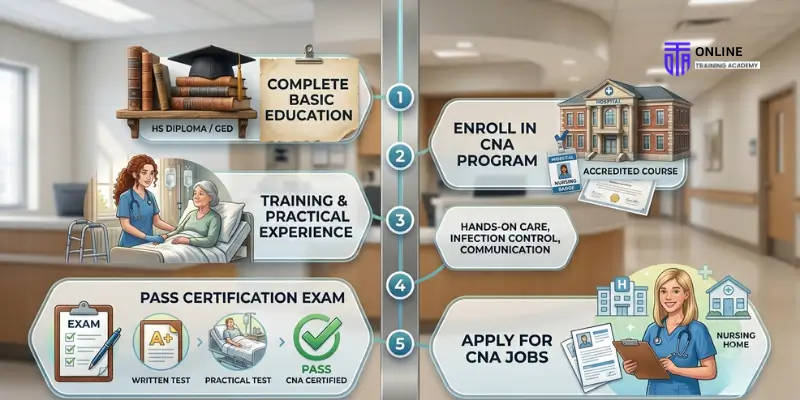
Step 3: Complete Training and Practical Experience
During the training period, you will learn essential skills such as patient care techniques, infection control, safety procedures, communication skills, and basic medical knowledge. You will also gain real-world experience by working directly with patients under supervision.
Step 4: Pass the Certification Exam
After completing the training program, you must take and pass a CNA certification exam. This usually includes a written test to assess your knowledge and a practical exam to evaluate your hands-on skills in patient care.
Step 5: Apply for CNA Jobs
Once you pass the exam and become certified, you can apply for CNA positions in hospitals, nursing homes, rehabilitation centers, or other healthcare facilities. At this stage, you are officially qualified to work as a Certified Nursing Assistant.
CNA Training Program: What You Learn
CNA training focuses on both theory and real-world practice. Students are taught how to safely care for patients while maintaining hygiene and preventing infections.
Training also includes learning how to take vital signs, assist with mobility, communicate with patients and healthcare teams, and follow ethical care standards.
Most importantly, students gain clinical experience in hospitals or care homes, which prepares them for real working conditions.
CNA Certification Exam: What to Expect
The certification exam is designed to test both knowledge and practical skills.
The written part evaluates understanding of patient care, safety procedures, and healthcare basics. The practical part assesses real-life skills such as assisting patients, taking vital signs, and following correct procedures.
Passing this exam confirms that a candidate is ready to work safely and effectively as a CNA.
Skills Required to Become a Successful CNA
A successful CNA needs both technical and personal skills.
Strong communication is essential for interacting with patients and healthcare staff. Empathy and compassion are equally important because CNAs work closely with vulnerable individuals who need emotional support.
Physical stamina is also necessary, as the job involves long hours, standing, and assisting patients with movement. Attention to detail ensures that even small changes in a patient’s condition are noticed and reported quickly.
Finally, teamwork is critical, since CNAs work closely with nurses and other healthcare professionals in fast-paced environments.
CNA Work Environment
CNAs work in different healthcare settings, including hospitals, nursing homes, rehabilitation centers, and home care services.
Their work environment can be fast-paced and physically demanding, but it is also highly structured and team-oriented. They are always supervised by nurses or medical staff and play a key role in daily patient care routines.
Challenges of Being a CNA
While working as a Certified Nursing Assistant can be highly rewarding, it also comes with several challenges that require strength, patience, and emotional resilience.
One of the main challenges is the physical demand of the job. CNAs often work long shifts that require them to stay on their feet for extended periods. They may also need to assist patients with mobility, lifting, or repositioning, which can be physically exhausting over time.
Another significant challenge is the emotional pressure. CNAs frequently care for elderly, seriously ill, or recovering patients, and this can sometimes be emotionally difficult. Witnessing patient suffering or dealing with end-of-life care situations requires strong mental resilience and compassion.
In addition to this, the work environment can be fast-paced and demanding, especially in hospitals or busy care facilities where multiple patients need attention at the same time. This requires good time management and the ability to stay calm under pressure.
Despite these difficulties, many CNAs continue in the profession because the work is deeply meaningful. The ability to support patients, provide comfort, and make a real difference in their daily lives often outweighs the challenges, making it a fulfilling career for those who are passionate about care work.
Benefits of Becoming a CNA

One of the main advantages of becoming a Certified Nursing Assistant is the fast and accessible entry into the healthcare field. Unlike many medical careers that require years of study, CNA training is relatively short and practical, making it a realistic option for people who want to start working in healthcare without a long academic pathway.
Another key benefit is the strong job demand and employment stability. Healthcare services are always needed, especially in hospitals, nursing homes, and long-term care facilities. This consistent demand means CNAs often have reliable job opportunities and steady career security in different locations and settings.
In addition, working as a CNA provides valuable hands-on experience in real healthcare environments. This practical exposure helps individuals develop essential patient care skills, understand medical routines, and build confidence in dealing with real-life situations. This experience can also become a strong foundation for progressing into higher roles such as nursing or specialized care positions.
Most importantly, the role offers deep personal satisfaction. CNAs are directly involved in improving patients’ daily lives by providing comfort, support, and care during some of their most vulnerable moments. This human connection and the ability to make a real difference often make the job highly meaningful and rewarding.
Salary and Job Outlook
CNA salaries vary depending on location, experience, and workplace type. In general, CNAs are in steady demand due to the growing need for healthcare services worldwide.
With experience and additional training, CNAs can increase their earning potential and move into more advanced healthcare roles.
Career Opportunities After Becoming a CNA
A CNA role is often more than just an entry-level job—it is commonly the beginning of a long-term career in healthcare. Because CNAs gain direct, hands-on experience with patients, they build a strong practical foundation that supports future professional growth in the medical field.
Many CNAs choose to continue their education and progress into becoming registered nurses. This pathway allows them to take on greater responsibilities, including patient assessment, treatment planning, and clinical decision-making. The experience gained as a CNA often makes this transition smoother because they already understand patient needs and hospital routines.
Others prefer to build expertise in specific areas of care. Some CNAs move into elderly care, working closely with older patients who require long-term support and attention. Others may specialize in rehabilitation services, helping patients recover after surgery, injury, or illness. Pediatric support is another common path, where care is focused on children and their unique healthcare needs.
Even for those who do not immediately pursue further qualifications, the CNA role itself provides valuable exposure to real healthcare environments. It helps individuals understand how hospitals and care facilities operate, how healthcare teams communicate, and how patient care is delivered in practice.
Overall, becoming a CNA opens the door to multiple career directions. It not only provides employment opportunities but also builds the experience and confidence needed to grow within the healthcare industry over time.
Conclusion
A Certified Nursing Assistant plays a vital role in the healthcare system by providing essential daily care and supporting medical staff in patient treatment.
Although it is considered an entry-level position, it offers valuable training, job stability, and clear career growth opportunities. For many people, it is the beginning of a meaningful and long-term journey in healthcare.
More importantly, being a CNA is not just about tasks—it is about compassion, responsibility, and making a real difference in people’s lives every single day.
FAQs
A Certified Nursing Assistant (CNA) is a trained healthcare professional who provides direct patient care under the supervision of registered nurses (RNs) or licensed practical nurses (LPNs). CNAs assist with daily living activities, monitor vital signs, support patient mobility, and help ensure patients are safe, comfortable, and well cared for.
To become a Certified Nursing Assistant, you typically need to complete a state- or provincially approved CNA training programme, gain hands-on clinical experience, and pass the required certification or competency examination where applicable. Requirements vary by country, state, and province, so it’s important to check your local healthcare regulations.
A CNA’s responsibilities include assisting patients with bathing, dressing, eating, toileting, mobility, and personal hygiene. They also take and record vital signs, observe changes in patients’ conditions, maintain a clean and safe environment, and report concerns to nurses and other healthcare professionals.
Successful CNAs need a combination of technical and soft skills, including compassion, communication, teamwork, attention to detail, physical stamina, time management, patience, infection control knowledge, and the ability to provide high-quality patient care in fast-paced healthcare environments.
Certified Nursing Assistants work in a variety of healthcare settings, including hospitals, nursing homes, long-term care facilities, rehabilitation centres, assisted living communities, hospices, home healthcare agencies, and outpatient clinics. Employment opportunities continue to grow as demand for healthcare services increases.
Yes. Becoming a Certified Nursing Assistant is an excellent entry point into the healthcare industry. The profession offers strong job demand, valuable hands-on clinical experience, opportunities for career advancement, and the chance to make a meaningful difference in patients’ lives. Many CNAs later pursue careers as Licensed Practical Nurses (LPNs), Registered Nurses (RNs), or other healthcare professionals.
Learn More





Get a FREE Course
- Learn useful skills online free
- Get CPD accredited certificate
- Add it to your CV today!