

The dream of the modern enthusiast is simple: a fully equipped garage, a car in need of repair, and the time to get it right. Yet, in the real world, the barrier to entry is high. Costs for tools, the space for a workshop, and the financial risk of a mistake on a daily driver keep many from picking up a wrench. This is where the virtual garage comes in. Titles like Car Mechanic Simulator 2021 offer a gateway into the world of automotive repair. But how does this digital experience translate to the reality of the Canadian automotive trade? Can a simulation actually prepare you for the life of a Red Seal Automotive Service Technician?
To answer this, we must look at the intersection of gaming, education, and the highly regulated Canadian trade environment.
Table of Contents
Car Mechanic Training
Car Mechanic Training provides essential knowledge and practical skills to inspect, service, diagnose, and repair vehicles safely. It covers vehicle systems, workshop safety, diagnostics, and maintenance, preparing learners for automotive technician roles.
The Rise of Digital Automotive Simulation
Car mechanic simulators have evolved from rudimentary “click-to-repair” interfaces into complex, 3D engines that model the internal components of a vehicle with impressive fidelity. These games provide an immersive environment where the user can disassemble a V8 engine, swap out a transmission, or diagnose an electrical fault, all while navigating a virtual economy that mimics a real-world auto shop.
For the user, the appeal is twofold: the satisfaction of solving mechanical problems and the learning experience that comes with seeing how disparate parts—from the intake manifold to the catalytic converter—function together. It provides a visual and interactive “anatomy lesson” for the automobile that textbooks often fail to deliver.
The "Anatomy" of a Simulator: What It Teaches Well
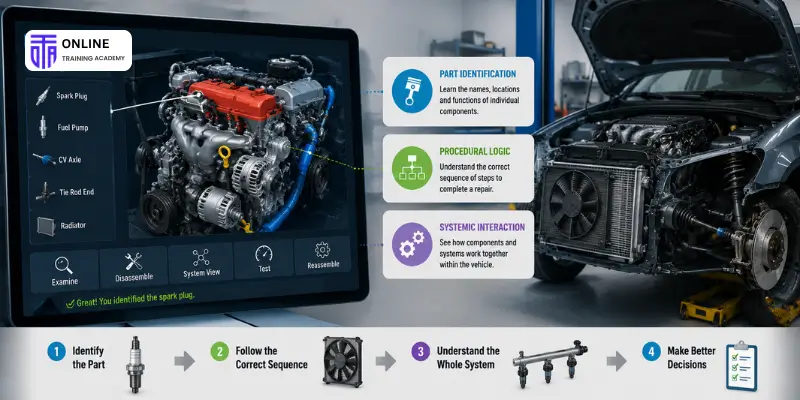
If you approach a simulator as a tool for foundational knowledge, it is incredibly effective. Here is where the digital environment shines:
➽Part Identification and Nomenclature: Many beginners are overwhelmed by the sheer number of components under the hood. A simulator forces you to handle these parts individually. You learn that a spark plug is not just a “plug” but a critical component of the ignition system, and you begin to differentiate between a CV axle and a tie rod end.
➽Procedural Logic: Repairing a car is not a random act; it is a sequence of events. A simulator requires you to remove a cooling fan before you can reach the radiator, or to pull the cylinder head before you can access the pistons. This teaches the “hierarchical” nature of mechanics—the understanding that systems are built on top of one another.
➽Systemic Interaction: When you replace a fuel pump in-game, you are often prompted to check the fuel filter and the fuel rail. This helps the user develop a holistic view of the vehicle as a series of interconnected systems rather than a collection of independent parts.
The Canadian Reality: Why Gaming is Not Enough
However, to claim that these simulators create “mechanics” would be a dangerous oversimplification, particularly in the Canadian context where professional standards are exceptionally high.
1. The "Rust Factor" and Environmental Challenges
A virtual engine is always clean. In Canada, every mechanic’s most frequent adversary is oxidation caused by road salt and moisture. A simulator cannot replicate the visceral struggle of a rusted, seized exhaust bolt that requires heat, penetrating oil, and sheer physical force to break loose. The “real” Canadian mechanic spends as much time on bolt extraction and cleanup as they do on the actual repair—a facet of the trade entirely absent from the game.
2. The Nuances of Diagnostics
Modern vehicle diagnostics in Canada involve more than just a computer readout. While a game might show you an OBD-II code like P0300 (Random/Multiple Cylinder Misfire), a real-world technician must verify that code by checking fuel pressure, performing a compression test, inspecting ignition coils, and verifying electrical ground integrity. The “logic” of a real fault is rarely as straightforward as the “replace X part” directive in a simulator.
3. Health, Safety, and Physicality
Working in a Canadian shop is a physically taxing profession governed by stringent Occupational Health and Safety (OHS) regulations. You are dealing with heavy, hot, and often hazardous materials. You must understand how to safely use a hydraulic lift, handle high-voltage batteries in modern hybrid/EVs, and dispose of toxic fluids in accordance with provincial environmental laws. These safety protocols are not just “nice to know”—they are the foundation of a professional career and are fundamentally impossible to learn behind a screen.
Bridging the Gap: Simulation as a Pedagogical Tool
If a simulator cannot turn you into a mechanic, what is its actual role? The answer lies in complementary learning.
In Canada, the path to becoming an Automotive Service Technician is structured. It requires a combination of thousands of hours of on-the-job training and in-school technical sessions, often leading to the Interprovincial Red Seal certification. This system is designed to produce high-level professionals capable of working on everything from basic sedans to complex, computer-controlled vehicles.
For a student entering an apprenticeship program, a simulator can serve as a “Pre-Apprenticeship Bridge.” It demystifies the vehicle. A student who has spent 50 hours in a virtual shop has already developed a “mental map” of an engine bay. When they walk into a college lab for the first time, they aren’t searching for the alternator—they already know where it lives, what it does, and how it is held in place. This allows them to dedicate their focus to the real challenges: the torque specs, the electrical testing, and the professional discipline required in the industry.
The Professional’s Perspective: What Real Mechanics Think
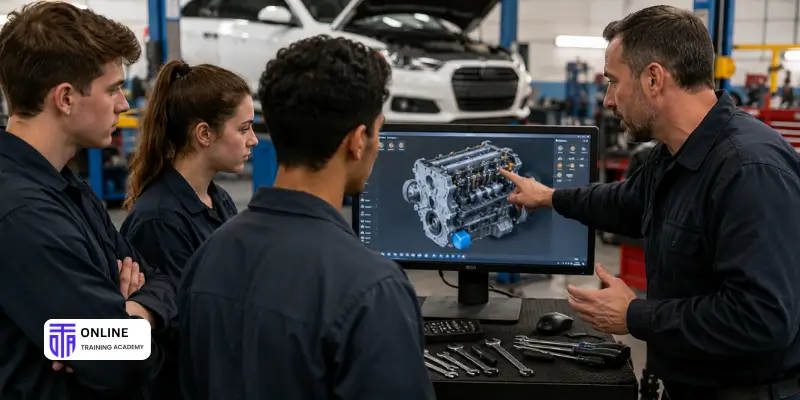
Professional technicians in Canada often view these simulations with a mixture of amusement and respect. While they would never hire a person based on their “game time,” they frequently encounter apprentices who are more comfortable with the terminology of specific parts because of their time playing these titles.
The common consensus among seasoned pros is that “gamification” is a bridge. It bridges the gap between the “general public” and the “informed enthusiast.” It does not provide the hand-eye coordination required to manipulate a wrench in a cramped engine bay, but it does provide the theoretical confidence to pick up the tool in the first place.
Toward a Career: The Official Canadian Path
For those inspired by the simulator to pursue a real career, Canada offers one of the most robust training infrastructures in the world.
➽The Apprenticeship Model: Unlike many other fields, the trade allows you to “earn while you learn.” You are indentured to a shop, supervised by a licensed Journeyman, and periodically attend technical college for block-release training.
➽The Red Seal Standard: The Red Seal is the gold standard for tradespeople in Canada. It signifies that your skills meet a national standard, allowing for mobility and high earning potential across provinces.
➽Specialization: As the automotive market shifts toward Electric Vehicles (EVs) and advanced driver-assistance systems (ADAS), the “mechanic” of tomorrow is becoming an “automotive diagnostic technician.” This field is increasingly rooted in software and electrical engineering, moving further away from the “grease monkey” stereotype.
The Role of Technology in Modern Training
Beyond simple games, the industry is adopting “Virtual Reality” (VR) and high-fidelity simulations for formal training. Institutions like the British Columbia Institute of Technology (BCIT) and other colleges across Ontario and Alberta are integrating e-learning platforms that mirror the “logic” of high-end simulators to teach complex electrical circuit troubleshooting.
This confirms that the concept of the simulator is sound—it is simply a matter of depth. A $30 video game is a casual learning tool; a $50,000 professional VR diagnostic suite is a training necessity.
The Future of the "Garage"
As cars become more like rolling computers, the divide between “mechanical” and “digital” will disappear. We are entering an era where a mechanic must understand high-voltage battery architecture just as well as they understand disc brakes.
This is where simulators will continue to evolve. Future titles will likely move away from simple bolt-removal gameplay and toward “digital twins,” where students can test the effects of changing parameters in a car’s ECU or simulate the thermal degradation of an EV battery over a five-year period.
Summary: Is It Worth Your Time?
If you are a student considering a trade, a car owner who wants to perform their own maintenance, or a gamer fascinated by engineering, the answer is a resounding yes, provided your expectations are managed.
Why you should play:
1.Lowering the Barrier: It makes the “complex” feel “accessible.”
2.Vocabulary Acquisition: You will learn the correct names for parts, which is the first step in communicating with parts counters and other mechanics.
3.Visualization: It trains your brain to visualize the “hidden” parts of an engine that aren’t visible from the outside.
What you must accept:
1.The “Tactile Gap”: You are missing the smell of oil, the strain on your back, and the satisfaction of a bolt finally turning after three days of rust-busting.
2.The Diagnostic Reality: A game cannot teach you the intuition required to find an intermittent electrical short or a vacuum leak that defies all logic.
3.Safety is Non-Negotiable: A simulated “safe” environment can create a false sense of security. Always remember that in a real garage, a single mistake can cause permanent injury.
Final Thoughts: From Virtual to Physical
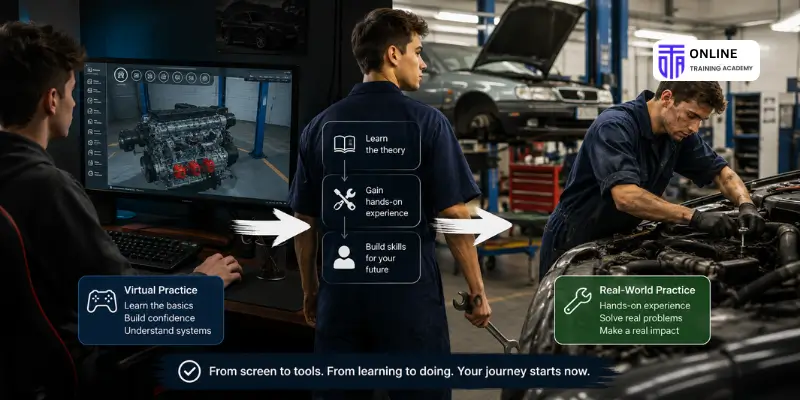
The transition from a simulator to a real workshop is the most significant leap you can take. If you have spent time in a virtual garage and feel the urge to take it further, the logical next step is not another game—it is a community college course or an entry-level position as a “lube tech” or shop assistant.
In those environments, the theory you learned in your simulation will suddenly “click” in three dimensions. You will see the heavy machinery, you will hear the specific sounds of the shop, and you will learn that while the logic of the repair remains the same as it was on your computer, the practice is a far more rewarding, challenging, and essential part of the Canadian economy.
The simulator is a window. It allows you to peer into the world of automotive mechanics and see if it captures your interest. Once you realize it does, it is time to step through that window, pick up a real, heavy, cold, greasy steel wrench, and start the journey for real.
Conclusion
The automotive trade is the backbone of Canadian transit. Whether it is the truck that delivers your groceries, the bus that gets you to work, or the car that keeps you connected to your family, you rely on the work of mechanics every single day.
If a simulator helps you appreciate that work, if it helps you decide to join the ranks of the trade, or if it simply gives you the confidence to change your own oil, it has succeeded. Just remember: the game is a starting line, not the finish. The real work—the work that keeps the world moving—is waiting for you in the shop. Pick up a wrench, stay safe, and welcome to the team.
FAQs
Absolutely not. An apprenticeship is a regulated legal agreement involving thousands of hours of work, mentorship, and formal certification. A simulator is a recreational tool.
Car Mechanic Simulator 2021 is widely recognized for its breadth of parts and systems, making it the most useful for someone trying to learn the “anatomy” of a vehicle.
While it won’t replace experience, being able to speak the “language” of a garage—knowing parts, tools, and basic procedures—can show a potential employer that you have a genuine, self-motivated interest in the trade.
Physical diagnostic skill—the ability to use your five senses (hearing rattles, smelling burning fluids, feeling vibrations) to identify a problem that a computer hasn’t already defined for you.
Yes. Some games automate things like “torqueing” bolts or oil drainage. In the real world, failing to torque a wheel lug or neglecting a proper oil drain procedure can lead to catastrophic failure. Always defer to a professional mentor and manufacturer service manuals.
Most current simulators focus heavily on internal combustion. As the industry shifts, we expect to see more “EV-centric” simulators that model battery health, inverter diagnostics, and high-voltage safety.
A standard gaming PC is sufficient. The educational value doesn’t come from the graphics, but from the process of the repair. Focus on the gameplay, not the high-end hardware.
Learn More




Get a FREE Course
- Learn useful skills online free
- Get CPD accredited certificate
- Add it to your CV today!