
The role of the Educational Assistant (EA) has transformed significantly over the last decade. No longer are they merely a “helper” in the background of the classroom; they are the fundamental architecture of the modern, inclusive Canadian school system. Across every province, from the urban centers of Toronto and Vancouver to the rural districts of the Prairies and the Maritimes, the EA is the primary mechanism through which “inclusive education” becomes a reality.
As classrooms diversify, and as the diagnosis rates for neurodivergent conditions and complex exceptionalities rise, the demand for highly skilled, empathetic, and professional support staff has reached a critical peak. If you are looking to pivot into a career that offers profound social impact, excellent job security, and a role in shaping the next generation, becoming an EA is an exceptional path. However, it is a path that requires deep preparation, professional certification, and a commitment to understanding the nuance of Canadian pedagogical law.
This master guide will serve as your comprehensive roadmap to understanding the profession, the Canadian educational infrastructure, the pathway to certification, and the long-term career trajectory of an Educational Assistant.
Part 1: The Modern Role – Beyond the "Assistant" Title
The term “Educational Assistant” is somewhat of a misnomer. In the context of 2026, you are not simply assisting in an education; you are facilitating it. You are an operational partner to the classroom teacher, and a personalized support system for students who experience the world differently.
1.1 The Architecture of Inclusion
Canada’s commitment to inclusive education means that students with severe cognitive, physical, and behavioural challenges are integrated into mainstream classrooms. This is the moral backbone of Canadian public schooling, but it presents a unique operational challenge. A teacher responsible for twenty-five students cannot provide the intensive, one-on-one attention that an autistic student, or a student with a physical disability, might require to succeed. The EA bridges this gap. You are the equalizer.
1.2 The Four Pillars of EA Responsibility
➽ Cognitive Scaffolding: You are the interpreter. You take a teacher’s high-level academic concepts and break them down into modular, bite-sized components. You may be using speech-to-text software for a student who cannot write, or visual scheduling tools for a student who struggles with transitions.
➽ Behavioural Regulation (The “Frontline Observer”): You are not a disciplinarian; you are a regulator. You are the person trained to read the pre-crisis cues of a student who is entering a state of overstimulation. Your role is to intervene before a behaviour escalates into a classroom-disrupting crisis, using trauma-informed strategies to help the student self-regulate.
➽ Physical Assistance and Care: In many roles, you are providing essential life-skills support. This can range from helping students with mobility impairments navigate school infrastructure to facilitating feeding or personal care. This is a role that requires immense empathy and the ability to maintain a student’s dignity throughout delicate tasks.
➽ Data and Collaborative Documentation: You are an essential part of the IEP (Individualized Education Plan) reporting cycle. Your observations—meticulously tracked in classroom logs—are the foundational evidence that school boards, parents, and medical professionals use to decide whether a student’s supports are working or need modification.
Teaching Assistant Course
Learn the key responsibilities, skills, and best practices of an Educational Assistant, including how to support students, promote inclusive learning, and contribute to a positive educational environment. Discover how Educational Assistants work alongside teachers to help create engaging, supportive, and effective learning experiences for all students.
Table of Contents
Part 2: The Canadian Educational Infrastructure
To thrive as an EA, you must understand the environment you are entering. Education in Canada is a provincial mandate. This means the Ministry of Education in Ontario (MOE), the Ministry of Education in British Columbia, and the Ministries in other provinces operate independently.
2.1 The Unionized Environment
Public school boards in Canada are among the most heavily unionized environments in the country. This means that hiring is rarely a casual affair. When you look at job postings, you will see references to unions like CUPE (Canadian Union of Public Employees), OPSEU, or various provincial staff associations. These unions dictate the hiring grid, the pay scale, the benefits, and the seniority rules. Understanding this is vital because it explains why you usually cannot walk into a permanent, full-time position immediately. You must enter the system via a “Supply” or “Casual” list, building your seniority and reputation within the board before bidding on permanent positions.
2.2 Provincial Nuances
➽ British Columbia: BC is known for high standards. Districts often require the “SEA” (Special Education Assistant) certificate, which is a rigorous, specialized program.
➽ Ontario: Ontario boards utilize a “Casual” pool system. EAs are central to the board’s operational survival, particularly in large districts like the TCDSB or YRDSB.
➽ Quebec: Quebec often utilizes the “Attendant to Handicapped Students” title, and the educational pathway is closely linked to CEGEP-level special care counseling.
Part 3: The Pathway to Certification
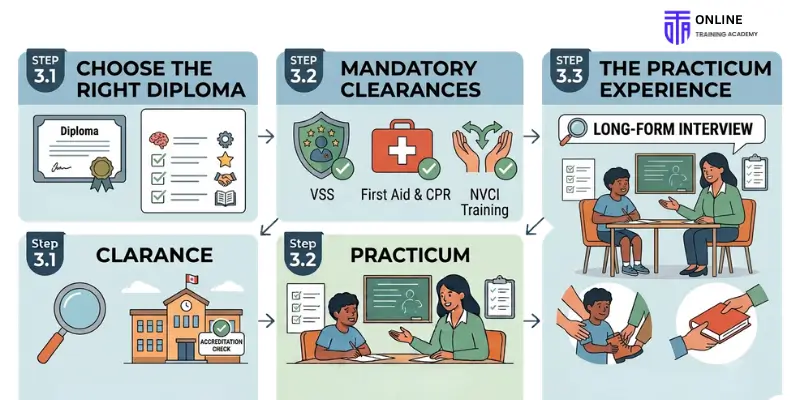
In Canada, the “friendly, good with kids” persona is a baseline requirement, not a qualification. You must obtain formal certification to be considered by any major public school board.
Step 3.1: Choosing the Right Diploma
You need to complete an EA Certificate or Diploma program from an accredited institution. These programs are designed to be practical. You aren’t just learning theory; you are learning how to manage a classroom.
➽ Curriculum Focus: Expect courses on Developmental Psychology, Exceptionalities, Behavioural Intervention Strategies, Communication Technology, and Professional Ethics.
➽ Accreditation Check: Before signing up, verify the program’s relationship with your local school board. Many colleges have direct partnerships that lead to automatic interviews or preferred hiring status upon graduation.
Step 3.2: Mandatory Safety and Legal Clearances
Canadian schools have zero tolerance for procedural lapses regarding student safety. You will need to maintain:
➽ Vulnerable Sector Search (VSS): This is a mandatory criminal background check. Do not attempt to bypass this. Even minor discrepancies in your history can lead to disqualification.
➽ First Aid & CPR (Level C): Keep these updated annually. School boards require the “Level C” (Professional Rescuer) certification, not just the basic public-level course.
➽ Non-Violent Crisis Intervention (NVCI): This is the gold standard for behavioural management. It provides you with the verbal and physical skills to keep yourself and your students safe when behaviour becomes dangerous.
Step 3.3: The Practicum Experience
Your practicum is your “long-form” job interview. When you are placed in a classroom, you are being watched by the classroom teacher, the special education resource teacher, and the principal.
➽ The Secret to Success: Do not be a “passive observer.” Be an active contributor. If you see a student struggling with their boots, help them. If you see the teacher looking for a resource, find it for them. You are demonstrating your professional reliability.
Part 4: The Financial and Structural Reality
One of the most common reasons EAs leave the profession early is an under-appreciation of the financial model.
4.1 The Income Math
You are paid for the 190–194 days that school is in session. While your hourly rate may look competitive ($26–$34/hr), your total annual income will reflect the fact that you are not working during the two months of summer, the two weeks of winter break, or the week of spring break.
➽ Total Annual Income: Most permanent EAs land in the $35,000–$48,000 range.
➽ Lifestyle Strategy: Many EAs supplement this with summer employment, or leverage their union-provided vacation pay (which is sometimes paid out incrementally) to balance their year.
4.2 The "Gold-Standard" Benefits
While the base salary is modest, the Total Compensation Package is often worth 30% more than the salary.
➽ The Pension: The municipal and provincial pension plans (like OMERS) are among the most secure retirement vehicles in the world. They are defined-benefit plans, meaning your pension is guaranteed for life, which is a rarity in today’s gig-economy-dominated world.
➽ Health and Wellness: Permanent lines include extensive benefits covering prescriptions, dental, vision, and mental health support, which are essential for long-term health in a high-stress, high-physical-intensity role.
Part 5: Career Trajectory and Long-Term Outlook

Is the EA role a destination, or a stepping stone? It is both.
5.1 Progression within the Board
You can progress into specialized EA roles, such as working exclusively in behavioural intervention, becoming a Lead EA in a resource room, or specializing in sensory integration or Braille/sign language. These roles often come with higher pay bands.
5.2 Transitioning to Other Sectors
The skills you learn—de-escalation, documentation, crisis management, and developmental psychology—are highly transferable. Many former EAs transition into:
➽ Speech-Language Pathology Assistants (SLPA): Working under the guidance of a Master’s-level SLP.
➽ Occupational Therapist Assistants (OTA): Providing specialized physical and sensory support.
➽ Child and Youth Care Workers (CYW): Moving into higher-acuity residential or community intervention settings.
➽ Education Administration: Moving into central school board offices to manage special education funding and student registration.
Part 6: Why This Job Matters – The Impact Perspective
We must speak about the emotional reality of this work. Becoming an EA is an exercise in human endurance and human compassion. You will be tested. You will work with students who have experienced horrific trauma, students who cannot express their frustration in words, and students who have been told by the system that they cannot succeed.
But you will also be the one who proves the system wrong. You are the adult who sits with a student in the “cool-down corner” and waits for them to breathe. You are the one who celebrates the tiny, invisible milestones that nobody else notices.
In a world of digital interfaces and remote work, being an EA is a raw, real, face-to-face human interaction. It requires you to be fully present, fully responsible, and fully compassionate. The shortage of EAs in Canada is a genuine crisis, and it is a crisis that only people with the right combination of skill and heart can solve.
Conclusion
Becoming an Educational Assistant in Canada is a strategic, structured career move that balances the need for job security with the desire for profound purpose. By following the pathway of certification, obtaining your clearances, and engaging with the unionized board structures, you are setting yourself up for a long, stable, and impactful career.
You are entering a profession that is the lifeblood of the Canadian education system. Schools are not just buildings; they are social ecosystems, and as an EA, you are the person who ensures that everyone in that ecosystem has the support they need to thrive. If you are ready for a career where your patience is your greatest asset and your compassion is your most valuable tool, then the Canadian classroom is the place for you.
FAQs
You need formal education (a diploma), but you do not need “experience” in a school. However, previous work in retail, hospitality, or caregiving is considered “experience” by hiring managers because those roles teach you how to manage people and volatility.
That is the beauty of the system. If you are a supply EA, you are constantly rotating. If you are in a permanent line that is a bad fit, you have the ability to bid on different positions within the board as your seniority increases.
Most do not. You have the choice to work elsewhere, spend time with your family, or collect Employment Insurance (EI).
Enormous demand. If you speak English and French, you can effectively name your school and your position. Bilingual EAs are prioritized in the hiring process across nearly every province.
Learn More





Get a FREE Course
- Learn useful skills online free
- Get CPD accredited certificate
- Add it to your CV today!