


A new hire walks into a UK workplace on their first day. Within hours, they notice something subtle. People step around a loose cable instead of fixing it. A warning sign sits ignored. A task gets rushed because “it’s quicker this way.”
Nothing goes wrong that day.
But this is how risk builds in real workplaces—not through dramatic failures, but through small, repeated decisions.
In the UK, occupational health and safety is not optional. It is a legal duty, a business priority, and a daily responsibility shared across every level of an organisation. Understanding how it works today is essential if you want to stay compliant, protect people, and avoid the quiet risks that lead to serious consequences.
Table of Contents
Occupational Health and Safety in the UK:What You Need to Know Today
Occupational Health and Safety: A Simple Guide to Workplace Safety explains the importance of creating a safe and healthy working environment for employees. It covers key workplace safety practices, risk prevention measures, employer and employee responsibilities, and the importance of following health and safety regulations. The guide helps readers understand how effective safety measures can reduce accidents, protect workers, and promote a safer, more productive workplace.
What Is Occupational Health and Safety?
Occupational health and safety (OHS) refers to the systems, processes, and behaviours used to protect workers from harm in the workplace.
In the UK context, this includes both physical safety and mental wellbeing. It covers everything from preventing slips and machinery accidents to managing stress, fatigue, and long-term health risks.
At its core, OHS is about prevention. It focuses on identifying hazards, assessing risks, and putting controls in place before harm occurs.
For example, in an office environment, OHS may involve ergonomic workstation setup, screen breaks, and workload management. On a construction site, it may involve fall protection, equipment safety, and site supervision.
The setting changes, but the principle remains the same—reduce risk before it becomes an incident.
What Is the Purpose of Occupational Health and Safety?
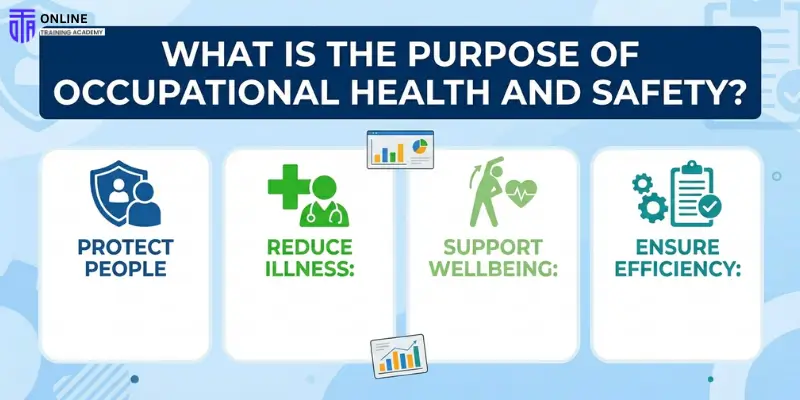
The purpose of occupational health and safety is to protect people while ensuring work can continue safely and efficiently.
This includes preventing injuries, reducing illness, and maintaining long-term wellbeing. It also ensures that workplaces are structured in a way that supports safe decision-making under pressure.
Beyond protection, OHS creates operational stability. When risks are controlled, there are fewer disruptions, fewer delays, and less uncertainty.
It also provides a clear framework for responsibility. Everyone understands what is expected, how to act, and how to respond when something goes wrong.
In practical terms, OHS turns safety from a reactive process into a proactive system. Instead of asking what caused an accident, it focuses on preventing that accident from happening at all.
Why Occupational Health and Safety Really Matters
Workplace safety is a big deal because its impact reaches way beyond the occasional accident . It shapes the way people work , how a company performs and how risks get managed over a long time.
For individuals, working in a bad safety environment is a recipe for trouble. Injuries, long-term health problems or having to stop working altogether are all very real possibilities. And then there’s the psychological toll. Witnessing or experiencing a bad safety situation can send anxiety spiking , make you lose confidence and generally impact your overall wellbeing.
For companies, the costs are pretty straightforward – medical bills, compensation claims, lawyer’s fees and potential fines. But the indirect costs are a whole different story. Those include lost productivity, delays, broken equipment, higher staff turnover and all that time spent trying to figure out what went wrong and how to fix it.
It’s also worth noting that there are some pretty subtle cultural effects that come out of the woodwork. When employees feel like they’re in a risky situation all the time, they start to lose focus and become more hesitant. Decision making slows down and eventually you end up with a situation where risks just keep on growing.
On the flipside, when you’ve got a safe workplace, that creates stability and confidence. People can focus on their actual job without worrying about some accident waiting to happen. That leads to better performance, fewer errors and stronger teamwork. Teams start to trust each other and the system, which makes communication better and overall morale higher.
Getting safety right also plays a huge role in a company’s reputation. Companies that show they care about safety are way more attractive to good staff, clients and partners. In competitive industries that can be a make-or-break factor when it comes to hiring new staff or attracting business.
In the UK, this isn’t just a nice idea – it’s the law. Employers have to follow the Health and Safety at Work etc Act 1974 and look after the health, safety and wellbeing of their staff as best they can. The Health and Safety Executive is there to make sure they’re doing their job, and they can fine, shut down or even prosecute if things go wrong.
Not taking safety seriously can end in some serious consequences, including improvement notices, prohibition notices and big fines – and in extreme cases, they could even face a court case. But its not just about the penalties – a company that neglects safety can also end up damaging their reputation in a way that takes ages to recover from.
So, why does occupational health and safety really matter? Its because it affects every part of how a workplace actually runs. It keeps people safe, gets your team performance up and makes sure your company can operate with integrity, confidence and accountability.
Legislation in Health and Safety

Occupational health and safety in the UK is governed by a structured legal framework designed to protect workers and ensure organisations actively manage risk rather than react to incidents.
At the centre of this framework is the Health and Safety at Work etc. Act 1974. This law places a legal duty on employers to ensure, so far as is reasonably practicable, the health, safety, and welfare of employees and anyone affected by their work activities. This includes providing safe systems of work, maintaining equipment, offering proper training, and creating a safe working environment.
The Act is enforced by the Health and Safety Executive, which has wide powers. Inspectors can enter workplaces, carry out investigations, request documentation, and take enforcement action where necessary. This enforcement role ensures that safety is not treated as optional or secondary.
Supporting regulations provide more detailed requirements and guidance:
- 1. Management of Health and Safety at Work Regulations 1999
These require employers to carry out suitable and sufficient risk assessments, identify hazards, evaluate risks, and implement control measures. They also emphasise the need for competent persons to manage health and safety and for clear emergency procedures.
- 2. Workplace (Health, Safety and Welfare) Regulations 1992
These focus on the physical working environment. They set standards for ventilation, temperature, lighting, cleanliness, and welfare facilities such as toilets and rest areas, ensuring that basic conditions support both safety and comfort.
- 3. Reporting of Injuries, Diseases and Dangerous Occurrences Regulations (RIDDOR) 2013
These require employers to report specific workplace incidents, including serious injuries, occupational diseases, and near-misses. This allows authorities to monitor trends and intervene where risks are not being properly managed.
- Together, these laws establish a baseline that all organisations must meet. However, compliance alone is not enough. Employers are expected to show that they are actively identifying risks, reviewing controls, and improving safety systems over time.
When organisations fail to meet these obligations, enforcement action can follow. This may begin with improvement notices requiring changes within a set timeframe. In more serious cases, prohibition notices can stop work immediately if there is a risk of serious harm. Financial penalties can be substantial, and severe breaches may lead to prosecution.
In practice, this legal framework does more than set rules. It creates accountability and ensures that workplace safety is built into everyday operations rather than treated as an afterthought.
You have not enough Humanizer words left. Upgrade your Surfer plan.
Who Is Responsible for Managing Occupational Health and Safety?
Responsibility for workplace safety in the UK is shared, but it operates in a structured way.
Employers hold the primary legal responsibility. They must provide a safe working environment, conduct risk assessments, offer training, and maintain equipment and systems.
Managers and supervisors are responsible for implementing these systems. They ensure that policies are followed in day-to-day operations and that risks are addressed promptly.
Employees also have legal duties. They must take reasonable care of their own safety and that of others, follow procedures, and report hazards or unsafe conditions.
In practice, this works as a system:
- Employers design and resource safety systems
- Managers apply and enforce them
- Employees operate within them and provide feedback
When all three levels align, safety becomes consistent. When one fails, gaps appear quickly.
What Are the 5 Pillars of Occupational Health?
Understanding occupational health becomes easier when broken into five key pillars. These pillars cover the full scope of workplace wellbeing.
1. Physical Health and Safety
This focuses on preventing immediate harm. It includes safe equipment use, hazard control, and protective measures such as personal protective equipment.
2. Mental Health and Wellbeing
Mental health is now recognised as a core part of workplace safety in the UK. Stress, anxiety, and burnout are among the most reported issues. Managing workload, support systems, and work pressure is essential.
3. Occupational Hygiene
This pillar deals with exposure to harmful substances such as chemicals, dust, and noise. It focuses on long-term health risks that may not be immediately visible.
4. Ergonomics and Work Design
Poorly designed work leads to strain and fatigue. Ergonomics ensures that tasks, tools, and environments fit the worker, reducing long-term injury risks.
5. Health Promotion and Prevention
This goes beyond avoiding harm. It includes encouraging healthy habits, balanced workloads, and proactive wellbeing initiatives
Together, these pillars create a complete approach. Ignoring any one area increases risk elsewhere.
How OHS Works in Real UK Workplaces
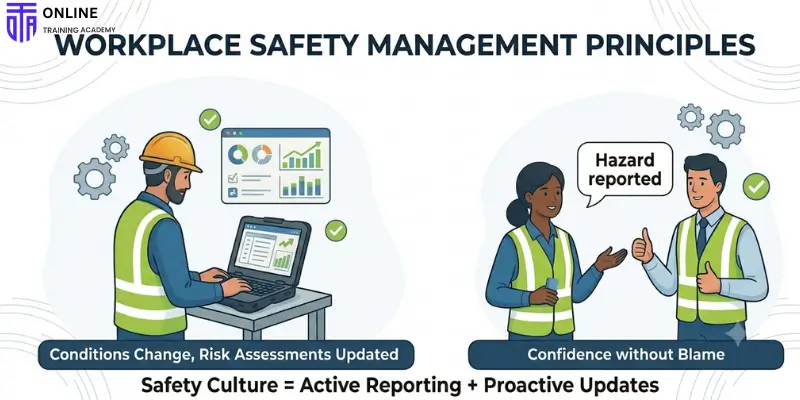
In a well-managed UK workplace, safety is part of daily behaviour, not just policy.
A near-miss is reported and reviewed, not ignored. Risk assessments are updated when conditions change. Employees feel confident raising concerns without fear of blame.
For example, if a worker notices a recurring hazard, it is logged, investigated, and addressed. The goal is not to assign fault but to improve the system.
This approach reflects how modern UK safety systems operate. They focus on learning, prevention, and continuous improvement rather than reacting only after incidents occur.
Conclusion
Workplace safety in the UK is not defined by documents or inspections alone. It is shaped by everyday behaviour.
It appears in small moments. Fixing a hazard instead of stepping over it. Reporting a concern instead of ignoring it. Choosing safety even when under pressure.
These decisions rarely feel significant in isolation. Yet over time, they determine whether a workplace prevents harm or reacts to it.
The systems are already in place. The laws are clear. The real difference comes from how consistently they are applied when it matters most.
FAQs
It is the legal and practical system used to protect workers from harm, guided by laws such as the Health and Safety at Work etc. Act 1974.
The Health and Safety Executive enforces health and safety laws through inspections and investigations.
To prevent injuries, illnesses, and fatalities while ensuring safe and efficient working conditions.
Yes, employers have the primary legal duty to protect employees and manage workplace risks.
Physical safety, mental wellbeing, occupational hygiene, ergonomics, and health promotion.
They may face enforcement action, fines, or prosecution depending on the severity of the breach.
Yes, mental health is recognised as a key part of occupational health and is increasingly regulated and monitored.
Learn More





Get a FREE Course
- Learn useful skills online free
- Get CPD accredited certificate
- Add it to your CV today!