
A small mistake at work rarely looks dangerous at first.
A loose cable stays on the floor because someone plans to fix it later. A machine runs without a guard just for “one quick job.” An employee ignores back pain because the shift is almost over. None of these feel urgent. Yet this is exactly how most workplace incidents begin.
Occupational health and safety exists to stop these small risks from turning into serious harm. It is not only about rules or inspections. It is about how people think, act, and respond in everyday work situations.
Understanding this topic is essential whether you manage a team, run a business, or simply want to stay safe at work. When done right, workplace safety protects lives, improves performance, and creates an environment where people can focus on their work without constant risk.
Table of Contents
Occupational Health and Safety: A Simple Guide to Workplace Safety
Occupational Health and Safety: A Simple Guide to Workplace Safety explains the importance of creating a safe and healthy working environment for employees. It covers key workplace safety practices, risk prevention measures, employer and employee responsibilities, and the importance of following health and safety regulations. The guide helps readers understand how effective safety measures can reduce accidents, protect workers, and promote a safer, more productive workplace.
What Is Occupational Health and Safety and Why Does It Matter?
Occupational health and safety, often shortened to OHS, refers to the systems, practices, and behaviours used to protect people from injury and illness at work. It covers both physical safety and mental wellbeing.
At its core, OHS is about prevention. Instead of reacting after something goes wrong, it focuses on identifying risks early and controlling them before harm occurs.
The purpose goes far beyond compliance. While laws require organisations to maintain safe workplaces, the real value of OHS lies in what it prevents. Injuries disrupt lives. Illness reduces long-term wellbeing. Unsafe environments create stress and uncertainty.
A workplace with strong safety practices operates differently. People are more confident in their roles. Tasks are performed with clarity. There is less downtime caused by accidents or errors. Over time, this leads to better productivity and stronger team performance.
Consider a simple comparison. In one warehouse, workers are trained to report hazards immediately, and managers respond quickly. In another, minor risks are ignored because “nothing has happened yet.” The first workplace prevents incidents before they occur. The second waits until something goes wrong.
That difference is what occupational health and safety is designed to create.
What Are the Most Common Workplace Hazards and Health Issues?
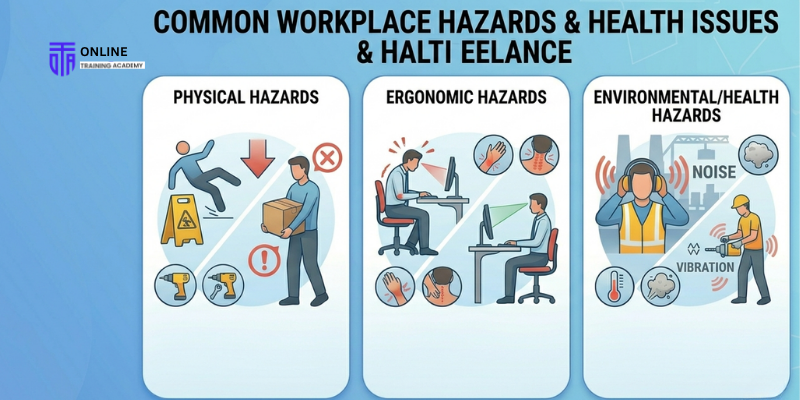
Workplace hazards are not always dramatic or obvious. Many are routine risks that become dangerous over time.
Physical hazards are the easiest to recognise. These include slips, trips, and falls, which are among the most common causes of workplace injuries. Machinery without proper safeguards can lead to serious accidents. Noise and vibration can damage hearing and affect long-term health. Even simple tasks like lifting heavy items repeatedly can lead to chronic injuries.
Some risks are less visible but equally harmful. Exposure to chemicals, dust, or fumes may not cause immediate symptoms, but over time they can lead to serious health conditions. Poor workstation setup in offices can result in neck strain, eye fatigue, and musculoskeletal disorders.
One of the most significant and often overlooked issues is mental health. Work-related stress, anxiety, and burnout are now among the most commonly reported occupational health problems. Tight deadlines, lack of control over work, and poor management practices all contribute to this.
For example, an employee working long hours under constant pressure may begin to lose focus. Mistakes increase. Fatigue sets in. Over time, this can lead to both mental health issues and physical accidents.
The key point is that workplace safety is not limited to visible dangers. It includes any factor that can harm a person’s physical or mental wellbeing.
How Workplace Safety Has Evolved (And Why It Still Fails Today)
Workplace safety has changed significantly over time.
During the industrial revolution, safety was often ignored. Workers operated in hazardous conditions with little protection. Over time, this led to the introduction of laws and regulations designed to protect workers. In the UK, for example, health and safety legislation developed to enforce standards and hold employers accountable.
Modern workplaces now use risk assessments, safety training, and monitoring systems to reduce hazards. The focus has shifted from reacting to accidents to preventing them.
Despite this progress, incidents still occur.
One reason is complacency. When tasks become routine, people stop noticing risks. Another reason is poor communication. Safety procedures may exist, but if they are not clearly explained or reinforced, they are not followed. In some cases, pressure to meet deadlines leads people to bypass safety measures.
A common scenario illustrates this. A factory has clear safety protocols, including machine guards and lockout procedures. During a busy period, a worker skips one step to save time. The system is in place, but behaviour does not match it. That is where failure occurs.
Safety systems only work when they are consistently applied. Without that, even the best policies lose their value.
What Are the Core Elements of an Effective Workplace Safety System?
An effective safety system is built on a few key elements that work together.
The first is risk assessment. This involves identifying potential hazards, evaluating how likely they are to cause harm, and taking steps to reduce or eliminate them. For example, in a warehouse, this might involve analysing how vehicles and pedestrians move through the space and adjusting layouts to prevent collisions.
Training is another essential component. However, effective training goes beyond simple instruction. People need to understand why safety matters and how it applies to their daily tasks. Real-life examples and practical demonstrations make training more meaningful and easier to remember.
Clear policies and procedures provide structure. Employees need to know what is expected of them and how to act in different situations. At the same time, leadership must reinforce these standards consistently. When managers take safety seriously, employees are more likely to do the same.
Monitoring and reporting complete the system. Incidents, near-misses, and hazards should be recorded and reviewed. This creates a feedback loop where organisations learn from what happens and improve their processes over time.
Without these elements working together, safety becomes inconsistent and reactive.
Why Occupational Health and Safety Is Critical Today
Workplace safety has always been important, but its role has expanded in modern organisations.
First, it protects lives. This is the most direct and important outcome. Preventing injuries and illnesses ensures that people return home safely at the end of the day.
Second, it reduces hidden costs. Accidents lead to downtime, compensation claims, legal issues, and damaged equipment. These costs often exceed what organisations expect.
Third, it improves performance. When employees feel safe, they can focus fully on their work. This leads to better efficiency and fewer errors.
Fourth, it strengthens reputation. Companies known for strong safety practices are more attractive to employees, clients, and partners. Trust builds over time.
Finally, it ensures compliance with legal requirements. Failing to meet safety standards can result in penalties, investigations, and long-term damage to an organisation’s credibility.
These factors show that occupational health and safety is not separate from business success. It is directly connected to it.
How to Build a Safer Workplace
Creating a safer workplace does not require complex systems at the start. It begins with simple, consistent actions.
Start by identifying risks in daily operations. Walk through the workplace and observe how tasks are performed. Speak with employees. They often notice hazards that are not immediately visible to management.
Next, prioritise and control those risks. Some hazards can be removed completely, while others require protective measures. For example, replacing a hazardous material with a safer alternative removes the risk entirely.
Building a safety-first culture is equally important. People need to feel comfortable reporting issues without fear. When employees speak up about risks, problems can be addressed early.
Regular review keeps the system effective. Conditions change, and new risks appear over time. Periodic audits and updates ensure that safety measures remain relevant.
These steps are simple, but their impact is significant when applied consistently.
Conclusion
Workplace accidents rarely come from a single, sudden event. They build over time through small decisions, ignored warnings, and routine shortcuts.
The difference between a safe workplace and a risky one is often not resources or technology. It is attention. It is the choice to notice, act, and improve before something goes wrong.
When safety becomes part of how people think, rather than something they are told to follow, workplaces begin to change. Risks are addressed earlier. People feel more secure. Performance improves naturally.
That shift does not start with a major change. It starts with one simple decision—to take safety seriously, even in the smallest moments.
FAQs
It is the practice of keeping workers safe and healthy by identifying risks and preventing harm in the workplace.
The main goal is to prevent injuries, illnesses, and fatalities while maintaining a productive work environment.
Common hazards include slips and falls, machinery accidents, chemical exposure, poor ergonomics, and work-related stress.
Mental health affects concentration, decision-making, and overall performance, making it a key part of staying safe at work.
Both employers and employees share responsibility. Employers provide systems and training, while employees follow procedures and report risks.
It is the process of identifying hazards, evaluating risks, and taking steps to reduce or eliminate them.
By identifying common risks, providing clear guidance, and encouraging open communication about hazards.
Learn More





Get a FREE Course
- Learn useful skills online free
- Get CPD accredited certificate
- Add it to your CV today!