



Most safety systems don’t fail because they are missing. They fail because they are not used in the way real work demands.
A process looks safe in a document, but employees adjust it to meet deadlines. A control is introduced, but no one checks whether it still works months later. Over time, safety becomes something that exists on paper rather than in practice.
Effective workplace health and safety management is about closing that gap. In the UK, this responsibility is grounded in Health and Safety at Work etc. Act 1974, but legal compliance alone does not create a safe workplace. What matters is how consistently risks are identified, understood, and controlled in everyday operations.
This guide takes a practical approach, focusing on how safety actually works in real environments rather than how it is described in theory.
Table of Contents
How to Manage Workplace Health and Safety Effectively: A Practical Guide
"Effective workplace health and safety management helps prevent accidents, reduce risks, and promote employee well-being. This blog provides practical guidance on identifying hazards, implementing safety measures, meeting legal responsibilities, and creating a strong safety culture to ensure a healthy and productive work environment."
Why Most Safety Systems Break Down in Practice
Before understanding how to manage safety effectively, it is important to recognise why many systems fail.
In most cases, the issue is not lack of policy but lack of alignment between procedures and real behaviour. Employees adapt tasks under pressure, supervisors focus on output, and safety controls become secondary. Over time, this creates hidden risks that are only discovered after an incident.
Effective management begins by recognising that safety is not a document. It is a living system that must reflect how work is actually done.
How to Identify Hazards in Real Working Conditions
Hazard identification is often treated as a checklist activity, but in practice it requires observation, judgement, and context.
The most reliable way to identify hazards is to examine how tasks are carried out under normal conditions. This includes looking at how employees interact with equipment, how workspaces are organised, and how decisions are made during busy periods. Hazards rarely appear in isolation. They emerge from a combination of environment, behaviour, and process.
Another important factor is recognising indirect hazards. These are not always physical. Work pressure, fatigue, poor communication, and unclear instructions can all increase the likelihood of unsafe behaviour. These factors are often overlooked, yet they play a significant role in workplace incidents.
Effective hazard identification, therefore, requires looking beyond obvious risks and understanding how conditions and behaviours interact.
How to Assess Risks Without Guesswork
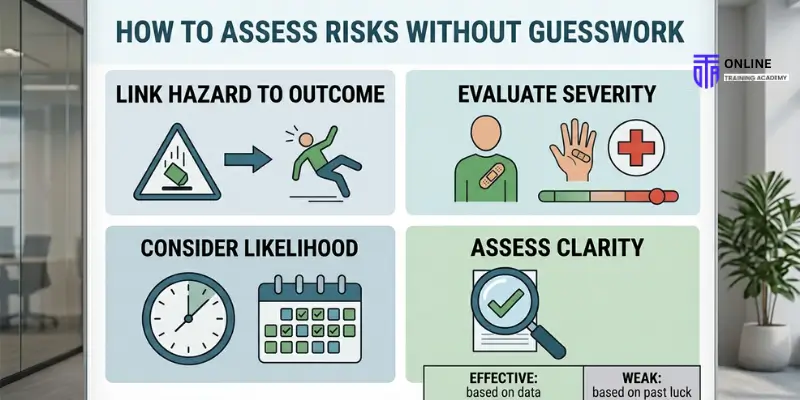
Risk assessment is not about filling out forms. It is about making informed decisions based on how likely harm is and how serious it could be.
A strong assessment begins by linking each hazard to a realistic outcome. Instead of simply listing a hazard, organisations must consider what could actually happen if it is not controlled. This shifts the focus from description to consequence.
The next step is evaluating severity. Some risks may result in minor discomfort, while others could lead to serious injury or long-term health conditions. At the same time, likelihood must be considered. A risk that occurs frequently, even if less severe, can have a significant cumulative impact.
What separates effective assessments from weak ones is clarity. Decisions should be based on real exposure, not assumptions or past luck. Just because an incident has not occurred does not mean the risk is low.
Turning Risk Assessments into Real Control Measures
A common failure point in safety management is the gap between assessment and action.
Identifying a risk is only the starting point. The real challenge is implementing controls that work in practice. This requires selecting measures that fit the way tasks are performed, rather than forcing employees to adapt to unrealistic procedures.
The most effective approach follows a structured method. Hazards should be removed where possible, replaced with safer alternatives where removal is not feasible, and controlled through design, supervision, and clear processes. Personal protective equipment should only be relied on when higher-level controls cannot fully eliminate the risk.
Controls must also be visible and understood. If employees are unclear about what is expected, or if controls slow down work unnecessarily, they are unlikely to be followed consistently.
When Risk Management Should Be Applied
A common misconception is that risk management is only necessary in high-risk industries such as construction or manufacturing. In reality, it should be applied whenever there is potential for harm, regardless of how routine or low-risk a task may appear.
In well-managed UK workplaces, risk management is not treated as a separate activity. It is embedded into everyday planning, decision-making, and supervision. This ensures that risks are considered before work begins, not after something goes wrong.
Routine tasks are often overlooked because they are familiar. However, repetition can create complacency, and small changes in conditions can introduce new risks. For example, a task that is normally safe may become hazardous if carried out under time pressure, with reduced staffing, or using slightly different equipment. These variations are common, yet they are rarely reassessed unless a system is already in place.
Risk management becomes even more critical during non-routine activities. Maintenance work, equipment repairs, process changes, or temporary adjustments to the workplace introduce higher levels of uncertainty. In these situations, normal procedures may not apply, and employees may need to make decisions outside their usual experience. This is where many incidents occur, not because the work is inherently dangerous, but because the risks are not fully understood.
Changes in the workplace are another key trigger. Introducing new machinery, altering layouts, or implementing new processes can create risks that were not previously present. Without reassessing these changes, organisations may continue operating under outdated assumptions about safety.
External factors should also be considered. Weather conditions, supply chain disruptions, or unexpected operational pressures can all influence how work is carried out. These factors may not be part of standard procedures, but they can significantly affect risk levels.
Effective organisations apply risk management before starting work, during the task, and after completion. Before work begins, risks are identified and planned for. During the task, conditions are monitored and adjustments are made if necessary. After completion, outcomes are reviewed to identify lessons and improve future performance.
Embedding risk management into daily operations ensures that safety is maintained even when conditions change. Rather than reacting to incidents, organisations develop the ability to anticipate, adapt, and control risks in real time, which is what ultimately prevents harm.
The 4 Core Principles Behind Effective Safety Management
Effective workplace health and safety is built on four principles that guide how risks are approached and controlled.
The first is prevention. The focus should always be on identifying risks early and addressing them before harm occurs. Waiting for incidents to reveal weaknesses leads to reactive management.
The second is realism. Safety systems must reflect how work is actually carried out. Controls that do not align with real conditions are rarely effective.
The third is shared responsibility. While employers have primary responsibility, employees play a critical role in following procedures, reporting issues, and maintaining safe practices. Safety systems are strongest when everyone is engaged.
The fourth is continuous review. Workplaces evolve, and risks change over time. Regular monitoring ensures that controls remain effective and relevant.
Why Effective Safety Management Improves Performance

Managing workplace health and safety effectively does more than prevent harm. It directly influences how smoothly and consistently an organisation operates.
When risks are properly identified and controlled, work becomes more predictable and stable. Tasks are completed without unexpected interruptions, equipment is used correctly, and employees are less likely to make errors caused by confusion or unsafe conditions. This consistency allows teams to focus on output rather than constantly reacting to problems.
Effective safety management also improves decision-making at all levels. When employees understand risks and procedures clearly, they can act with confidence instead of hesitation. Supervisors spend less time dealing with incidents and more time managing performance. Over time, this creates a more controlled and efficient working environment.
There is also a strong link between safety and employee confidence. When people feel that risks are taken seriously and managed properly, they are more engaged in their work. This leads to better communication, fewer shortcuts, and greater accountability across teams.
From an operational perspective, fewer incidents mean less downtime, fewer disruptions, and lower costs. Investigations, repairs, and absences all reduce productivity. By preventing these issues, organisations maintain momentum and improve overall performance.
Safety, therefore, is not separate from performance. It supports it. When safety is managed well, work flows more reliably, people perform more effectively, and the organisation operates with greater control and consistency.
Conclusion
Managing workplace health and safety effectively is not about creating more rules. It is about ensuring that those rules reflect reality and are applied consistently.
When hazards are identified through observation, risks are assessed with clarity, and controls are designed to match real work, safety becomes part of everyday operations rather than an external requirement.
The organisations that succeed are not the ones with the most detailed systems. They are the ones that ensure those systems work where it matters most, in the way people actually work.
You have not enough Humanizer words left. Upgrade your Surfer plan.
FAQs
The most effective approach is observing how work is actually carried out, combined with employee input and review of past incidents. This provides a realistic view of where risks exist.
An effective risk assessment clearly links hazards to real outcomes, evaluates both likelihood and severity, and leads to practical control measures that can be applied consistently.
They should be reviewed regularly and whenever there are changes in equipment, processes, staffing, or after incidents and near misses.
The most common mistake is relying on written procedures without ensuring they reflect real working conditions. This creates a gap between policy and practice.
Employers hold primary responsibility, but employees must follow procedures, use equipment correctly, and report hazards.
Because risks evolve over time. Continuous review ensures that safety systems remain effective and adapt to changing conditions.
Effective safety management reduces disruptions, improves consistency, and supports better overall productivity.
Learn More





Get a FREE Course
- Learn useful skills online free
- Get CPD accredited certificate
- Add it to your CV today!