


Every construction project starts with plans, drawings, and deadlines—but what often decides its success is something less visible: safety management.
Imagine a site where workers are rushing to meet targets, heavy machinery is operating nearby, and multiple subcontractors are working at the same time. Without proper health and safety management, even a small mistake can lead to serious injury, delays, or legal consequences.
Managing health and safety in construction is not about reacting after accidents happen. It is about building a system that prevents them in the first place. This article explains how effective safety management works, what influences unsafe behaviour, and how construction risks can be controlled in real working environments.
Table of Contents
Health and Safety Management for Construction Level 3
Health and Safety Management for Construction Level 3 is a practical course that provides learners with the knowledge and skills to manage health and safety in construction environments. It covers risk assessment, hazard identification, legal responsibilities, site safety procedures, accident prevention, and compliance with health and safety regulations. The course helps supervisors, managers, and construction professionals create safer workplaces, reduce risks, and promote a strong safety culture across construction projects.
What Does It Mean to Manage Health and Safety in Construction?
Managing health and safety in construction means organizing, controlling, and monitoring all activities on a site to ensure workers are protected from harm.
It involves more than just rules or PPE. It includes planning safe work methods, identifying hazards before work begins, assigning responsibilities, and making sure every worker understands how to work safely.
A well-managed construction site reduces accidents, improves productivity, and ensures legal compliance. In simple terms, it creates a controlled environment where work can be completed safely and efficiently.
How to Effectively Manage Health and Safety in Construction
Managing health and safety in construction becomes much easier when it follows a clear step-by-step system. Instead of reacting after accidents happen, a structured approach helps prevent risks before work even starts.
1. Start with Risk Assessment
Before any task begins, the site must be checked for possible hazards. This includes risks like working at height, exposed electrical systems, moving machinery, or unstable surfaces. Identifying risks early helps prevent accidents before they happen.
2. Apply Control Measures
Once hazards are identified, they must be controlled or removed. This can include using PPE, installing barriers, isolating electrical sources, or changing the way a task is carried out to make it safer.
3. Provide Proper Training
Workers must be trained not only on what to do, but also on how to do it safely. Training ensures everyone understands site risks, safety procedures, and correct working methods. Without proper training, even simple tasks can become dangerous.
4. Ensure Strong Supervision
Supervisors play a key role in daily safety. They check that rules are followed, correct unsafe behaviour, and make sure workers are following safe systems of work. Good supervision keeps safety standards consistent on site.
5. Monitor and Improve Regularly
Safety management does not stop after planning. Regular inspections, site checks, and reviews are needed to find problems early. This helps improve safety systems and prevents repeated mistakes.
Final Point
When these steps are followed in order, construction safety becomes clear, structured, and easy to manage—reducing risks and making the site safer for everyone.
Improving Health and Safety in the Construction Industry
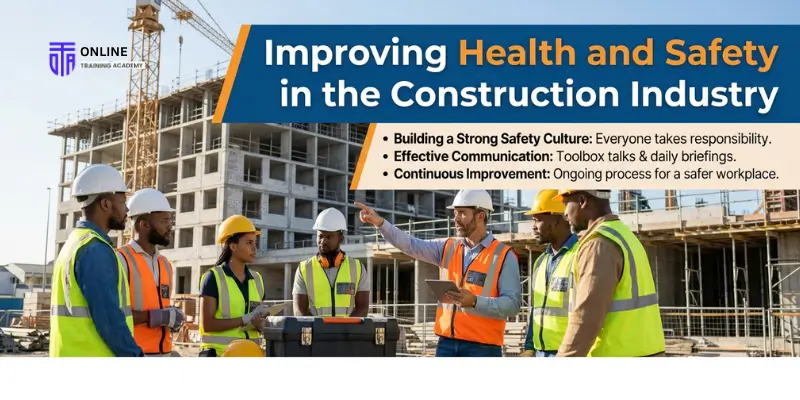
Improving safety is an ongoing process, not a one-time task. One of the most effective ways is building a strong safety culture where everyone takes responsibility.
Communication plays a big role. Toolbox talks, daily briefings, and clear instructions help workers stay aware of risks and expectations.
Another important factor is leadership. When managers and supervisors actively follow safety rules themselves, workers are more likely to do the same.
Regular inspections also improve safety standards. They help identify unsafe conditions early, such as damaged equipment, poor housekeeping, or missing protective measures.
Encouraging workers to report hazards without fear of blame is another key improvement strategy. This helps identify risks before they become accidents.
Human Factors That Influence Unsafe Behaviour
Not all construction accidents are caused by equipment or systems. Many are caused by human behaviour.
Fatigue is a major factor. Tired workers are more likely to make mistakes, ignore procedures, or lose concentration.
Stress is another issue, especially when workers are under pressure to meet tight deadlines. This can lead to shortcuts and unsafe decisions.
Lack of training or experience can also result in unsafe actions, as workers may not fully understand the risks involved in their tasks.
Poor communication between teams often leads to misunderstandings, which can result in dangerous situations on site. Understanding these human factors is essential for creating a safer working environment.
How to Improve Safety Behaviour at Work
Improving behaviour starts with awareness and training. Workers need to understand not only what the rules are but why they exist.
Positive reinforcement is more effective than punishment. Recognizing safe behaviour encourages workers to continue following procedures.
Supervisors also play a key role by setting examples. When leaders follow safety rules consistently, it builds trust and discipline across the site.
Regular toolbox talks help reinforce safety messages and remind workers of key risks and controls.
Creating a culture where workers feel comfortable reporting unsafe behaviour without fear of punishment is also essential for long-term improvement.
Safe Use of Vehicles on Construction Sites
Construction sites often have heavy vehicles moving in tight spaces, which creates serious risks. To manage this, clear traffic management plans should be in place. These define vehicle routes, pedestrian areas, and restricted zones. Speed limits must be strictly enforced to reduce the risk of collisions. Vehicles should also be regularly inspected to ensure brakes, lights, and warning systems are working properly. Where possible, pedestrians and vehicles should be physically separated using barriers or designated walkways.
Essential Safety Toolkit for Small Construction Contractors
Small contractors often face the same risks as large companies but with fewer resources. A basic safety toolkit can make a big difference. This includes simple risk assessment templates, inspection checklists, PPE guidelines, and emergency procedures.
Having clear documentation helps ensure that even small teams follow consistent safety practices. Regular short training sessions and safety briefings can also significantly improve awareness and reduce risks.
Importance of Supervision in Construction Safety
Supervision is one of the most important elements of safety management. Supervisors ensure that workers follow procedures, use equipment correctly, and maintain safe working conditions.
They also act as the first point of response when hazards arise. Good supervision helps prevent unsafe behaviour, improves communication, and ensures that safety systems are actually followed on site.
Role of Communication in Construction Safety
Communication is one of the most critical factors in construction safety, yet it is often underestimated. Even when strong safety systems and equipment are in place, poor communication can quickly lead to confusion, unsafe actions, and serious accidents on site.
Clear communication helps ensure that every worker understands exactly what needs to be done, how it should be done, and what risks are involved. When instructions are simple, direct, and properly confirmed before starting a task, the chances of misunderstanding are greatly reduced. This is especially important in high-risk activities such as working at height, operating machinery, or handling electrical systems.
On busy construction sites, communication is not limited to spoken instructions. Hand signals play a vital role when noise levels are high or when workers are operating heavy equipment. Similarly, safety signage provides constant visual reminders of hazards, restricted areas, and required precautions. Verbal briefings, such as toolbox talks, help reinforce daily safety expectations and ensure that all teams are aligned before work begins.
Poor communication, on the other hand, can create dangerous situations very quickly. When multiple teams are working in the same area, a lack of coordination can lead to collisions, incorrect use of equipment, or workers entering unsafe zones without awareness of ongoing activities. Misunderstandings between supervisors and workers can also result in tasks being carried out incorrectly, increasing the risk of injury or structural failure.
In construction safety, effective communication is not just about giving instructions—it is about ensuring understanding. When everyone on site is informed, alert, and properly coordinated, the entire working environment becomes significantly safer and more efficient.
Benefits of Strong Health and Safety Management
- Reduces downtime by preventing accidents and unexpected site stoppages
- Improves worker morale as employees feel safer and more supported
- Increases productivity by creating a more organized and controlled work environment
- Lowers insurance and compensation costs by reducing workplace incidents
- Ensures legal compliance and reduces the risk of penalties or legal action
- Builds trust between employers, workers, and clients
- Enhances overall site efficiency by minimizing disruptions
A safe site is always a more productive site.
Conclusion
Managing health and safety in construction is not just about following rules—it is about building a system where risks are identified early, controlled effectively, and continuously improved.
When safety becomes part of everyday behaviour rather than a checklist, construction sites become more efficient, more productive, and far safer for everyone involved.
In the end, the strongest construction project is not the one that finishes fastest—it is the one where every worker goes home safely.
FAQs
It is the process of planning, organizing, and controlling construction activities to prevent accidents and ensure worker safety.
Because construction sites are high-risk environments where accidents can cause serious injuries, delays, and legal issues.
Risk assessment, implementing control measures, training workers, supervision, and continuous monitoring.
Through training, leadership, communication, and encouraging a positive safety culture.
Supervisors ensure safety rules are followed, guide workers, and respond to hazards on site.
Learn More





Get a FREE Course
- Learn useful skills online free
- Get CPD accredited certificate
- Add it to your CV today!