

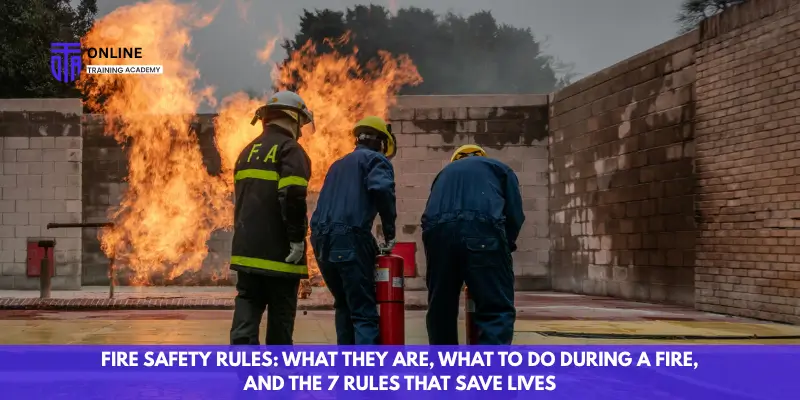
The Decision That Happens Too Late
In many fire incidents, the most critical decision is not made during the fire—it was made days, weeks, or months earlier. A blocked exit that stayed blocked. A detector that was never tested. A plan that was never practiced. When fire appears, people do not rise to the occasion. They fall back on what they already know—or what they failed to prepare. Fire safety rules exist to remove hesitation, reduce risk, and create automatic responses in moments where thinking clearly becomes difficult.
This guide goes beyond surface-level advice. It breaks down what fire safety really means, what actions matter during a fire, and the exact rules that separate controlled incidents from disasters.
What Is Fire Safety?
Fire safety is the structured control of fire risk through prevention, detection, response, and recovery systems designed to protect life, property, and operations.
It is built on three core realities:
- Fire follows predictable patterns
- Most fires are preventable
- Human response determines outcomes
Fire safety operates across two domains:
Active Fire Safety
Systems that respond directly to fire:
- Smoke detectors
- Fire alarms
- Sprinklers
- Fire extinguishers
These systems act immediately when a fire is detected.
Passive Fire Safety
Structural and design elements that limit fire spread:
- Fire-resistant walls and doors
- Compartmentation (dividing spaces to contain fire)
- Fire-rated materials
Passive measures buy time by slowing the fire.
The Fire Triangle (Core Concept)
Every fire requires three elements:
- Heat
- Fuel
- Oxygen
Remove any one of these, and the fire cannot sustain itself.
All fire safety rules are built around controlling these three variables.
Fire Safety Rules: What They Are, What to Do During a Fire, and the 7 Rules That Save Lives
"This blog explains the essential fire safety rules that help prevent accidents and protect lives. It covers the actions to take during a fire emergency, including evacuation procedures, emergency response steps, and the seven key fire safety rules that can reduce risks and save lives. Understanding these principles helps individuals and organisations stay prepared, respond effectively, and maintain a safer environment.
"
Table of Contents
What to Do During a Fire
When a fire starts, time compresses. Visibility drops. Breathing becomes difficult. Decision-making slows.
The goal is not to “fight the fire.” The goal is to survive and exit safely.
Step 1: Raise the Alarm Immediately
Do not investigate. Do not confirm.
If you suspect fire, activate the alarm and alert others.
Delay is one of the leading causes of fire fatalities.
Step 2: Evacuate Using the Nearest Safe Exit
Follow pre-identified escape routes. Never use lifts. Stay low to avoid smoke inhalation. If visibility is reduced, use walls as guides.
Step 3: Close Doors Behind You
Closing doors slows fire spread and limits oxygen supply. This simple action can significantly delay fire growth.
Step 4: Assist Others If Safe to Do So
Help children, elderly individuals, or anyone who needs support—but only if it does not put you at risk.
Step 5: Do Not Re-Enter the Building
Once outside, stay outside. Re-entry attempts are a common cause of injury.
Step 6: Use Fire Extinguishers Only in Early Stages
Only attempt to extinguish a fire if:
- It is small and contained
- You have a clear escape route
- You know how to use the equipment
Otherwise, prioritise evacuation.
7 Fire and Safety Rules Everyone Should Know
These rules are not theoretical. They are designed to function in real environments under real pressure.
1) Develop a Fire Escape Plan (Decision-Making Before the Emergency)
A fire escape plan is not just a drawing. It is a pre-loaded decision system. In an emergency, people do not think clearly. A plan removes the need to think.
A complete plan includes:
- At least two exit routes from every room
- A clearly defined external meeting point
- Assigned roles if needed (for workplaces or large households)
The critical factor is repetition.
Monthly drills transform knowledge into instinct. Without practice, plans fail.
2) Install Smoke Detectors (The Earliest Warning System)
Smoke detectors act as the first alert mechanism in a fire event.
Their effectiveness depends on:
- Placement (every level, near sleeping areas, high-risk zones)
- Maintenance (monthly testing, battery replacement)
- Reliability (no disabled or ignored units)
A non-functional detector creates a false sense of safety. Early warning is often the difference between escape and entrapment.
3) Keep Flammables Away from Heat Sources (Control the Fuel-Heat Interaction)
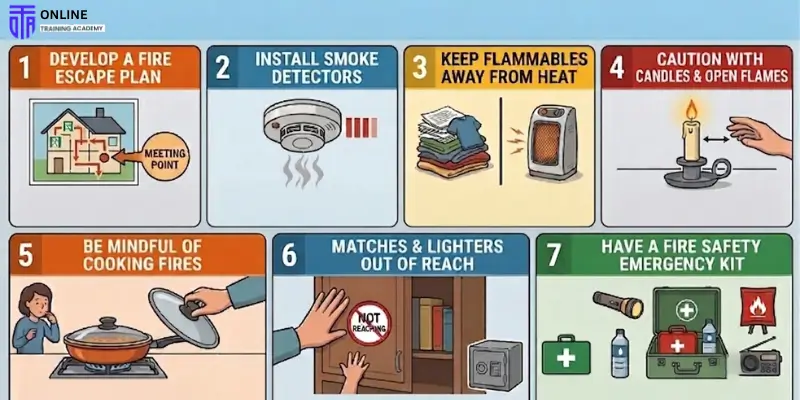
Fire begins when heat meets fuel.
Common mistakes include:
- Placing fabrics near heaters
- Storing chemicals near electrical equipment
- Leaving paper or waste near heat sources
This rule is about separation.
Maintaining distance between heat and fuel reduces ignition probability significantly.
4) Be Cautious with Candles and Open Flames (Managing Visible Ignition Sources)
Open flames are controlled fire—but still fire.
Key controls include:
- Stable, heat-resistant placement
- Safe distance from flammable materials
- Constant supervision
The highest risk factor is unattended flames. A moment of inattention is often enough for ignition.
5) Be Mindful of Cooking Fires (High-Frequency Risk Zone)
Cooking is one of the most common sources of fire incidents.
Risk increases with:
- Unattended cooking
- Grease buildup
- Improper appliance use
Key control actions:
- Stay present while cooking
- Keep flammable items away from heat
- Clean grease regularly
In case of a grease fire:
- Do not use water
- Smother with a lid or use a fire extinguisher
6) Keep Matches and Lighters Out of Reach (Behavioural Risk Control)
Fire risk is not only technical. It is behavioural. Children and untrained individuals may misuse ignition tools.
Controls include:
- Secure storage
- Education on fire risks
- Supervision
This rule focuses on preventing unintended ignition.
7) Have a Fire Safety Emergency Kit (Preparedness Under Disruption)
A fire safety kit supports survival when normal systems are disrupted.
Essential items include:
- Flashlight
- First aid supplies
- Water
- Fire blanket
- Battery-powered radio
The value of the kit lies in accessibility and readiness. Preparedness reduces response time and improves outcomes.
What Are the 4 Principles of Fire Safety?
Fire safety is not built on random rules. It is built on how fire behaves under physical conditions. Every effective system—whether in homes, hospitals, or industrial plants—follows four core principles: prevention, detection, containment, and evacuation. These principles are not independent. They form a sequence of control. If one fails, the next must compensate. When all four are strong, fire becomes manageable instead of catastrophic.
1) Prevention (Eliminating the Conditions That Allow Fire to Start)
Prevention is the most powerful and most overlooked principle. It focuses on stopping fire before it exists.
At its core, prevention is about controlling the fire triangle:
- Heat
- Fuel
- Oxygen
If heat cannot reach fuel, or fuel is limited, ignition cannot occur.
In practice, prevention includes:
- Maintaining electrical systems to avoid overheating and short circuits
- Storing flammable liquids and chemicals in controlled environments
- Managing waste and combustible materials to reduce fire load
- Controlling ignition sources such as open flames, sparks, and hot surfaces
A deeper operational insight: Prevention is not a one-time action. It is a continuous monitoring process. Risks change over time—new equipment, new materials, or new behaviours introduce new hazards. Organisations that fail at prevention often rely too heavily on response systems. But once a fire starts, even the best systems are already reacting to a failure.
2) Detection (Identifying Fire Before It Becomes Visible and Uncontrollable)
Detection is about time. The earlier a fire is identified, the more options exist to control it.
Fires do not become dangerous instantly. They develop through stages. Detection systems are designed to identify fire in its earliest phase—often when it is still invisible to occupants.
Effective detection requires:
- The right type of detector (smoke, heat, or multi-sensor) based on the environment
- Strategic placement to ensure full coverage
- Integration with alarm systems for immediate notification
A key technical insight:
Different fires produce different signatures.
- Smouldering fires produce smoke before heat
- Rapid fires produce heat before visible smoke
This is why system design matters.
Another critical factor is reliability:
- Systems must be tested regularly
- Backup power must be available
- False alarms must be managed without disabling systems
Detection does not stop fire. It creates the opportunity to act before it escalates.
3) Containment (Limiting Fire Spread and Protecting Critical Areas)

Containment is the principle that prevents a fire from turning into a building-wide or system-wide disaster. Once a fire begins to grow, the goal shifts from prevention to control of spread.
Containment works through:
- Passive systems such as fire-resistant walls, doors, and compartmentation
- Active systems such as sprinklers and suppression systems
Compartmentation is one of the most critical but misunderstood strategies. It involves dividing a building into sections so that fire is contained within a limited area.
This achieves three outcomes:
- Slows fire spread
- Protects escape routes
- Reduces structural damage
Sprinkler systems complement containment by:
- Reducing temperature
- Limiting oxygen availability locally
- Preventing flashover
A deeper insight: Containment is about buying time. Time for evacuation. Time for emergency response. Time for systems to work. Without containment, even small fires can escalate into full structural failures.
4) Evacuation (Ensuring Safe Human Exit Under Adverse Conditions)
Evacuation is the final and most critical layer—because it directly relates to survival.
By the time evacuation begins:
- Visibility may be reduced
- Air quality may be compromised
- Stress levels are high
This is why evacuation systems must remove complexity.
Effective evacuation depends on:
- Clearly defined and unobstructed escape routes
- Emergency lighting that functions during power failure
- Signage that remains visible in smoke
- Pre-planned assembly points
A key behavioural insight: People do not behave rationally during emergencies. They hesitate, search for confirmation, or attempt to retrieve belongings. Evacuation systems must therefore:
- Be simple and intuitive
- Require minimal decision-making
- Be reinforced through regular drills
The goal is not just to exit.
It is to exit quickly, safely, and without confusion.
Strategic Insight: How the Four Principles Work Together
These four principles form a layered defence system:
- Prevention reduces the chance of fire starting
- Detection ensures early awareness
- Containment limits damage and spread
- Evacuation protects lives
If prevention fails, detection must succeed. If detection is delayed, containment must compensate. If containment is overwhelmed, evacuation becomes the final safeguard. This layered approach is what makes fire safety effective at scale.
What Are the 5 Golden Safety Rules?
While the four principles define the system, the five golden rules define human behaviour within that system.
Fire safety systems do not act alone. Their effectiveness depends on how people interact with them.
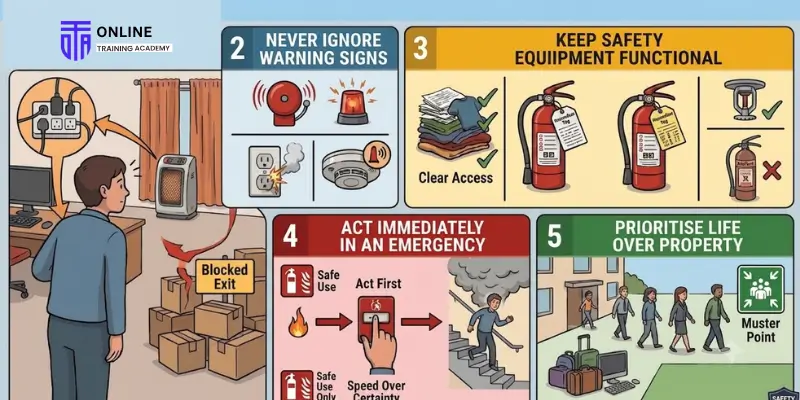
1) Always Stay Alert to Fire Risks (Situational Awareness as a Safety Skill)
Fire risk is rarely hidden. It is often visible but ignored.
Situational awareness means:
- Noticing overloaded sockets
- Recognising unusual heat or smells
- Identifying blocked exits or unsafe storage
This rule transforms individuals from passive occupants into active risk controllers.
A critical insight:
Most fire incidents are preceded by warning signs that were noticed—but not acted upon.
Awareness is the first step in prevention.
2) Never Ignore Warning Signs (Early Intervention Saves Lives)
Warning signs are early indicators of failure:
- Burning smells
- Flickering electrical systems
- Repeated alarm triggers
- Equipment overheating
Ignoring these signals allows small issues to escalate.
In high-risk environments, near-miss incidents are treated seriously because they reveal system weaknesses.
A strong fire safety culture encourages:
- Immediate reporting
- Rapid investigation
- Corrective action
The principle is simple:
Small signals prevent large failures.
3) Keep Safety Equipment Functional (Readiness Over Presence)
Fire safety equipment is only effective if it works at the moment it is needed.
Common issues include:
- Expired extinguishers
- Disabled alarms
- Blocked sprinkler heads
Functional readiness requires:
- Regular inspection
- Clear access
- User familiarity
A deeper insight: Equipment failure is rarely due to design. It is due to neglect. Maintaining equipment is not maintenance work—it is risk control.
4) Act Immediately in an Emergency (Speed Over Certainty)
In fire scenarios, delay is more dangerous than incorrect action.
People often hesitate because they:
Evacuation is the final and most critical layer—because it directly relates to survival.
By the time evacuation begins:
- Want confirmation
- Underestimate the risk
- Fear false alarms
However, fire development is exponential. What is small now may be uncontrollable in minutes.
Immediate action includes:
- Raising the alarm
- Initiating evacuation
- Using extinguishers only when safe
The guiding principle is:
Act first. Verify later.
5) Prioritise Life Over Property
One of the most dangerous behaviours during a fire is attempting to save belongings.
This leads to:
- Delayed evacuation
- Re-entry into dangerous environments
- Increased exposure to smoke and heat
Fire safety systems are designed with one priority:
protecting life.
Property can be replaced. Human life cannot. This rule must be reinforced through training and culture, especially in workplaces where assets may be high-value.
Operational Insight: Why These Rules Fail in Practice
Despite their simplicity, these rules are often not followed.
The reasons include:
- Complacency over time
- Lack of training
- Poor enforcement
- Misaligned priorities
The solution is not more rules. It is consistent reinforcement through systems, leadership, and culture.
Why Most Fire Safety Systems Fail in Practice
This is where most content stops—and where real risk begins.
Fire safety systems fail not because they are absent, but because they are:
- Poorly maintained
- Improperly used
- Ignored over time
Common failure points include:
- Disabled alarms due to nuisance triggers
- Blocked escape routes
- Lack of training
The gap is not technical. It is operational discipline.
Fire Safety Is a System, Not a Reaction
Fire does not create chaos on its own. Chaos comes from unprepared environments.
Fire safety rules are not restrictions. They are controls that shape outcomes before a fire begins.
When these rules are applied consistently:
- Fires are less likely to start
- They are detected earlier
- They are controlled faster
- People respond with clarity instead of panic
Every major fire once began as something small and manageable. The difference lies in whether the system—and the people within it—were ready.
The real question is not whether you know the rules. It is whether those rules are already built into your environment.
Conclusion
Fire safety is not just about responding to emergencies—it is about preventing them through preparation, awareness, and consistent action. By understanding fire risks, following essential safety rules, and maintaining effective prevention and detection measures, individuals and organisations can significantly reduce the likelihood and impact of fire incidents. Simple actions, such as keeping escape routes clear, testing alarms, and practising evacuation plans, can make a critical difference when every second counts.
Ultimately, effective fire safety is built on knowledge, responsibility, and regular practice. Whether at home, in the workplace, or in public spaces, applying fire safety principles helps protect lives, minimise property damage, and create safer environments for everyone. Staying prepared today is the best way to respond confidently should a fire emergency ever occur.
FAQs
Early detection and immediate evacuation are the most critical.
Regularly—monthly for homes and periodically for workplaces.
Never use lifts or attempt to re-enter the building.
Because they involve heat, fuel, and human distraction.
Ignoring small risks until they combine into a larger hazard.
Learn More





Get a FREE Course
- Learn useful skills online free
- Get CPD accredited certificate
- Add it to your CV today!