

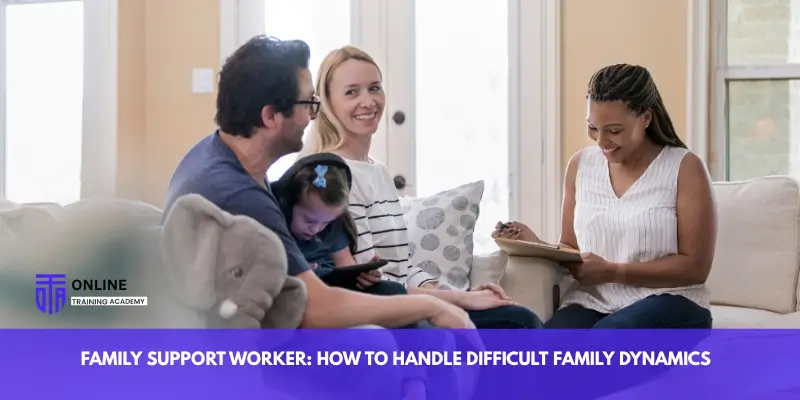
One family problem can produce three very different stories. A parent may feel unheard, a teenager may feel misunderstood, and another family member may see the situation differently. There may be no simple answer, yet the family still needs a way forward.
That is where a Family Support Worker does more than offer advice. They listen to different perspectives, manage tense conversations, understand what may be driving the conflict and maintain clear boundaries.
Difficult family dynamics do not always mean there is a difficult person. Stress, changing relationships, communication problems and outside pressures can all play a part. A good Family Support Worker looks at the bigger picture instead of rushing to assign blame.
Table of Contents
Family Support Worker
The Family Support Worker course develops practical knowledge of supporting families, safeguarding children, child development, health and safety, legislation, family issues, and child protection, including awareness of coronavirus prevention and care.
How Should a Family Support Worker Handle Difficult Family Dynamics?
The first step is to understand the dynamic before trying to change it. A Family Support Worker can listen to different perspectives, ask clear questions, identify what is causing tension and keep the conversation focused on appropriate next steps.
That means being supportive without automatically agreeing with everyone. It also means staying neutral where appropriate, keeping professional boundaries and recognising when a situation needs another service or a different level of support.
The goal is not to decide who is right. It is to help create a clearer, safer and more constructive way forward.
Understand the Dynamic Before Trying to Change It
Look beyond the obvious argument.
A parent who seems angry may feel ignored. A teenager who refuses to speak may feel that adults have already made decisions for them. Two parents who constantly disagree may be dealing with unresolved relationship issues, different expectations or pressures outside the family.
The worker can look for patterns: Who speaks first? Who withdraws? Who gets blamed? When does the tension usually increase? What happens after an argument?
Those observations can provide more useful information than simply labelling someone as “difficult.”
Stay Neutral Without Becoming Passive
Being neutral does not mean sitting silently while everyone argues.
It means giving people a fair opportunity to explain their perspective without rushing to support one person’s version of events. A worker can acknowledge that someone is upset without confirming that their interpretation is automatically correct.
For example, saying, “I can hear that this has been frustrating for you,” is different from saying, “You’re right, they are treating you unfairly.”
That small distinction can protect the working relationship with everyone involved.
Know the Difference Between Support and Taking Sides
Family members may sometimes try to bring the worker into the conflict.
“Tell them they’re wrong.”
“You need to speak to my partner.”
“You know what they’re really like.”
The worker can listen to the concern without becoming the family’s referee. Keeping the conversation centred on needs, concerns and appropriate next steps is usually more productive than deciding who deserves to win the argument.
What Should a Family Support Worker Do When Family Members Tell Different Stories?

Conflicting accounts are not unusual when relationships are tense. Two people can remember the same event differently because they experienced it from different perspectives.
The worker’s responsibility is not to immediately determine which person is telling the truth. It is to listen carefully, ask appropriate questions and distinguish what has been observed from what has been interpreted.
Listen Without Deciding Who Is Right
Give each person reasonable space to speak.
Instead of interrupting with, “That isn’t what happened,” a worker can ask the other person to explain their perspective and then clarify the points that remain unclear.
This approach reduces the chance of turning the support session into another argument.
Use Neutral Questions to Clarify What Happened
Questions can be more useful than assumptions.
Instead of asking, “Why did you do that?” a worker might ask, “What happened after that conversation?”
Instead of, “Who started the argument?” a more useful question might be, “What was happening just before things became tense?”
Neutral wording helps people describe events without feeling that they have already been judged.
Keep the Focus on What the Family Needs Next
It is easy for a conversation to become a replay of everything that has gone wrong.
A Family Support Worker can help bring the discussion back to what can be addressed now.
What does the family need? What concern needs attention first? Is there something everyone can agree on? Is another service needed?
The purpose is not to rewrite the past. It is to identify the next appropriate step.
How Can a Family Support Worker Handle Conflict Without Making It Worse?
Telling people to “communicate better” sounds sensible, but it is not much help when everyone is already talking over each other.
Effective communication often depends on small choices in the moment.
Slow Down a Conversation That Is Escalating
When people interrupt one another, the worker may need to slow the conversation down.
That can mean asking one person to finish before another responds, using a calmer tone, allowing a pause or addressing one issue at a time.
The aim is not to control the family. It is to create enough structure for people to actually hear one another.
Replace Loaded Language With Neutral Language
Words such as “lazy,” “selfish,” “impossible” or “uncooperative” can quickly make a conversation more defensive.
Neutral descriptions are more useful.
Instead of saying, “You never cooperate,” a worker can help clarify what actually happened: “The appointment was missed twice. What made attendance difficult?”
The second approach identifies a problem without turning it into a judgement about someone’s character.
Reflect, Summarise and Check Understanding
Sometimes tension continues because people are arguing about what they think the other person meant.
A worker can briefly summarise:
“I’m hearing that you want more consistency at home, while you’re worried that the current expectations are creating more conflict.”
That gives both people an opportunity to correct misunderstandings and makes the conversation easier to follow.
Know When a Conversation Needs to Pause
Not every disagreement can be resolved in one conversation.
If people become too distressed, hostile or unable to communicate productively, continuing may not help. Depending on the setting, the worker may need to pause the discussion, seek guidance or follow workplace procedures.
Good support sometimes means knowing when not to push a conversation further.
What If a Parent Feels Judged by the Support Process?
Family support can feel uncomfortable when a parent believes they are being evaluated rather than helped.
A parent may wonder why certain questions are being asked, why information needs to be recorded or whether the worker has already formed an opinion. That concern should not simply be brushed aside.
Acknowledge the Concern Instead of Dismissing It
A worker does not need to agree with the parent’s interpretation to recognise the feeling behind it.
“I understand why you might feel that way” can open a conversation more effectively than immediately defending the organisation.
The parent may then explain what caused the concern.
Be Clear About the Worker’s Role
Transparency matters.
Explain what the worker’s role involves, what information is relevant to the support process and what the worker can and cannot provide. Avoid vague promises designed to make the conversation easier in the moment.
Clear expectations can feel uncomfortable, but they are usually easier to work with than uncertainty.
Support Without Making the Parent Feel Powerless
A parent should not feel that support means losing their voice.
Where appropriate, involve the family in identifying priorities, discussing options and deciding on realistic next steps. A strengths-based approach can also help shift the conversation away from everything that is going wrong and toward what the family is already doing well.
That creates a more collaborative relationship.
How Should a Family Support Worker Handle Changing Family Roles?
Family relationships can change significantly over time. Separation, remarriage, new partners, different households and changing responsibilities can all affect how people communicate.
These situations are not automatically problematic. The challenge often comes when roles, expectations or boundaries become unclear.
When Separated Parents Disagree
Separated parents may have very different views about routines, parenting approaches, communication or family decisions.
A Family Support Worker should avoid becoming the person who decides which parent is right.
Instead, the worker can listen to both perspectives, identify the concerns that matter to the support plan and keep communication focused on appropriate goals.
When conflict is beyond the worker’s role, additional support may be needed.
When Parenting Approaches Conflict
One parent may prefer strict routines while another takes a more flexible approach. One may want consequences for a behaviour while the other wants more discussion.
The worker does not need to choose a winner.
The more useful approach is to explore what each person is trying to achieve, identify where they agree and consider whether there are practical ways to reduce unnecessary conflict.
When a New Partner or Step-Parent Changes the Dynamic
A new adult in the household can change expectations and relationships.
Questions may arise about authority, routines, discipline or communication. Children may also take time to adjust to the changes.
Rather than treating the family structure itself as the problem, the worker can focus on unclear roles, communication and the needs of the people involved.
How Can a Family Support Worker Avoid Getting Pulled Into Family Conflict?

A worker can become part of the conflict without realising it.
When family members trust the worker, they may share private complaints about one another or expect the worker to take action against another person.
When Someone Says, “Tell Them They’re Wrong”
This is a moment for role clarity.
The worker can acknowledge the concern and ask what outcome the person is hoping to achieve, rather than becoming the person who confirms one side’s argument.
That keeps the focus on support rather than winning.
Don't Become the Family’s Messenger
Carrying personal messages between family members can put the worker in an uncomfortable position and sometimes make the conflict worse.
Where direct communication is appropriate and safe, family members may need to communicate with one another rather than using the worker as a go-between.
Keep the Relationship Supportive but Boundaried
Being approachable does not mean becoming personally involved in every part of a family’s life.
Clear boundaries help the worker remain consistent and make the purpose of the relationship easier for everyone to understand.
For related social and community service occupations in Canada, active listening, negotiating, persuading and coordinating are identified as important competencies, which reflects how much of the work depends on managing relationships without losing sight of the role.
What Is Really Behind Difficult Family Dynamics?
Sometimes the argument you can see is not the problem that started it.
A family may be dealing with financial pressure, housing difficulties, isolation, employment concerns, relationship breakdown or changing responsibilities. These pressures can affect patience, communication and the ability to cope with everyday demands.
Stress Outside the Family Can Affect Relationships
Imagine a household dealing with unstable housing and financial uncertainty.
A disagreement about school attendance might appear to be a parenting problem, but the family may also be managing transportation difficulties, work schedules or other pressures.
Understanding the wider context does not excuse harmful behaviour. It helps the worker avoid reducing a complicated situation to a single person’s attitude.
Behaviour May Be Communicating Something Else
A withdrawn teenager may not simply be “uncooperative.” A parent who repeatedly becomes angry may be overwhelmed or feel unheard.
This does not mean every behaviour has one hidden explanation.
It means the worker should remain curious enough to ask what may be contributing to the pattern before deciding how to respond.
Why Understanding the Context Matters
The same behaviour can mean different things in different families.
That is why effective family support is not about applying one response to every household. The worker needs to listen, consider the circumstances and adapt the approach within the limits of the role.
Difficult Family Dynamics: What Should a Family Support Worker Do in Real Situations?
The best way to understand these principles is to see them in action.
Scenario 1 — A Parent and Teenager Keep Talking Over Each Other
The parent answers every question before the teenager can respond. The teenager becomes irritated and eventually stops participating.
Instead of labelling either person as the problem, the worker can slow the conversation down, give each person space to speak and use clear questions.
The aim is not to embarrass the parent or force the teenager to talk. It is to create a conversation where both perspectives can be heard.
Scenario 2 — Separated Parents Blame Each Other
One parent says the other never follows through. The other says they are being unfairly blamed.
The worker should avoid choosing a side based on the first account they hear.
Neutral questions can help clarify what has actually been happening, while the conversation can remain focused on the support needs rather than turning into an argument about the relationship.
Scenario 3 — A Parent Says, “You've Already Decided I'm the Problem”
This statement should not simply be corrected.
The worker can ask what has created that impression and give the parent an opportunity to explain their experience.
The response may reveal a misunderstanding, a previous negative experience with services or a genuine communication problem that needs to be addressed.
Scenario 4 — One Family Member Dominates Every Conversation
One person may answer every question, interrupt frequently or speak on behalf of everyone else.
The worker can create space for quieter family members through direct but respectful questions, while avoiding language that publicly labels one person as controlling.
The goal is a more balanced conversation, not a confrontation.
When Does Family Conflict Require More Than Family Support?
Not every disagreement needs escalation. Families can disagree without being in crisis.
The important question is whether the situation can still be appropriately addressed within the Family Support Worker’s role.
Signs That the Situation Is Escalating
Repeated hostility, serious breakdowns in communication, behaviour that prevents constructive support or concerns that clearly fall outside the worker’s responsibilities may indicate that more support is needed.
The worker should use professional judgement rather than trying to force a solution.
Knowing When to Seek Guidance or Refer
A Family Support Worker does not need to manage every issue independently.
Depending on the employer and role, the appropriate response may involve consultation with a supervisor, referral to another service or following an established workplace procedure.
This is also where role boundaries matter. Social workers, for example, have a distinct occupational scope that can include counselling, therapy, assessment and referrals, while Family Service Workers fall within the broader social and community service worker group in Canada’s occupational classification.
The exact responsibilities vary by position, so workers should follow the requirements that apply to their own workplace.
Documenting Relevant Concerns Clearly
When something significant happens, accurate documentation matters.
Record what was observed, what was discussed, what action was taken and what follow-up is required. Avoid turning notes into personal judgements about family members.
Good documentation supports continuity and gives other authorised members of the support team a clearer understanding of what has happened.
Common Mistakes Family Support Workers Should Avoid

1. Taking Sides Too Quickly
The first person to speak may not provide the complete picture. Listening to different perspectives before forming conclusions helps preserve trust.
2. Labelling a Family Member
Calling someone “difficult,” “lazy” or “uncooperative” can hide the actual issue. Describing the behaviour and circumstances is usually more useful.
3. Trying to Solve the Argument
The worker’s role is not necessarily to decide who wins. The focus should be on understanding concerns, supporting appropriate communication and identifying next steps.
4. Ignoring Boundaries Because the Family Needs Help
A worker can care deeply about a family’s situation and still maintain professional limits. Clear boundaries protect the relationship rather than making it less supportive.
5. Treating Every Disagreement as a Crisis
Not every argument requires escalation. Proportionate responses, careful observation and appropriate judgement matter.
Conclusion
Three people can experience the same family conflict and walk away with three completely different versions of what happened.
A strong Family Support Worker does not need to decide which person is the villain. The more useful job is to understand the pattern, listen carefully, keep communication respectful and help the family identify an appropriate next step.
That may mean slowing down a heated conversation, giving a quieter family member space to speak, clarifying a worker’s role or recognising that another service is needed.
The goal is not to make every family conversation comfortable. It is to make difficult conversations clearer, more respectful and more constructive—one next step at a time.
FAQs
Start by listening carefully and trying to understand the family dynamic rather than immediately assigning blame. Use calm, neutral communication, maintain appropriate boundaries and follow workplace procedures when the situation requires additional support.
A Family Support Worker listen to different perspectives, avoid taking sides too quickly and focus on the family’s needs, concerns and appropriate goals. Being neutral does not mean ignoring important concerns.
The worker can give both parents an opportunity to explain their perspectives, use neutral questions and keep the discussion focused on appropriate family needs. The worker should avoid becoming the person who decides which parent is right.
Listen to the concern instead of immediately defending the service. Clarify the worker’s role, explain expectations honestly and give the parent an opportunity to describe why they feel judged.
Look at the circumstances around the behaviour, remain calm, avoid labels and establish appropriate boundaries. If the concern goes beyond the worker’s role, they should follow the relevant workplace process or seek guidance.
Referral may be appropriate when a family’s needs fall outside the worker’s responsibilities, require specialised support or cannot be appropriately addressed through the available family-support intervention.
The worker should not attempt to manage serious safety concerns alone. They should follow the safety, escalation and emergency procedures that apply to their workplace and role and seek appropriate guidance.
Learn More





Get a FREE Course
- Learn useful skills online free
- Get CPD accredited certificate
- Add it to your CV today!