


Introduction
Many people assume data entry is simply about typing quickly, but that’s only one piece of the job. Employers today need professionals who can manage information accurately, work confidently with digital tools, and help keep business operations running smoothly. As workplaces become more data-driven, the expectations for Data Entry Administrators continue to grow.
That’s why Data Entry Administrator Training is more relevant than ever. Effective training goes beyond improving typing speed by developing the technical knowledge, attention to detail, organization, and communication skills employers look for when hiring administrative staff.
In this guide, you’ll discover the skills employers value most, how those skills are used in real workplaces, and how the right training can help you become a stronger candidate in today’s competitive job market.
Table of Contents
Data Entry Administrator Training
Data Entry Administrator Training equips you with the essential skills to manage data accurately, use office software efficiently, maintain organised records, and follow professional administrative practices, helping you build confidence for a wide range of data entry and office support roles.
What Skills Do Employers Look for in Data Entry Administrators?
The short answer is this: employers want candidates who can process information accurately, work efficiently with digital tools, and maintain high standards of organization and professionalism.
While typing speed remains important, it is no longer the defining qualification for a successful Data Entry Administrator. Modern workplaces generate enormous amounts of digital information every day, and businesses depend on employees who can maintain data quality, protect confidential records, and work collaboratively across departments.
Today’s employers typically look for candidates who can demonstrate:
- Excellent typing accuracy and speed
- Strong attention to detail
- Effective time management
- Confidence using office software and databases
- Organizational abilities
- Professional communication skills
- Reliability and accountability
- A commitment to maintaining data integrity
These skills allow administrators to support daily business operations while reducing costly errors that can affect productivity, customer service, and decision-making.
Why Data Entry Is More Than Just Fast Typing
Many people still assume data entry is simply about typing information into a computer. In reality, the role has become much more sophisticated.
A Data Entry Administrator often works with customer records, financial documents, inventory databases, employee files, healthcare information, or legal documents. Before entering any information, they may need to verify its accuracy, identify inconsistencies, organize digital files, or communicate with colleagues to clarify missing details.
For example, imagine an employee entering supplier invoices for a manufacturing company. Typing the numbers correctly is only one part of the job. They also need to ensure purchase order numbers match company records, identify duplicate invoices, and update payment information accurately. One small mistake could delay payments, affect inventory planning, or create unnecessary administrative work.
This is why employers increasingly value analytical thinking and attention to detail alongside technical skills.
The Balance Between Speed, Accuracy, and Reliability
One of the biggest misconceptions about data entry is that faster always means better.
In reality, employers want candidates who can maintain a balance between productivity and precision. Entering hundreds of records quickly means little if those records contain mistakes that require hours of correction later.
Consider two employees:
- Employee A processes 800 records a day but frequently makes errors.
- Employee B processes 650 records with consistently high accuracy.
In many workplaces, Employee B is the stronger performer because accurate information saves time, reduces operational risks, and supports better business decisions.
Many employers therefore evaluate candidates on both typing speed and accuracy rather than either skill in isolation.
Typical expectations may include:
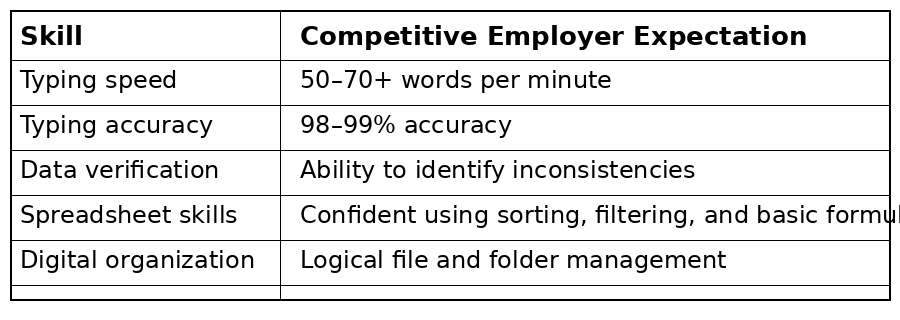
These benchmarks vary by industry, but they provide a useful goal for learners preparing for administrative roles.
How Employer Expectations Have Changed in Modern Workplaces
Technology has transformed how organizations collect, store, and use information. Businesses increasingly rely on cloud-based systems, digital records, and collaborative platforms that require employees to work efficiently while maintaining high standards of accuracy.
Rather than replacing Data Entry Administrators, these changes have expanded the range of skills employers expect. Today’s administrators may work with shared online documents, customer relationship management (CRM) systems, inventory software, or cloud storage platforms in addition to traditional spreadsheets.
As a result, employers now value candidates who can:
- Learn new software quickly
- Adapt to changing digital workflows
- Maintain accurate electronic records
- Protect confidential information
- Work collaboratively with colleagues across departments
- Identify and correct data inconsistencies before they become larger problems
Training that combines technical knowledge with workplace skills helps prepare learners for these evolving expectations.
Instead of asking, “Can this person type quickly?” employers are increasingly asking, “Can this person manage information accurately, responsibly, and efficiently?”
Those are very different questions—and the answer often determines who gets hired.
What Does a Data Entry Administrator Do Every Day?
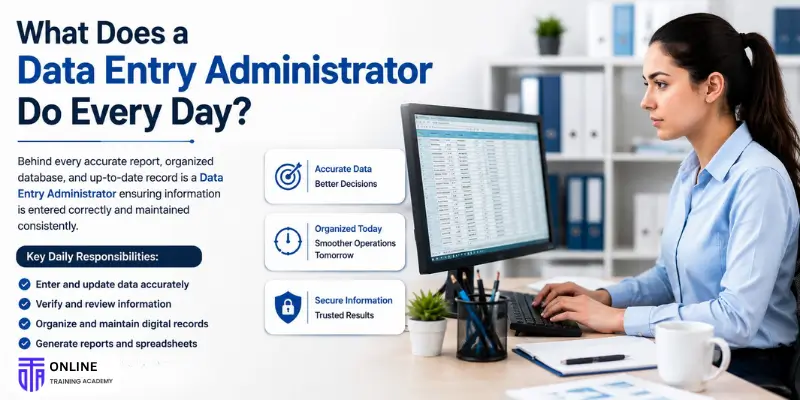
Behind every accurate report, organized customer database, and up-to-date business record is someone ensuring information is entered correctly and maintained consistently. That responsibility often falls to a Data Entry Administrator.
Although the job title suggests a focus on entering information, the role is much broader. Data Entry Administrators help businesses manage one of their most valuable assets—reliable data. Whether working for a healthcare provider, financial institution, retailer, logistics company, educational organization, or government office, they ensure information is accurate, accessible, and secure.
Their daily responsibilities may vary depending on the industry, but the objective remains the same: maintaining high-quality records that support smooth business operations.
Core Roles and Responsibilities in Modern Offices
Successful Data Entry Administrators perform much more than repetitive keyboard work. They contribute to the efficiency of an organization by ensuring information is complete, accurate, and available when needed.
Typical responsibilities include:
- Entering information into databases, spreadsheets, and business systems
- Reviewing documents for accuracy before entering data
- Updating existing records to reflect new information
- Verifying information against original documents
- Organizing electronic files and digital records
- Removing duplicate or outdated entries
- Maintaining confidentiality when handling sensitive information
- Assisting colleagues by locating and retrieving records
- Preparing reports using collected data
- Following company procedures for data management and security
Many organizations also expect Data Entry Administrators to identify inconsistencies instead of simply entering information exactly as it appears. For example, if two customer records contain conflicting contact details, a skilled administrator knows to verify the information before updating the system rather than creating duplicate or inaccurate records.
This proactive approach helps prevent problems before they affect other departments.
How Accurate Data Supports Business Decisions
Every department within an organization depends on reliable information.
A sales team uses customer records to manage relationships. Human resources maintains employee information. Finance relies on accurate invoices and payment records. Inventory teams monitor stock levels using digital databases. If the underlying data contains errors, the consequences can extend throughout the organization.
For example:
- An incorrect customer address could delay an important shipment.
- A misplaced decimal point might produce inaccurate financial reports.
- Duplicate inventory records can lead to unnecessary purchases.
- Incorrect patient information could delay healthcare services.
- Missing employee records may create payroll issues.
These examples demonstrate why employers place such a strong emphasis on accuracy and attention to detail during recruitment. Every correctly entered record supports smoother operations and better decision-making.
Real Workplace Scenarios Across Different Industries
The responsibilities of a Data Entry Administrator change depending on the industry, but the need for accuracy remains constant.
Healthcare
Healthcare organizations manage appointment schedules, patient records, insurance information, and medical documentation. Accuracy is essential because even minor errors can affect patient care or create administrative delays.
Finance
Banks, accounting firms, and financial departments process invoices, transactions, payroll information, and financial reports. Employers expect administrators to work carefully with numerical data while maintaining confidentiality.
Logistics and Supply Chain
Shipping companies rely on accurate inventory records, delivery schedules, and tracking information. Timely data updates help prevent shipping delays and inventory shortages.
Retail and E-commerce
Retail businesses constantly update product inventories, customer information, pricing, and online orders. Accurate data helps improve customer satisfaction while reducing stock discrepancies.
Education
Schools, colleges, and training providers maintain student records, enrolment information, attendance, and assessment data. Administrators help ensure information remains current and accessible.
Government and Public Services
Government departments process large volumes of applications, official documents, and public records. Employers in this sector often emphasize confidentiality, consistency, and compliance with organizational procedures.
Although the industries differ, the underlying skills employers seek remain remarkably similar.
The 6 Essential Skills Employers Expect Every Data Entry Administrator to Have
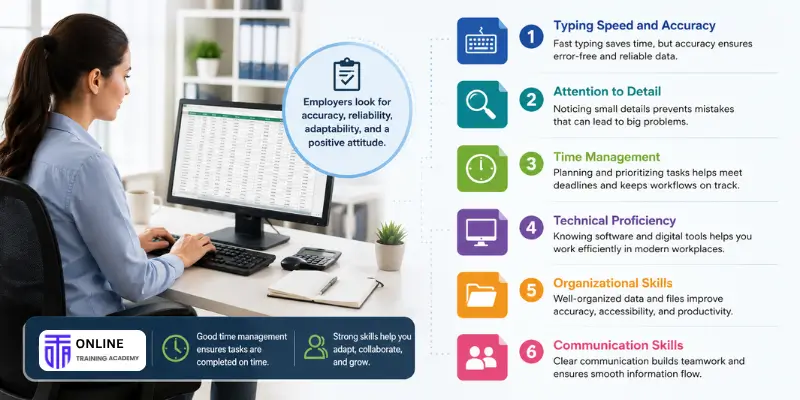
Employers rarely hire based on typing speed alone. They want individuals who can consistently produce accurate work, adapt to modern office technologies, and contribute positively to the workplace.
Developing the following six skills through Data Entry Administrator Training can significantly improve your readiness for administrative roles.
1. Typing Speed and Accuracy: Why Both Matter
Typing efficiently allows administrators to manage large workloads, but accuracy is what builds employer trust.
Correcting errors often takes more time than entering information correctly the first time. For this reason, employers typically assess both speed and precision during recruitment.
A competitive candidate should aim for:
- Typing speed of approximately 50–70 words per minute
- Accuracy of 98–99%
- Consistent formatting across documents
- Minimal data entry errors
Training helps improve keyboard familiarity, posture, and typing techniques while encouraging habits that reduce mistakes under pressure.
2. Attention to Detail Prevents Costly Mistakes
One incorrect number, missing letter, or misplaced file can create problems that affect multiple departments.
Strong attention to detail enables Data Entry Administrators to:
- Detect duplicate records
- Identify missing information
- Correct formatting inconsistencies
- Verify source documents
- Maintain high-quality databases
Imagine processing hundreds of customer orders each day. Entering an incorrect postal code or customer identification number could result in delayed deliveries, billing issues, or dissatisfied customers. Employers therefore value candidates who consistently review their work before submitting it.
3. Time Management Keeps Workflows Moving
Modern offices often manage multiple priorities simultaneously. A Data Entry Administrator may need to update customer databases while preparing reports, processing invoices, and responding to urgent requests.
Good time management helps employees:
- Prioritize high-priority tasks
- Meet deadlines consistently
- Balance speed with quality
- Adapt to changing workloads
- Maintain productivity throughout the day
Employers appreciate individuals who can stay organized without sacrificing accuracy, especially during busy periods.
4. Technical Proficiency Supports Modern Digital Workplaces
Today’s Data Entry Administrators interact with far more than spreadsheets.
Depending on the role, employers may expect familiarity with tools such as:
- Microsoft Excel
- Microsoft Word
- Google Sheets
- Google Workspace
- Database management systems
- Customer Relationship Management (CRM) software
- Cloud storage platforms
While advanced programming knowledge is rarely required, understanding how to navigate digital systems confidently allows administrators to work more efficiently and adapt to new technologies as businesses evolve.
5. Organizational Skills Improve Data Quality
Managing thousands of records requires a logical approach to organization.
Well-organized administrators create clear folder structures, use consistent naming conventions, and maintain orderly databases that make information easy to retrieve.
Strong organizational skills also help prevent:
- Duplicate records
- Lost documents
- Version control issues
- Filing inconsistencies
- Unnecessary administrative delays
These habits improve collaboration because colleagues can quickly locate the information they need.
6. Communication Skills Strengthen Team Collaboration
Although much of the work is completed independently, Data Entry Administrators regularly communicate with supervisors, colleagues, customers, or other departments.
Clear communication is important when:
- Clarifying missing information
- Reporting data inconsistencies
- Confirming updates
- Explaining administrative processes
- Collaborating on shared projects
Employers value candidates who can communicate professionally in both written and verbal formats while maintaining accuracy and confidentiality.
Together, these six skills form the foundation of an effective Data Entry Administrator. More importantly, they represent the qualities employers consistently seek when evaluating candidates for administrative positions.
How Employers Assess Data Entry Skills During Hiring
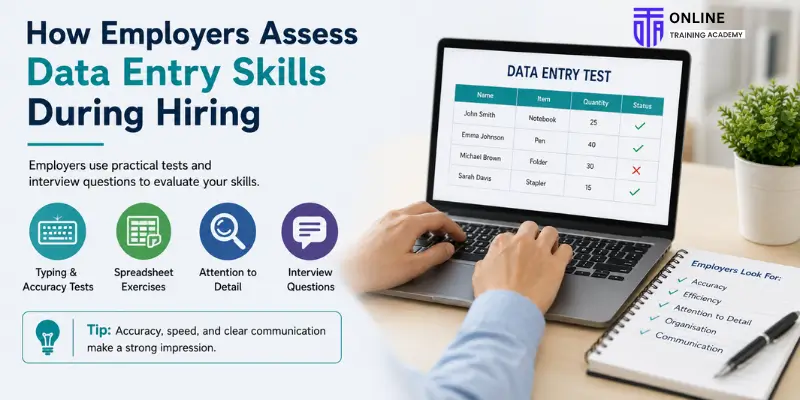
Completing Data Entry Administrator Training is an excellent first step, but employers also want to see how well you apply those skills in practical situations. During the hiring process, they often evaluate candidates through a combination of tests and interview questions rather than relying solely on a résumé.
Common assessment methods include:
➽ Typing and accuracy tests to measure speed and precision.
➽ Spreadsheet exercises using tools like Microsoft Excel or Google Sheets.
➽ Attention-to-detail tasks, such as identifying errors or duplicate records.
➽ Scenario-based interview questions that assess problem-solving and organization.
➽ Communication questions to evaluate how you would handle missing or incorrect information.
Preparing for these assessments during your training can help you approach interviews with greater confidence.
Which Skills Help Candidates Stand Out?
Meeting the minimum requirements is important, but employers often prefer candidates who demonstrate a well-rounded mix of technical and workplace skills.
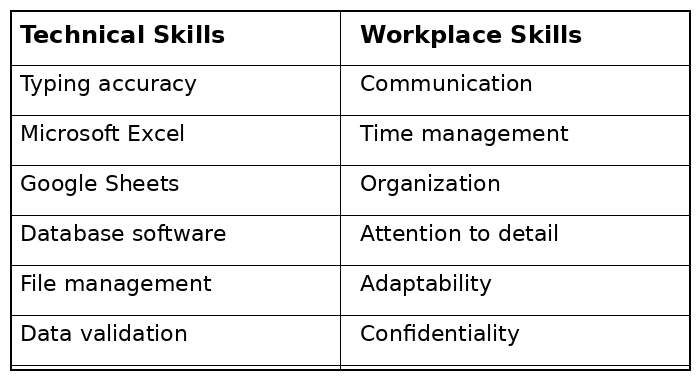
Candidates who combine these abilities are better prepared to manage information accurately while working effectively with colleagues and adapting to changing workplace demands.
How Data Entry Administrator Training Prepares You for the Workplace
One of the biggest advantages of structured training is that it bridges the gap between learning and real workplace expectations. Rather than focusing only on theory, quality training helps you build the skills employers actively seek.
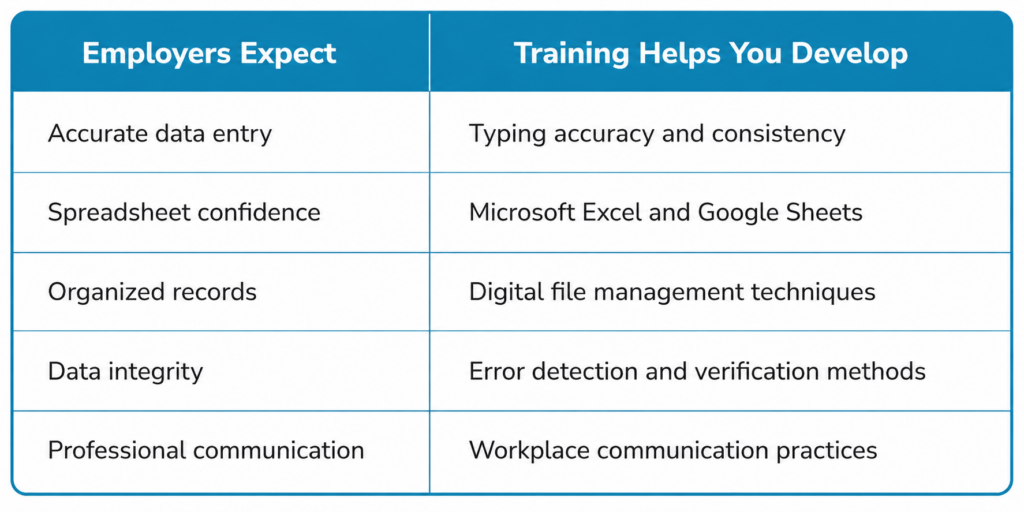
As your skills improve, you’ll be better prepared to contribute to office operations from your first day on the job.
Conclusion
The skills employers look for in Data Entry Administrators go well beyond fast typing. Accuracy, attention to detail, technical proficiency, organization, and communication all play an important role in supporting efficient day-to-day business operations.
Building these skills through Data Entry Administrator Training can help you feel more confident, meet workplace expectations, and stand out when applying for administrative roles. The stronger your skill set, the better prepared you’ll be for today’s digital work environment.
If you’re ready to take the next step, use the insights from this guide to identify your strengths, improve any skill gaps, and continue developing the abilities employers value most. Small improvements today can make a meaningful difference to your future career opportunities.
FAQs
The most important skills include typing speed, accuracy, attention to detail, time management, Microsoft Excel, database management, file organization, communication, problem-solving, and confidentiality.
While requirements vary, many employers look for typing speeds of 50–70 words per minute combined with 98–99% accuracy.
Data Entry Administrator know Microsoft Excel, Microsoft Word, Google Sheets, Google Workspace, database management systems, and cloud storage platforms are among the most commonly used tools.
Yes. Many training programs are designed for beginners and gradually introduce essential technical and workplace skills needed for entry-level administrative roles.
In most workplaces, yes. Fast typing is beneficial, but consistently accurate work is often more valuable because it reduces errors and improves overall efficiency.
Training can strengthen your technical knowledge, improve workplace skills, and help you demonstrate the competencies employers expect when recruiting Data Entry Administrators.
Learn More





Get a FREE Course
- Learn useful skills online free
- Get CPD accredited certificate
- Add it to your CV today!