

The front desk can change in seconds. A receptionist may be helping a visitor when the phone starts ringing, a colleague asks for a message, and a client calls with an urgent request. When several demands arrive together, even a capable receptionist can make avoidable mistakes.
That is where receptionist skills are really tested. Knowing the right skill is one thing; using it well under pressure is another. A rushed response, missed detail or poor decision can quickly affect a client, appointment or colleague.
Receptionists in Canada handle calls, visitors, messages, appointments and everyday office tasks across many workplaces. Understanding common receptionist skills mistakes can help new receptionists build stronger habits and help experienced staff improve the way they handle busy situations.
Table of Contents
Office Skills & Receptionist Course
Develop essential office and receptionist skills, including communication, customer service, administration, organisation, telephone handling, appointment scheduling, and professional workplace practices to support efficient daily office operations.
What Are the Most Common Receptionist Skills Mistakes?
Common receptionist mistakes include not listening carefully, trying to multitask instead of prioritizing, rushing, losing track of information, handling difficult clients defensively, using office technology carelessly, trying to solve issues outside the role and following routines too rigidly.
These mistakes may seem minor, but they can affect appointments, messages, client experiences and the wider office.
Canadian Job Bank identifies active listening, oral comprehension, oral expression, reading comprehension, social perceptiveness and coordinating among the competencies associated with receptionists.
The eight mistakes to watch for
The most useful mistakes to focus on are:
1. Not actively listening and making assumptions
2.Trying to multitask instead of prioritizing
3.Rushing and sacrificing accuracy
4.Handling difficult or angry clients defensively
5.Losing track of messages, appointments and follow-ups
6.Using office technology carelessly
7.Trying to solve problems outside your role
8.Following scripts or routines without adapting
Why small receptionist mistakes can become bigger problems
Consider a simple example.
A caller gives a receptionist an appointment date and asks for a change. The receptionist is distracted, records the wrong date and passes the information along without confirming it.
The result may be a missed appointment, an unnecessary follow-up call and a frustrated client.
The original mistake took only a few seconds. Fixing it may take much longer.
That is why preventing small errors matters.
1. Not Actively Listening and Making Assumptions
One of the easiest receptionist mistakes to make is assuming you already know what someone is going to say.
A caller may explain why they are calling, but the receptionist starts preparing an answer before hearing the whole request. A visitor may ask a question, but the receptionist responds to what they think the person meant.
That can create misunderstandings.
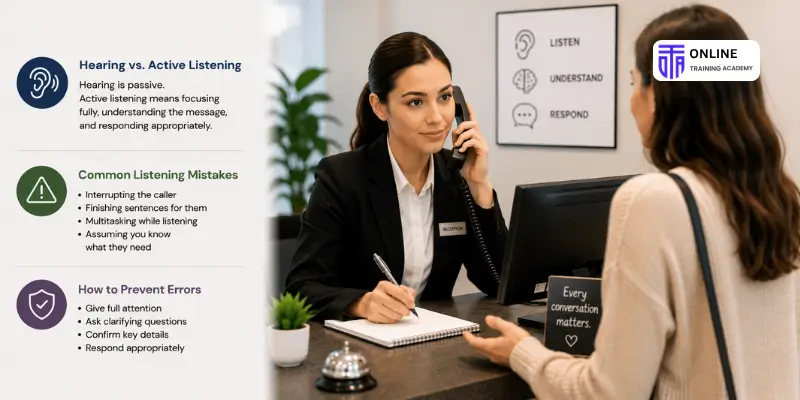
The difference between hearing and active listening
Hearing information is not the same as actively listening to it.
Active listening means paying attention, allowing the person to explain their situation, asking questions when something is unclear and confirming important details.
This matters because receptionist work involves frequent communication. Canadian Job Bank specifically identifies active listening and oral comprehension among receptionist competencies.
Common receptionist listening mistakes
Watch for habits such as:
- Interrupting before someone finishes speaking
- Assuming what a caller needs
- Taking incomplete messages
- Forgetting important names or numbers
- Answering before fully understanding the question
- Failing to clarify unclear information
These habits can make conversations longer rather than shorter because the person may have to repeat themselves.
How to prevent communication errors
A few simple habits can improve accuracy:
Listen → clarify → confirm → respond.
If someone gives a phone number, appointment time or name that matters, repeat it back when appropriate.
For example:
“Just to confirm, you’d like to move the appointment from Tuesday to Thursday?”
That short confirmation can prevent a much bigger problem later.
2. Trying to Multitask Instead of Prioritizing
Receptionists often deal with several demands at once. The mistake is assuming that the best response is to give every task equal attention.
Sometimes, prioritization is more useful than multitasking.
Why multitasking can create receptionist mistakes
Imagine a receptionist is:
- Answering a telephone call
- Greeting a visitor
- Checking an appointment
- Responding to an email
- Trying to remember a message
Switching constantly between tasks increases the chance of missing information.
The issue is not that receptionists should never manage several demands. It is that they need to decide what needs attention first.
Multitasking vs. prioritization
Multitasking means attempting to manage multiple activities at the same time.
Prioritization means deciding:
- What is urgent?
- What affects another person immediately?
- What can wait?
- What should be recorded for later?
- Does someone else need to become involved?
A receptionist who knows how to prioritize can still handle a busy desk without treating every request as an emergency.
What to do when several things need attention
Suppose the phone is ringing while a visitor is waiting.
A receptionist might acknowledge the visitor, answer the call according to workplace procedure, record what is needed and then return attention to the visitor.
The exact approach depends on the workplace, but the principle remains the same: recognize competing demands and make deliberate choices rather than reacting randomly.
3. Rushing and Sacrificing Accuracy
Busy periods can create another common problem: rushing through tasks simply to make the workload disappear.
But faster is not always better.
A receptionist may save ten seconds by skipping a confirmation, only to spend ten minutes correcting the resulting error.
Small errors that can cause bigger problems
Examples include:
- Recording the wrong appointment time
- Misspelling a name
- Writing down the wrong telephone number
- Leaving details out of a message
- Entering information incorrectly
- Filing something in the wrong place
Receptionists handle appointments, messages and other clerical duties, so accuracy matters throughout the working day.
Why busy periods increase the risk of errors
When several people need attention, it can feel tempting to finish each interaction as quickly as possible.
That is exactly when slowing down for a few seconds can help.
Before completing an important task, check whether the information is correct and whether anything still needs to be confirmed.
A simple accuracy check
Before moving on, ask:
- Did I record the right information?
- Did I understand the request?
- Does anything need confirmation?
- Is there a follow-up?
This quick mental check can become a useful habit.
4. Handling Difficult or Angry Clients Defensively

Not every interaction at reception will be easy.
A client may be frustrated about a delay, unhappy about an appointment or upset because they cannot immediately reach the person they want to speak with.
The receptionist does not necessarily control the original problem. However, the way they respond can either calm the situation or make it worse.
Common mistakes during difficult interactions
Some common reactions include:
- Interrupting
- Becoming defensive
- Matching the person's angry tone
- Taking the complaint personally
- Arguing about who is right
- Making promises that cannot be kept
- Saying “that's not my job” without offering a next step
Reception training resources commonly emphasize active listening and handling distressed or angry clients as important parts of reception work.
A better approach: listen, clarify and respond
A calmer approach is:
Listen → acknowledge → clarify → explain → act or escalate.
For example:
“I understand you’re waiting for an update. Let me check what information I can provide and see who can assist you.”
This does not promise something the receptionist cannot control. It simply gives the person a clear next step.
Knowing when to escalate
Receptionists should not be expected to solve every complaint themselves.
If an issue requires a manager, supervisor or another employee with the appropriate authority, escalation may be the correct response.
Asking for help is not a weakness. Sometimes it is the most responsible way to handle a situation.
5. Losing Track of Messages, Appointments and Follow-Ups
Organization problems can be particularly costly at a reception desk.
A receptionist may remember something perfectly when they hear it, but relying on memory becomes risky once several other tasks appear.
Common organization mistakes
These include:
- Forgetting to record a message
- Relying on memory instead of the workplace system
- Failing to update an appointment
- Losing track of a follow-up
- Filing information inconsistently
- Leaving tasks unfinished without recording them
How one missed follow-up can affect the workplace
Imagine a client calls and asks someone to return their call.
The receptionist intends to pass on the message but gets interrupted by a visitor. The message is never recorded.
The client waits.
The employee never receives the information.
Later, someone has to investigate what happened.
The original problem was not necessarily a lack of effort. It was the absence of a reliable system.
Building a simple organization system
Use the systems your workplace provides consistently.
That might include:
- A digital calendar
- Message-taking procedures
- Task lists
- Appointment systems
- Filing systems
- Follow-up reminders
The important thing is not having the most complicated system. It is having a system you actually use.
6. Using Office Technology Carelessly
Technology can make reception work much easier, but it can also create problems when used without enough care.
The mistake is not always “being bad with computers.” Sometimes the problem is rushing, making assumptions or failing to check what was entered.
Common digital and software mistakes
A receptionist might:
- Enter information in the wrong field
- Create an incorrect calendar entry
- Save documents inconsistently
- Send information through the wrong channel
- Ignore system notifications
- Fail to check an update after making it
Receptionist work can involve clerical systems and technology alongside communication and coordination tasks. Canadian Job Bank currently identifies systems analysis, reading comprehension and oral communication among competencies associated with receptionists.
What software tools should a receptionist be comfortable using?
The exact tools vary between employers, but common categories can include:
- Email platforms
- Word-processing software
- Spreadsheets
- Digital calendars
- Appointment-booking systems
- Databases
- Document management systems
- Video meeting platforms
The goal is not to know every program available.
It is to be comfortable learning the systems needed for the job.
What to do when you don't know the system
Do not guess when an incorrect action could affect appointments, records or other important information.
Instead:
1.Check the workplace instructions.
2.Ask an appropriate colleague if needed.
3.Make the required change carefully.
4.Check that the result is correct.
That approach is usually safer than pretending you know how something works.
7. Trying to Solve Problems That Are Outside Your Role
There is a difference between being helpful and trying to handle something you are not responsible for.
A receptionist may feel pressure to provide an immediate answer, especially when someone is waiting.
But guessing can be worse than saying:
“Let me check that for you.”
When should a receptionist handle something independently?
Routine responsibilities may include:
- General enquiries
- Scheduling
- Taking messages
- Directing visitors
- Standard administrative tasks
- Providing approved information
The exact responsibilities depend on the workplace.
When is it better to ask or escalate?
A receptionist should consider asking for assistance when:
- The question requires specialized knowledge
- A decision is outside their authority
- A complaint needs management involvement
- Workplace procedures require escalation
- They are unsure whether information can be provided
Why asking for help can be a strength
Good workplace judgement includes knowing your limits.
Receptionists are part of a wider team. Canadian occupational information describes reception work as involving coordination and interaction with people, rather than working completely independently.
Knowing when to involve someone else can protect accuracy and prevent unnecessary problems.
8. Following Scripts or Routines Without Adapting

Scripts and procedures have a purpose. They can help receptionists provide consistent information and follow workplace standards.
But a script should not replace listening.
When a script becomes a problem
Problems can occur when a receptionist:
- Repeats the same response without addressing the actual question
- Ignores what the caller has already explained
- Sounds dismissive
- Fails to adapt to an unusual situation
- Treats every person as though they need exactly the same response
A standard greeting, for example, is useful. But once the person explains why they are calling, the conversation should respond to their actual need.
Use procedures as a guide, not a substitute for listening
A receptionist can follow required procedures while still communicating naturally.
If a caller needs information that is not covered by the standard response, the receptionist can listen, clarify and find the appropriate next step.
This balance between consistency and judgement is particularly useful in busy workplaces.
Balancing consistency with human communication
A good approach is:
- Follow required procedures
- Keep information accurate
- Listen to the individual
- Adjust your explanation where appropriate
- Know when a standard response is not enough
The aim is not to abandon procedures. It is to use them intelligently.
How Can You Prevent Common Receptionist Skills Mistakes?
Avoiding mistakes is not about expecting yourself to be perfect.
It is about building small habits that reduce preventable errors.
Use the “Pause, Check and Confirm” habit
Before completing an important task:
Pause. Do not rush simply because the desk is busy.
Check. Review the information you have recorded.
Confirm. Clarify anything that could cause confusion.
This is particularly useful for appointments, messages, contact details and other information that someone else will rely on.
Build systems instead of relying on memory
A good system reduces the number of things you need to remember.
Use your workplace’s calendar, task system, message process and filing method consistently.
If something needs follow-up, record it immediately rather than assuming you will remember it later.
Learn from mistakes without repeating them
Making an occasional mistake does not automatically mean you are poor at the job.
The more useful question is:
Why did it happen?
Was the information unclear? Were you interrupted? Did you rely on memory? Did you skip a checking step? Were you unsure about a procedure?
Once you understand the cause, you can change the process.
What Makes a Receptionist Better at Handling Pressure?
Pressure is part of many reception environments, but good performance does not require pretending that pressure does not exist.
Stay calm enough to think clearly
A short pause can prevent a rushed response.
Before reacting, identify what needs immediate attention and what can wait.
Know what can wait
Not every email, filing task or administrative request is urgent.
Prioritizing helps protect accuracy when the front desk becomes busy.
Know when to ask for support
If the workload becomes difficult to manage or an issue falls outside your responsibilities, asking for support may be the right decision.
The strongest receptionists are not necessarily those who handle everything alone. They know how to use the people and systems around them.
Receptionist Skills Mistakes Beginners Should Watch Most Closely

If you are new to reception work, you do not need to master everything at once.
Start by paying close attention to three areas.
Communication mistakes
Focus on:
- Listening before responding
- Asking when something is unclear
- Confirming important details
- Taking complete messages
Active listening is especially relevant to receptionist work in Canada, where Job Bank lists it among the occupation’s core competencies.
Organization and accuracy mistakes
Avoid:
- Relying on memory
- Forgetting follow-ups
- Rushing through entries
- Leaving information incomplete
Build dependable habits early.
Confidence and judgement mistakes
Do not feel that you need to know everything immediately.
It is better to ask an appropriate question than provide incorrect information with confidence.
Likewise, do not assume that following a routine means every situation should receive exactly the same response.
Conclusion
Receptionist mistakes rarely happen because someone does not care about doing a good job. More often, they happen when useful skills break down under pressure.
A receptionist may know that communication matters but still make assumptions. They may value organization but rely on memory during a busy afternoon. They may want to help a frustrated client but become defensive. They may be confident with technology but rush through an important entry.
The solution is not perfection. It is building better habits: listen, prioritize, check, record, adapt and ask when necessary.
FAQs
Common receptionist mistakes include poor listening, making assumptions, weak prioritization, rushing, losing track of messages or appointments, handling difficult clients defensively, using technology carelessly and failing to ask for help when needed.
Stay calm, listen without unnecessary interruption, acknowledge the concern, clarify what the person needs and explain what you can realistically do. If the issue requires someone else, follow the workplace’s escalation process.
Prioritize rather than trying to give every task equal attention. Consider urgency, the needs of people waiting and workplace procedures, while recording tasks that can safely be completed later.
Listen carefully, record important information immediately, confirm names, numbers or dates when appropriate and review the message before passing it on.
Avoid guessing. Check the appropriate information or refer the question to someone who is authorized and able to answer it.
Practise active listening, clear phone communication, concise email writing and accurate message-taking. Asking clarifying questions and confirming important information can also improve communication accuracy.
Receptionists often need to manage competing demands, but trying to do everything simultaneously can increase errors. Effective prioritization, organization and task management are usually more useful than simply attempting to multitask constantly.
Learn More




Get a FREE Course
- Learn useful skills online free
- Get CPD accredited certificate
- Add it to your CV today!