
One cleaning contractor loses a million-dollar healthcare tender because their proposal lacks proof of certified pathogen-control management. Another wins it easily. The difference isn’t company size or equipment budget—it’s specialized, high-level knowledge.
In today’s commercial spaces, professional cleaning is no longer just about mops and basic sanitation. It is a complex, data-driven discipline governed by biological safety standards, strict chemical compliance, and high-level operational leadership.
This is precisely where a Level 5 Certificate in Cleaning changes the game. Built for supervisors, facility managers, and ambitious business owners, this credential bridges the gap between manual labor and strategic facility management. But with so many programs claiming to be the best, picking the right one can feel like navigating a minefield.
This comprehensive guide cuts through the marketing fluff to help you evaluate, select, and enroll in a program that actually moves your career or business forward.
Table of Contents
Level 5 Certificate in Cleaning
Level 5 Certificate in Cleaning teaches professional cleaning techniques, safe chemical handling, housekeeping, and effective cleaning of homes, kitchens, bathrooms, offices, and external areas using industry-standard equipment and practices.
What Is a Level 5 Cleaning Program and How Do You Choose One?
Choosing the right Level 5 Certificate in Cleaning program comes down to aligning a course’s curriculum with your specific career milestones. It ensures the training pairs advanced technical cleaning science with rigorous leadership and regulatory training.
Defining the Scope and Academic Weight of Level 5 Qualifications
Level 5 sits squarely on the higher tier of vocational and professional education frameworks, roughly equivalent to a foundation degree or an advanced vocational diploma.
➽Beyond Execution: Unlike entry-level courses that teach you how to clean a specific surface, a Level 5 qualification shifts the lens entirely to high-level auditing, quality assurance, and risk management.
➽Trust Signals: Earning this credential acts as an instant trust signal. Corporate boards, government procurement officers, and hospital compliance teams recognize Level 5 holders as professionals capable of managing enterprise-level sanitation risks.
➽Strategic Focus: It moves your professional identity from an operational worker to an administrative facility strategist.
Who Needs a Level 5 Certificate?
This level of education is built for specific industry professionals looking to scale their impact:
➽Facility supervisors ready to transition into senior operations management roles overseeing budgets, multi-site compliance, and large teams.
➽Independent cleaning business owners aiming to break out of residential or basic office contracts to secure high-margin corporate, industrial, or medical sectors.
➽Health, safety, and environmental (HSE) professionals wanting to master sanitation compliance, infection control, and chemical safety protocols.
Core Pillars to Evaluate in Any Level 5 Program
When evaluating potential courses, look past flashy brochure designs and assess them against core structural pillars:
➽Theory-to-Practice Balance: Does the course balance management theory with actionable, real-world application?
➽Modern Industry Alignment: Does the syllabus address contemporary disruptions like smart-building cleaning tech, IoT chemical monitoring, and evolving green building standards?
➽Scalability: Are the management frameworks taught applicable to both small teams and enterprise-level operations?
Critical Curriculum Evaluation: What Should a High-Caliber Program Cover?
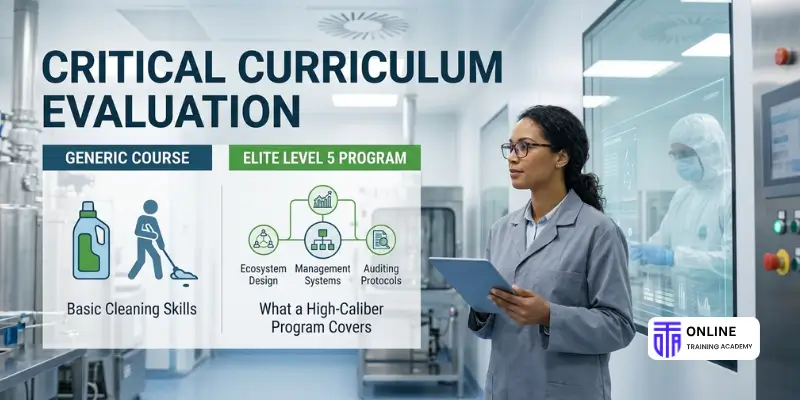
A generic course teaches you how to clean a room. An elite Level 5 program teaches you how to design, manage, and audit an entire contamination-control ecosystem. Here are the core curriculum blocks you should demand from any program.
Advanced Infection Prevention and Biohazard Management
Modern commercial cleaning requires a deep understanding of microbiology and public health protection. Your training must cover rigorous medical-grade protocols.
➽Pathogen Control: Mastery of hospital-grade disinfection, bloodborne pathogen safety, and proven chain-of-infection breaking strategies.
➽Scientific Validation: Instruction on using ATP (adenosine triphosphate) bioluminescence testing to scientifically validate surface cleanliness rather than relying on visual checks.
➽Specialized Containment: Syllabus coverage of hazardous waste containment, post-construction cleanup, and specialized trauma scene procedures.
Sustainable Green Practices and Environmental Compliance
Environmental regulations are tightening globally, and clients increasingly demand eco-friendly facility management. A top-tier program must address modern ecological standards.
➽Eco-Chemical Mastery: Transitioning facilities to zero-VOC chemicals, advanced microfiber systems, and water-efficient cleaning technology.
➽Building Certifications: Understanding LEED (Leadership in Energy and Environmental Design) building standards and how cleaning programs impact green building ratings.
➽Lifecycle Analysis: Conducting lifecycle analyses of cleaning equipment to systematically shrink corporate environmental footprints.
Facility Operations, Industrial Equipment, and Smart Technology
The days of manual oversight are fading. Level 5 programs must prepare you to manage advanced facility ecosystems.
➽Automated Fleets: Managing automated floor care fleets, IoT-enabled chemical dispensers, and heavy-duty asset maintenance.
➽Resource Optimization: Utilizing labor forecasting and resource allocation software to run efficient, profitable teams.
➽SOP Generation: Drafting watertight Standard Operating Procedures (SOPs) for high-risk environments like data centers, pharmaceutical labs, or food processing plants.
Accreditation, Recognition, and Industry Credibility: Separating Gold Standards from Diploma Mills
Not all certificates carry the same weight. Enrolling in an unaccredited course can mean wasting hard-earned money on a piece of paper that corporate procurement teams and tender boards will completely ignore.
Verifying Governing Body Approvals and National Frameworks
Before paying tuition, check the administrative backing of the course provider.
➽National Framework Validation: Look for validation by legitimate national qualification authorities (such as Ofqual in the UK, NZQA in New Zealand, or equivalent regional qualification frameworks).
➽ISO Standard Alignment: Confirm whether the syllabus aligns with recognized ISO standards for quality management and occupational health, such as ISO 9001 and ISO 45001.
Employer Recognition and Real-World Market Value
An accredited certificate means nothing if the local market doesn’t respect it.
➽Alumni Placement: Research graduate placement histories and active industry partnerships tied to the training provider.
➽Corporate Buy-In: Assess whether major facility management companies actively look for this specific qualification during hiring cycles or contract evaluations.
Instructor Expertise: Learning from Industry Veterans vs. Theorists
Classroom theory is important, but nothing compares to real-world experience.
➽Industry Trenches: The best programs are led by instructors who have spent decades in facility management, commercial cleaning entrepreneurship, and health consultancy.
➽Active Portfolios: Review faculty credentials, active consultancy backgrounds, and real-world project portfolios before committing to a program.
Delivery Models and Support Systems: Balancing Professional Life with Advanced Study
Level 5 programs demand dedication, and since most students are working professionals, the delivery structure determines whether you finish the course or burn out halfway through.
Synchronous vs. Asynchronous Online Learning Flexibility
Life doesn’t stop because you enrolled in a course.
➽Pacing Options: Evaluate whether the program offers self-paced asynchronous modules or requires strict synchronous attendance for live lectures.
➽LMS Accessibility: Ensure the digital learning management system (LMS) runs smoothly across all devices, allowing you to study on a tablet during your commute or a desktop at your office.
Practical Assessment Methods and Hands-On Validation
Because cleaning is inherently practical, online or hybrid programs must utilize smart assessment methods.
➽Performance Audits: Look for courses that use video submissions of workplace audits, scenario-based case studies, and real-world site assessments.
➽Formative Feedback: Prioritize programs offering continuous, constructive feedback from instructors over high-stress, memorization-heavy final exams.
Mentorship, Peer Networks, and Dedicated Student Support
Studying at an advanced level can occasionally hit roadblocks when complex regulatory questions pop up.
➽Direct Access: Check if the program provides direct access to expert tutors for complex regulatory or technical queries.
➽Peer Collaboration: Look for opportunities to build a powerful network with fellow facility managers and cleaning entrepreneurs through interactive student forums and study pods.
Financial Investment and Return on Investment (ROI): Is a Level 5 Program Worth It?
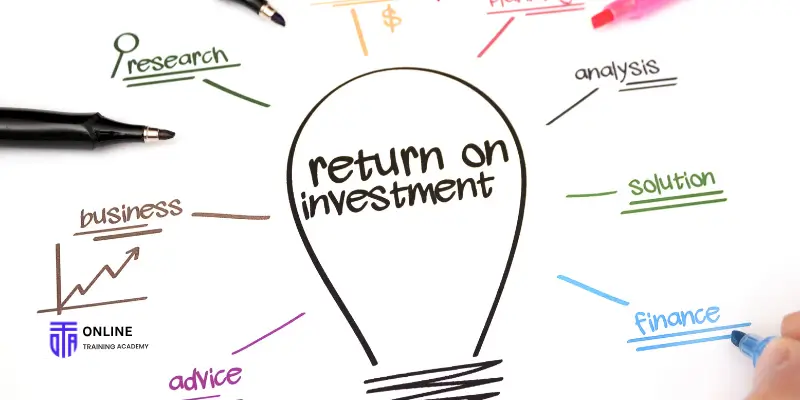
Investing time and tuition into an advanced certificate requires a clear path toward financial payback and long-term career growth.
Analyzing Upfront Costs vs. Long-Term Career Earnings
View your course fee as a strategic business investment rather than an ordinary expense.
➽Salary Scaling: Balance upfront costs against potential salary bumps for senior management roles or higher profit margins on enterprise commercial contracts.
➽Financial Aid: Investigate employer sponsorship opportunities, flexible monthly payment plans, and professional development grants that make tuition easier to manage.
➽The ROI Calculation: Earning a Level 5 certificate often unlocks contracts or promotions that yield a financial return 5 to 10 times higher than the initial course fee within the first year alone.
Avoiding Common Pitfalls When Choosing a Cleaning Course
Keep specific red flags on your radar during your search:
➽Hidden exam or certification fees revealed only after enrollment.
➽Outdated study materials that reference obsolete chemical safety regulations.
➽Zero tutor support or automated-only responses to technical queries.
➽A total lack of verified, independent student reviews or alumni success stories.
➽Note: Choosing the cheapest course almost always backfires, costing you significantly more in missed career opportunities down the road.
Leveraging Your Certification for Promotions or Contract Bids
Once you graduate, you need to market your achievement effectively to reap the rewards.
➽Profile Optimization: Update your resume, LinkedIn profile, and business portfolio to showcase your Level 5 status front and center.
➽Tender Advantage: Use your new credentials to build immediate trust and authority during client pitch meetings and RFP (Request for Proposal) submissions. Explicitly detailing your certified status gives your proposals a massive competitive edge over non-certified competitors
Specialized Industry Verticals: High-Margin Niches Unlocked by Level 5 Expertise
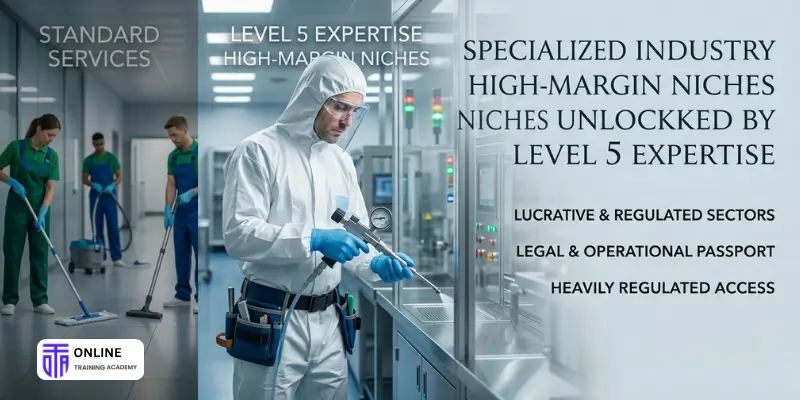
A Level 5 certificate doesn’t just look good on a resume. It acts as a specialized passport to lucrative, heavily regulated sectors that standard cleaning crews are legally or operationally barred from entering.
Healthcare and Clinical Environments (Hospitals, Clinics, and Aged Care)
Healthcare-associated infections (HAIs) cost healthcare systems billions annually, making clinical sanitation a matter of life and death.
➽Strict Regulatory Compliance: Hospitals demand cleaning partners who understand clinical governance, infection transmission chains, and medical waste legislation.
➽Advanced Validation: Your Level 5 training equips you to implement ATP testing protocols and microbial auditing that hospital risk committees require before signing vendor contracts.
➽Vulnerable Population Protection: Managing sanitation in aged care facilities requires specialized care protocols that prioritize immune-compromised residents over standard commercial speed.
Sensitive Technology and Data Center Facilities
Data centers and server farms house multi-million-dollar technology infrastructure where a single speck of dust or improper chemical usage can cause catastrophic hardware failure.
➽Electrostatic Discharge (ESD) Safety: Level 5 training teaches you how to manage anti-static flooring systems and specialized cleaning agents that prevent electronic damage.
➽Sub-Micron Particulate Control: Understanding cleanroom standards and air-handling interactions during cleaning operations.
➽High-Security Clearances: Positioning your business to pass rigorous security vetting required for tech campuses and financial server rooms.
Food Processing and Pharmaceutical Manufacturing
In environments where consumable products or medicines are manufactured, sanitation is legally bound to strict public health codes.
➽HACCP Frameworks: Mastering Hazard Analysis Critical Control Point (HACCP) principles to prevent biological, chemical, and physical food contamination.
➽Audit-Ready Documentation: Being able to write, maintain, and present flawless sanitation logs that satisfy government health inspectors during surprise audits.
➽Cross-Contamination Prevention: Designing physical zoning and workflow layouts that separate raw production areas from sterilized zones..
Conclusion
Choosing the right Level 5 Certificate in Cleaning program is a strategic career move, not just a checkbox exercise. By prioritizing rigorous curricula, recognized accreditation, and real-world applicability, you position yourself at the forefront of modern sanitation and facility management.
The cleaning industry has quietly transformed into a high-stakes science of safety and operational excellence. You can stay stuck competing in a crowded, low-margin race to the bottom, or you can arm yourself with the right Level 5 credential and step up as the industry authority clients trust.
Ready to Take Your Cleaning Career to the Next Level?
Stop guessing which course is right for your goals. Click here to explore our industry-leading Level 5 Certificate in Cleaning program, download our full syllabus, and schedule a free strategy session with one of our expert advisors today!
FAQs
Most programs look for a foundational background in cleaning operations (such as a Level 2 or Level 3 certificate) or proven supervisory experience within the janitorial or facility management sector.
Depending on your schedule and whether you study part-time, completion generally takes between 6 to 18 months through flexible online modules.
Yes, as long as the institution holds proper national accreditation and enforces strict assessment standards, online delivery is widely accepted by modern employers.
While Levels 2 and 3 focus on technical execution and hands-on safety, Level 5 shifts the focus entirely to leadership, strategic planning, budgeting, regulatory compliance, and system auditing.
Definitely. The curriculum dives deep into compliance, tendering, operational management, and safety protocols—everything required to scale a profitable commercial cleaning enterprise.
Look out for providers offering career counseling, alumni networking opportunities, resource libraries, and ongoing access to updated regulatory modules.
Learn More



Get a FREE Course
- Learn useful skills online free
- Get CPD accredited certificate
- Add it to your CV today!