


A small accounting error rarely feels serious at first. A receipt goes missing, a personal purchase lands on the business credit card, or GST/HST collected from customers gets spent because it looks like available cash. The problem is that these small oversights can quietly build into bigger issues by tax time.
For Canadian small businesses, accurate Canadian Tax Accounting is about more than filing a tax return. It means keeping reliable records, tracking income and expenses correctly, handling GST/HST properly, and staying on top of payroll and other tax responsibilities throughout the year.
In this guide, we’ll look at the most common tax accounting mistakes small businesses make, why they matter, and practical ways to prevent or correct them before they become costly problems.
Table of Contents
Canadian Tax Accounting
Canadian Tax Accounting covers the principles of tax preparation, financial reporting, deductions, compliance, and effective tax planning to help individuals and businesses manage their Canadian tax responsibilities accurately.
What Are the Most Common Canadian Tax Accounting Mistakes Small Businesses Make?
The most common mistakes include mixing personal and business finances, falling behind on bookkeeping, failing to record all business income, incorrectly classifying expenses, mishandling GST/HST, keeping incomplete records, and misunderstanding payroll or worker-classification responsibilities.
What makes these mistakes particularly troublesome is that they can work in two directions.
Some can create compliance problems, such as incorrect filings, interest or penalties. Others can cause a business to pay more tax than necessary because legitimate expenses or other amounts were not properly recorded or supported.
It also helps to distinguish three related terms:
➽ Bookkeeping mistake: A transaction is missing, duplicated or recorded incorrectly.
➽ Accounting mistake: Financial information is classified, reconciled or presented incorrectly.
➽ Tax mistake: Incorrect accounting information affects a tax return, deduction, GST/HST obligation or other tax responsibility.
For example, imagine a business owner pays for a legitimate business expense but never records it. That starts as a bookkeeping problem. If the expense is still missing when the tax return is prepared, it may become a tax issue because the business’s taxable income could be overstated.
The lesson is simple: tax accuracy starts with everyday financial accuracy.
Which Bookkeeping Mistakes Can Create Canadian Tax Problems?
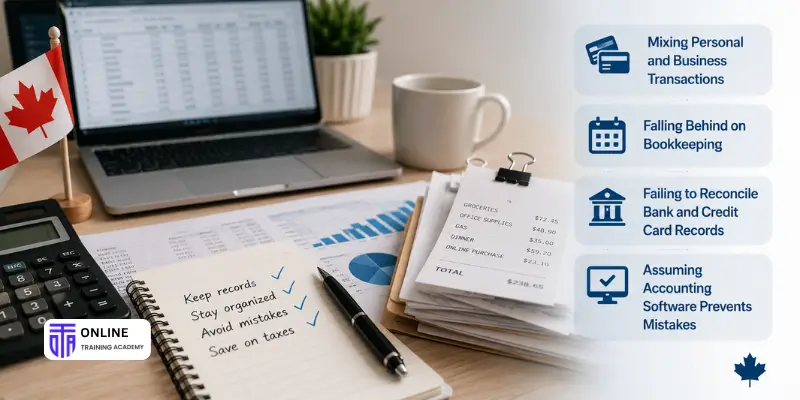
Mixing Personal and Business Transactions
One of the most common problems for small businesses is using the same accounts for personal and business spending.
A business owner might buy office supplies with a business credit card, then use the same card for groceries or a family purchase. Later, when the books are reviewed, it becomes difficult to determine which transactions genuinely relate to the business.
This can lead to:
- Incorrect expense claims
- More time spent reviewing transactions
- Confusion over GST/HST
- Poor financial reporting
- Difficulty determining the actual cost of running the business
Separate business banking and credit-card accounts make the process much easier. They do not eliminate the need to review transactions, but they create a much cleaner starting point.
Falling Behind on Bookkeeping
Another common mistake is leaving months of bookkeeping until tax season.
It may seem efficient to “deal with everything later,” but reconstructing an entire year’s transactions increases the chance of missing something.
Receipts may have disappeared. Customer payments may be difficult to match with invoices. Business and personal purchases may become harder to distinguish. Small discrepancies can also accumulate without being noticed.
A monthly review is usually much easier than a year-end rescue project.
You do not necessarily need a complicated system. A regular routine of recording transactions, reconciling accounts and reviewing unusual items can prevent a large backlog from developing.
Failing to Reconcile Bank and Credit Card Records
Your accounting software showing a balance does not automatically mean the books are correct.
Reconciliation compares your accounting records with external records such as bank and credit-card statements. It can uncover:
- Missing transactions
- Duplicate entries
- Incorrect amounts
- Unrecorded fees
- Timing differences
- Unexplained withdrawals or deposits
This is particularly important for businesses with a high volume of transactions.
A monthly reconciliation gives you a chance to investigate discrepancies while the transactions are still easy to remember.
Assuming Accounting Software Prevents Mistakes
Accounting software can make bookkeeping faster, but it cannot replace judgment.
If an owner selects the wrong category, uses an incorrect GST/HST setting or enters incomplete information, the software can faithfully preserve the mistake.
Automation is useful for repetitive work. It is not a substitute for reviewing unusual transactions and understanding what the numbers represent.
What Canadian Tax Mistakes Can Affect Income, Expenses and Deductions?
Forgetting to Record All Business Income
Businesses do not always receive income through one obvious channel.
Depending on the business, revenue could come through:
- Bank transfers
- Credit and debit card payments
- Online payment platforms
- Cash
- E-commerce platforms
- Invoiced customers
- Other business payment systems
A common mistake is assuming that the deposits visible in one bank account represent the complete picture.
Business income should be tracked against appropriate sales and accounting records so that the business can identify what it actually earned.
The bigger lesson is not simply “remember your income.” It is to build a process where sales records, invoices and financial accounts can be compared.
Claiming Personal Expenses as Business Expenses
A business owner may occasionally use something for both personal and business purposes. That does not automatically make the entire cost a business expense.
For example, consider a vehicle used to visit clients but also for family errands. Or a home internet connection used for both business and personal activities.
The business-related portion needs to be supported appropriately.
The same principle applies to other mixed-use expenses. If a transaction is partly personal, the accounting records should reflect that rather than simply treating the full amount as a business expense.
Misclassifying Current and Capital Expenses
Not every business purchase should be treated the same way.
A recurring operating expense and a long-term business asset can have different tax treatment. The Canada Revenue Agency distinguishes current expenses from capital expenses, with capital expenditures generally relating to assets that provide a lasting benefit to the business.
Consider the difference between:
- Printer paper and office supplies
- Routine maintenance
- Computer equipment
- Major equipment purchases
- Significant improvements to business property
Treating a large asset as an ordinary day-to-day expense without considering its proper classification can create inaccurate financial and tax records.
When a purchase is unusual, expensive or expected to benefit the business for several years, it is worth checking its appropriate treatment rather than assuming it belongs in a standard expense category.
Assuming Every Business Meal Is Fully Deductible
A business meal can be a legitimate business expense, but that does not necessarily mean the entire bill is deductible.
The CRA generally limits the deduction for eligible food, beverage and entertainment expenses to 50% of the lesser of the amount incurred and an amount that is reasonable in the circumstances, subject to applicable exceptions.
That makes documentation important.
A business owner should retain the receipt and enough information to explain the business purpose of the expense. Simply writing “business meal” on a transaction months later may not provide the same level of useful documentation as maintaining the details when the expense occurs.
What GST/HST Accounting Mistakes Should Canadian Small Businesses Avoid?
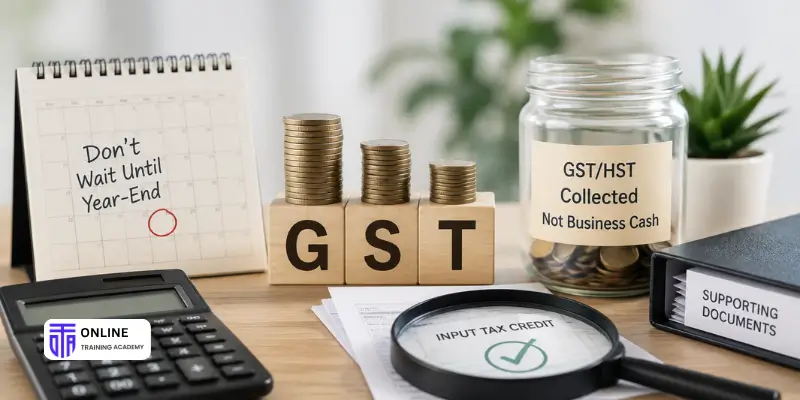
GST/HST is an area where a small misunderstanding can become a significant accounting problem.
Waiting Until Year-End to Think About GST/HST Registration
For most businesses, the CRA’s small-supplier threshold is $30,000 in taxable supplies, but determining when registration becomes necessary is not as simple as checking annual revenue on December 31.
The rules consider taxable supplies over particular periods, including a single calendar quarter and four consecutive calendar quarters.
That means a business should monitor taxable revenue throughout the year.
For example, a business owner might think:
“I’m under $30,000 for the year, so I don’t need to worry about GST/HST.”
That conclusion may not be correct if the business exceeded the applicable threshold during a relevant period.
Monitoring revenue regularly makes it easier to identify when registration requirements may apply.
Treating GST/HST Collected as Business Cash
This is one of the most practical mistakes for a growing business.
Suppose a customer pays $1,130 on an invoice consisting of $1,000 in taxable sales and $130 in GST/HST. Seeing $1,130 arrive in the bank account can make it tempting to treat the whole amount as business money available for spending.
But the tax collected is not simply additional operating revenue.
If a business spends the tax collected and later needs to remit it, the owner may suddenly face a cash-flow problem.
A better approach is to track GST/HST separately and avoid treating collected sales tax as though it were ordinary business income.
Losing Track of Input Tax Credits
GST/HST paid on eligible business purchases may be recoverable through input tax credits, provided the applicable requirements are met.
But that depends on accurate records.
If receipts are missing, GST/HST amounts are not properly identified, or purchases are incorrectly classified, the business may have difficulty supporting its claims.
This is another reason why “I’ll organize the receipts at year-end” is not always a good system.
Missing Filing or Remittance Responsibilities
GST/HST filing periods vary between businesses.
The important point is not to rely on a generic tax calendar found online. Business owners should know their own assigned filing frequency and payment obligations and record those dates in their financial calendar.
A missed remittance can become a much bigger issue when it is discovered late.
What Recordkeeping and Payroll Mistakes Can Put a Small Business at Risk?
Keeping Receipts Without Keeping Useful Supporting Records
“Keep your receipts” is good advice, but it is incomplete.
A useful recordkeeping system should help answer questions such as:
- What was purchased?
- When was it purchased?
- How much did it cost?
- Was GST/HST charged?
- How was it paid?
- What was the business purpose?
- Was the expense entirely business-related?
The CRA generally expects businesses to retain records for six years from the end of the relevant tax year, although specific circumstances can affect how long records must be kept.
The goal is not simply to accumulate files. It is to maintain records that allow the business to support its income, expenses and tax reporting.
Claiming Vehicle Expenses Without Tracking Business Use
Vehicle expenses can become complicated when a vehicle is used for both business and personal purposes.
Suppose a vehicle travels 20,000 kilometres during a year, but only 8,000 kilometres relate to business activities.
The owner should have records that support the business-use portion rather than automatically claiming all vehicle costs as business expenses.
A mileage log can help establish:
- Total kilometres
- Business kilometres
- Dates of business travel
- Destinations or purposes where appropriate
The more clearly the business and personal use can be distinguished, the easier it is to support the relevant expenses.
Assuming Anyone Who Invoices You Is Automatically a Contractor
A person sending your business an invoice does not automatically settle the question of whether they are self-employed.
Worker classification can affect obligations related to CPP, EI and income-tax deductions.
The CRA looks at the actual working relationship when determining whether someone is an employee or self-employed. Factors can include the degree of control, ownership of tools, financial risk and other elements of the relationship.
This matters because incorrectly treating an employee as a contractor can create significant problems later.
If the classification is genuinely unclear, a business should not rely solely on the wording of a contract or the fact that the worker has a business number.
Treating Payroll as Just Another Business Expense
Payroll is more than recording wages as an expense.
Businesses with employees may have responsibilities involving:
- Income-tax deductions
- CPP contributions
- EI premiums
- Remittances
- Payroll records
- Year-end reporting
Remittance deadlines can also vary according to the employer’s remitter type.
For example, regular remitters generally remit source deductions by the 15th of the following month, while eligible small employers may have different remittance schedules.
The safest approach is to know the business’s specific remitter requirements rather than relying on memory.
What Should You Do If Your Small Business Has Already Made a Tax Accounting Mistake?
Finding an error does not mean the business should panic—or quietly ignore it.
The first step is to understand what actually happened.
Step 1: Reconstruct the Transaction History
Gather the original information:
- Bank statements
- Credit-card statements
- Invoices
- Receipts
- Payment records
- Payroll information
- GST/HST records
- Accounting reports
Avoid changing historical records simply to make the numbers appear correct. Start with the original evidence and determine what the transaction actually was.
Step 2: Identify What the Error Affects
Ask whether the mistake affects:
- Business income
- Expenses
- GST/HST
- Payroll
- A previous tax return
- Financial statements
- Supporting documentation
Not every bookkeeping error creates a tax error.
A duplicated transaction, for example, may first need to be corrected in the books. A missed income amount could potentially affect a previous filing.
Step 3: Correct the Accounting Records Properly
Once the facts are clear, correct the underlying accounting records and keep supporting documentation for the adjustment.
Do not simply delete transactions because they are inconvenient.
A clean audit trail is more useful than a set of books that has been altered without explanation.
When Should You Get Accounting or Tax Help?
Consider getting appropriate help when an issue involves significant amounts, previous tax filings, GST/HST registration, employee versus contractor classification, payroll problems, complex transactions or uncertainty about how a correction should be reported.
The goal is not to outsource every financial task.
It is to recognize when an error has moved beyond a simple bookkeeping correction.
How Can Canadian Small Businesses Prevent Tax Accounting Mistakes All Year?

The most effective approach is not waiting for tax season.
Create a simple monthly routine.
A Monthly Canadian Tax Accounting Check
- 1. Reconcile bank accounts and credit cards
Make sure transactions recorded in the books agree with the statements.
2.Review income
Compare invoices, sales records, payment platforms and deposits.
3. Review expenses
Check unusual transactions and confirm that personal expenses have not been mixed into business deductions.
4. Review GST/HST
Check tax collected, eligible purchases and upcoming filing or remittance obligations.
5. Review payroll
Confirm deductions and remittances are being handled according to the business’s schedule.
6. Investigate unusual transactions
Large equipment purchases, loans, owner withdrawals, vehicle costs and mixed-use expenses deserve closer attention.
7. Back up financial records
A reliable backup system reduces the risk of losing important supporting documents.
Create a “Before You File” Review
Before submitting a tax return or relevant tax filing, review the bigger picture.
- Is all business income recorded?
- Are major expenses supported?
- Are personal and business transactions separated?
- Have bank and credit-card accounts been reconciled?
- Has GST/HST been reviewed?
- Are payroll records complete?
- Are unusual transactions properly classified?
- Can the business explain the numbers if asked?
This short review can catch problems that routine data entry may miss.
Remember That Good Accounting Is Also About Knowing Your Business
Tax compliance is only one reason to keep accurate financial records.
Reliable accounting can also show:
- Whether sales are actually growing
- Which expenses are increasing
- How much cash is available
- Whether customers are paying on time
- Which parts of the business are profitable
- Where spending needs attention
In other words, Canadian Tax Accounting is not simply something to deal with when a tax deadline approaches. It can become part of how a small business understands and manages itself.
Conclusion
Good Tax Accounting Starts Before Tax Season
Most small-business tax accounting problems start with simple oversights: a missing receipt, an unrecorded payment, a personal purchase on a business card, or GST/HST treated as regular cash.
The best defence is consistency. Keep business and personal finances separate, record income and expenses accurately, reconcile accounts regularly, and stay on top of GST/HST, payroll and supporting records. If a mistake has already happened, address it early rather than letting it grow.
Good tax accounting doesn’t need to be complicated. It just needs to keep your records telling the same story as your business. The best time to catch a mistake is before tax season—not when the return is already due.
FAQs
Common mistakes include mixing personal and business finances, failing to record all income, claiming unsupported expenses, mishandling GST/HST, falling behind on bookkeeping, keeping incomplete records and misunderstanding payroll or worker-classification requirements.
Business income generally needs to be accurately reported. Failing to report income can lead to an incorrect tax return and potentially additional tax, interest or penalties. Businesses should keep records that allow income to be properly identified and reconciled.
The CRA generally requires business records and supporting documents to be kept for six years from the end of the relevant tax year, although particular circumstances can affect the applicable retention period.
For most businesses, the small-supplier threshold is $30,000 in taxable supplies. However, the rules consider taxable supplies over specific periods, including a single calendar quarter and four consecutive calendar quarters, so businesses should monitor revenue throughout the year.
Personal expenses should not simply be treated as business deductions. An expense generally needs to meet the applicable requirements for business expenses, and mixed personal/business costs may need to be divided appropriately.
Worker classification can affect CPP, EI and income-tax obligations. The CRA considers the actual working relationship rather than relying solely on the label used in a contract or the fact that a worker submits invoices.
In many situations, an error can be corrected, but the appropriate process depends on what went wrong and whether it affected a tax return, GST/HST filing, payroll remittance or other obligation. Businesses should determine the correct correction process rather than simply changing historical records without documentation.
Learn More





Get a FREE Course
- Learn useful skills online free
- Get CPD accredited certificate
- Add it to your CV today!