


A career in tax accounting is often pictured as a desk, a calculator and a stack of tax returns. That picture is incomplete. In Canada, tax accounting can involve researching tax rules, reviewing financial information, working with accounting technology, solving unusual problems and explaining complex information to clients or business leaders.
That variety is one reason Canadian Tax Accounting offers several possible career directions. Someone can begin in an entry-level accounting or tax role and later move into corporate tax, GST/HST, tax advisory, management or another specialized area.
But is tax accounting a good career in Canada? What skills do employers actually want? Do you need a CPA? How much can you earn, and what does the job outlook look like? This guide answers those questions while giving you a realistic picture of where a Canadian tax accounting career can lead.
Table of Contents
Canadian Tax Accounting
Canadian Tax Accounting covers the principles of tax preparation, financial reporting, deductions, compliance, and effective tax planning to help individuals and businesses manage their Canadian tax responsibilities accurately.
Is Canadian Tax Accounting a Good Career Choice?
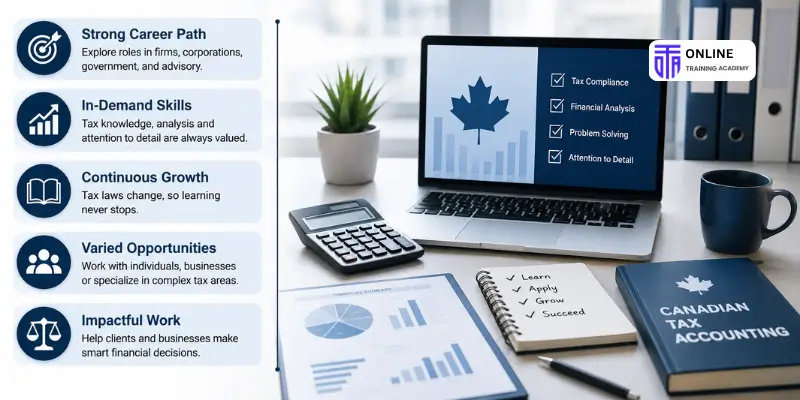
Canadian Tax Accounting can be a strong career option for people who enjoy working with financial information, solving problems and keeping up with rules and regulations. It can also provide several directions for career development rather than locking someone into one type of work.
Tax accounting sits at the intersection of accounting, taxation, analysis and business decision-making. Depending on the role, you might prepare or review tax information, research tax issues, analyse financial records, support compliance work or help a business understand the tax implications of a decision.
It is also worth looking beyond salary when deciding whether the field suits you. Tax accounting can involve deadline-driven periods, detailed documentation and ongoing learning. Canadian tax rules change, technology continues to reshape accounting work, and employers expect accuracy.
What Makes Tax Accounting Different From General Accounting?
General accounting covers a wide range of work, including financial reporting, bookkeeping, auditing and management accounting.
Tax accounting focuses more specifically on tax-related work, such as preparing tax information, reviewing transactions, researching tax treatment and supporting compliance. Bookkeeping is generally centred on recording and organizing financial transactions.
The roles can overlap, but they are not the same. Titles such as Tax Accountant, Tax Analyst, Tax Associate and Tax Specialist can also carry different responsibilities depending on the employer.
Who Is Likely to Enjoy a Tax Accounting Career?
Tax accounting may suit people who like:
- Working with numbers and financial information
- Investigating discrepancies
- Solving structured problems
- Understanding rules and applying them to real situations
- Organizing detailed information
- Explaining complicated topics clearly
- Learning continuously
It can be less appealing to someone who strongly dislikes detailed documentation, deadlines or work that requires regular updates as rules and technology change.
That balance is worth considering before choosing a career path.
What Roles Can You Pursue in Canadian Tax Accounting?
One of the biggest misconceptions about tax accounting is that it represents one specific job.
In reality, there can be a progression from entry-level positions to specialist and management roles, although job titles and responsibilities vary between employers.
Entry-Level Tax Accounting Roles
People entering the field may encounter positions such as:
- Tax Assistant
- Tax Preparer
- Junior Accountant
- Accounting Assistant
- Tax Associate
Early responsibilities may include organizing financial records, entering or reviewing information, supporting tax preparation, checking documentation and assisting more experienced accounting staff.
These roles can be useful for building familiarity with Canadian tax concepts and accounting systems.
The goal at this stage is not necessarily to know everything. It is to develop accuracy, understand how financial information flows through a business and learn how tax work is actually completed.
Intermediate Tax Accounting Roles
With experience, opportunities can expand into positions such as:
- Tax Accountant
- Tax Analyst
- Intermediate Accountant
- Senior Tax Associate
The work may become less about simply following instructions and more about analysing information, handling files independently, researching tax questions and communicating with clients or colleagues.
This is often where specialization begins to become clearer.
Someone may discover that they particularly enjoy corporate tax, GST/HST, personal tax, tax compliance or another area.
Senior and Specialist Tax Accounting Roles
Experienced professionals can move toward roles such as:
- Senior Tax Accountant
- Tax Specialist
- Tax Advisor
- Tax Manager
- Corporate Tax Manager
At this level, the work can involve more complex tax matters, review responsibilities, client relationships, planning, research and team leadership.
Not every person follows the same progression. Some remain highly technical specialists, while others move into management or broader advisory roles.
Where Can Tax Accounting Professionals Work?
Canadian tax accounting careers can exist across several environments.
Public accounting firms can provide exposure to multiple clients and industries. The work can be varied, although some periods of the year may be particularly busy.
Corporate or industry tax departments allow professionals to focus more deeply on one organization and understand how taxation connects with its operations and financial decisions.
Government offers another direction, including work connected with tax administration, regulation and public-sector financial responsibilities.
Independent practice can appeal to experienced professionals who want to build their own client base and business.
The right environment depends on the type of work, career progression and working style a person prefers.
What Skills Do Canadian Tax Accounting Employers Look For?
Saying that accountants need to be “good with numbers” does not tell a job seeker very much.
The modern tax accounting skill set is broader.
Technical Skills for Canadian Tax Accounting
A strong foundation can include knowledge of:
- Canadian tax principles
- Accounting fundamentals
- Tax return preparation
- Financial statements
- GST/HST concepts
- Tax documentation
- Tax research
- GST/HST concepts
- Accounting software
- Spreadsheet analysis
The exact requirements depend on the role.
Someone working in a corporate tax position may need a different depth of knowledge from someone supporting personal tax preparation.
The important point is that technical knowledge needs to be connected to actual financial information.
Analytical and Problem-Solving Skills
Tax accounting is rarely just a matter of entering a number into a box.
Imagine a business transaction that does not fit neatly into the usual pattern. The tax accountant may need to determine what happened, review the supporting information, consider the relevant rules and identify the appropriate treatment.
That requires analytical thinking.
Useful abilities include:
- Identifying discrepancies
- Reviewing financial information
- Recognizing unusual transactions
- Applying tax rules to specific circumstances
- Comparing possible treatments
- Investigating inconsistencies
- Making reasoned decisions
The ability to ask “Does this make sense?” can be just as valuable as the ability to calculate a figure.
Communication Skills Matter More Than Many Beginners Expect
Tax professionals do not work with numbers in isolation.
They may need to explain an issue to a business owner who does not have an accounting background, answer questions from a client, discuss an issue with a manager or communicate with other professionals.
A technically correct answer that nobody understands is not particularly helpful.
Clear communication means being able to explain:
- What the issue is
- Why it matters
- What information is needed
- What options may exist
- What the next step should be
This is one reason strong tax accountants combine technical knowledge with plain-language communication.
Digital Skills and Technology Awareness
Technology has become a normal part of accounting work.
Candidates may encounter:
- Excel and other spreadsheet tools
- Accounting software
- Digital document management
- Automated workflows
- Data analysis tools
- Tax software
- AI-assisted tools
Government of Canada Job Bank competency information for accountants includes areas such as digital literacy, numeracy, monitoring, evaluation, problem solving and systems analysis.
That reflects an important change in the profession: accountants increasingly need to understand both financial information and the systems used to process it.
Do You Need a CPA to Build a Career in Canadian Tax Accounting?
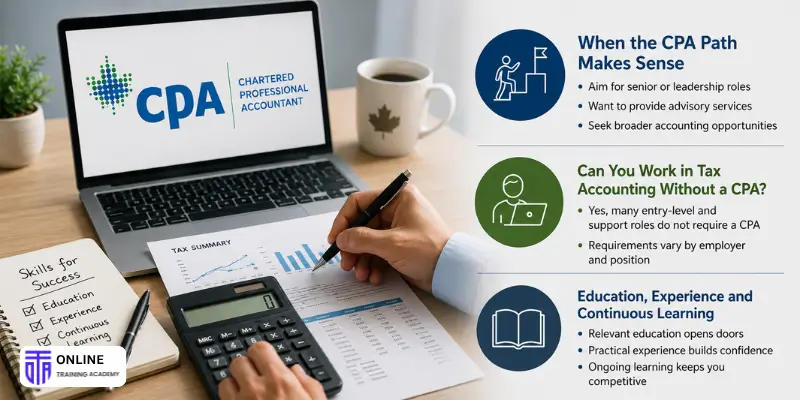
This is one of the most common questions from people considering the field.
The answer depends on the career you want.
The Chartered Professional Accountant (CPA) designation is an important professional pathway in Canada and can be particularly relevant to people aiming for broader accounting responsibilities, senior positions, advisory work or leadership.
However, it would be misleading to suggest that every tax-related job requires a CPA.
Entry-level tax preparation, accounting support and some other tax-related positions may have different educational and experience requirements depending on the employer.
When the CPA Path Makes Sense
The CPA route can make sense for someone who wants to build a long-term accounting career with opportunities to move into more senior or specialized positions.
It provides a structured professional pathway involving education, professional development and relevant experience.
Anyone considering the designation should review the current requirements through the appropriate Canadian CPA organization because requirements and pathways can change.
Can You Work in Tax Accounting Without a CPA?
Yes, depending on the position.
Some tax and accounting roles have requirements based on education, experience and technical ability rather than requiring the CPA designation.
This means someone interested in Canadian Tax Accounting does not necessarily need to make one large career decision on day one.
They can begin by developing relevant knowledge and experience, then determine whether pursuing a professional designation aligns with their long-term goals.
Education, Experience and Continuous Learning
Credentials matter, but they are only part of the picture.
Tax accounting is a field where continued learning is important because rules, technology and business practices change.
A strong career foundation can combine:
Relevant education + Canadian tax knowledge + experience + technology skills + continuous learning.
How Much Do Tax Accountants Earn in Canada?
Salary is one of the first questions people ask when researching a career, but one national figure can be misleading.
Government of Canada Job Bank places tax accountants within the broader Financial auditors and accountants — NOC 11100 occupational group. Its current national wage data reports a median of approximately $40.36 per hour, with wages varying substantially across the lower and upper ends of the occupational range.
That figure should not be interpreted as a guaranteed tax accountant salary. The occupational group includes a broader range of accounting and auditing roles.
Why Experience and Role Affect Salary
A person’s earning potential can be influenced by:
- Level of responsibility
- Years of experience
- Employer
- Industry
- Location
- Specialization
- Credentials
- Management responsibilities
An entry-level tax position and an experienced tax manager are obviously not comparable roles.
Similarly, someone specializing in a complex area of taxation may have a different compensation profile from someone working in an entry-level compliance position.
Salary Differences Across Canadian Provinces
Location also matters.
Current Job Bank wage information shows differences between provinces. For example, the reported median wage for the broader occupational group is currently around $40.87 per hour in Ontario, $43.27 in Alberta and $40.00 in British Columbia.
These figures should be treated as labour-market indicators rather than promises of what an individual tax accountant will earn.
When comparing opportunities, salary should be considered alongside living costs, career progression, employer, responsibilities and opportunities to develop specialized expertise.
What Is the Job Outlook for Canadian Tax Accounting Careers?
It is tempting to describe accounting as a career that is simply “always in demand.”
The Canadian labour-market data gives us a more useful and nuanced picture.
Government of Canada Job Bank currently assesses the national 2024–2033 outlook for the broader Financial Auditors and Accountants occupational group as broadly balanced between labour demand and labour supply.
That does not mean every accounting specialization or every Canadian city has the same prospects.
What Canada's Labour-Market Data Says
Job Bank’s current outlook for 2025–2027 varies by province.
For example, the outlook is currently rated Moderate in Ontario, Alberta and British Columbia, while some provinces have Good or Limited outlooks.
This matters because someone choosing where to study or work should not assume that Canadian job prospects are identical from coast to coast.
Why the Outlook Can Differ by Province
Regional opportunities can be influenced by:
- Population
- Business activity
- Industry concentration
- Number of employers
- Accounting and professional-services firms
- Local economic conditions
For a job seeker, this means location can be part of career strategy.
Rather than asking only, “Are tax accountants in demand?”, a better question is:
“Where are the opportunities, which roles are hiring, and which skills do those employers need?”
What Could Strengthen Your Position in the Job Market?
Candidates can improve their competitiveness by developing a combination of technical and transferable skills.
Canadian tax knowledge is valuable, but so are:
- Excel and digital skills
- Accounting software experience
- Communication
- Analytical thinking
- Problem-solving
- Relevant experience
- Specialized tax knowledge
- Professional credentials where appropriate
The more complex the work becomes, the less useful it is to rely on one skill alone.
How Is AI and Technology Changing Canadian Tax Accounting Careers?

This is one of the most important questions for anyone entering Canadian Tax Accounting in 2026.
AI and automation are already changing how financial information is processed. Tasks that once required extensive manual effort can increasingly be supported by software.
Which Tax Accounting Tasks Are Becoming More Automated?
Automation can assist with areas such as:
- Data entry
- Document processing
- Transaction categorization
- Routine calculations
- Repetitive reporting
- Workflow management
- Information extraction
That does not necessarily mean the profession disappears.
It means the mix of work can change.
What Still Requires Human Judgment?
Consider a complicated transaction with incomplete information.
Software may identify the relevant documents or calculate figures, but someone still needs to ask:
Is the information complete?
Does the treatment make sense?
Are there unusual circumstances?
What rules apply?
Can the conclusion be explained and supported?
These questions require judgment, context and accountability.
Tax professionals also need to communicate findings and understand the business situation behind the numbers.
The Tax Accountant of the Future Needs Both Tax and Technology Skills
The strongest candidates may not be those who compete with technology.
They may be the ones who know how to work with it.
That means understanding digital tools while also knowing when their output needs to be checked.
For someone starting a career, this creates an opportunity rather than simply a threat.
Learning Canadian tax fundamentals alongside Excel, accounting software, data analysis and responsible AI use can create a broader skill set.
What Does Career Progression Look Like in Canadian Tax Accounting?
A career in tax accounting can develop in several directions.
A simplified progression might look like:
Entry-level → Tax Accountant/Analyst → Senior → Specialist or Manager → Leadership
The exact path varies by employer.
Building Experience in the First Few Years
Early career experience can help develop:
- Accuracy
- Canadian tax knowledge
- Accounting processes
- Software familiarity
- Client communication
- Deadline management
- Financial analysis
This is also the stage when people often discover which areas of tax accounting interest them most.
Choosing a Tax Specialization
Potential areas include:
- Personal tax
- Corporate tax
- GST/HST
- Tax compliance
- Tax research
- Tax advisory
- International and cross-border tax
You do not necessarily need to choose a specialization immediately.
Early experience can help you understand which type of work suits your interests and strengths.
Moving Into Senior, Advisory or Management Roles
As responsibilities increase, the work may shift from completing individual tasks toward:
- Reviewing work
- Handling complex files
- Managing client relationships
- Researching difficult tax issues
- Supervising team members
- Advising businesses
- Supporting strategic decisions
This is where communication and judgment can become increasingly important.
How Can You Start a Canadian Tax Accounting Career With Little Experience?
Not everyone begins with years of accounting experience.
Students, recent graduates and career changers can build relevant skills before landing a long-term tax accounting position.
Build a Foundation in Canadian Tax Accounting
Start by understanding Canadian terminology and basic concepts.
Useful areas include:
- Canadian tax fundamentals
- Accounting principles
- GST/HST
- Financial records
- Tax documentation
- Tax-related calculations
- Basic financial statements
The aim is to understand how the pieces fit together rather than memorizing isolated terms.
Develop Skills Employers Can Actually See
Rather than simply writing “strong Excel skills” on a résumé, show how you used the skill.
For example:
Weak:
“Excellent Excel skills.”
Stronger:
“Used Excel to organize financial data, reconcile transactions and identify discrepancies.”
The second statement gives an employer something concrete to evaluate.
The same principle applies to communication, accounting software and analytical skills.
Consider Entry-Level and Related Roles
Depending on employer requirements, relevant starting points may include:
- Junior accounting roles
- Accounting support
- Tax preparation
- Bookkeeping
- Accounts-related administrative roles
- Tax assistant positions
These positions can help candidates develop familiarity with financial records, accounting systems and Canadian workplace expectations.
Make Your Résumé Evidence-Based
Avoid filling a résumé with broad statements such as:
- Hardworking
- Good with numbers
- Detail-oriented
- Fast learner
Instead, connect skills to evidence.
For example:
“Reviewed transaction records and identified discrepancies during a simulated accounting project.”
That gives the employer a clearer idea of what you can actually do.
Is Canadian Tax Accounting a Good Career for the Future?

There is no single answer for every person.
Canadian Tax Accounting can offer a structured career path, opportunities for specialization and work across public practice, corporations and government. It also combines technical knowledge with analytical and communication skills.
But it is not a career that stands still.
Tax rules change. Technology changes. Employers’ expectations change. The work itself can change as automation takes over more routine processes.
Reasons to Consider the Career
You may find the field appealing if you want:
- A structured accounting career
- Multiple specialization options
- Transferable financial skills
- Opportunities to work in different organizations
- A career combining numbers and problem-solving
- Opportunities to develop alongside technology
What You Should Be Comfortable With
You should also be prepared for:
- Detailed work
- Deadlines
- Documentation
- Ongoing learning
- Regulatory changes
- Technology
- Responsibility for accuracy
A realistic career decision considers both sides.
Who May Not Enjoy It?
Someone who strongly dislikes detailed records, rules, numerical analysis or deadline-driven work may find certain tax-accounting positions frustrating.
On the other hand, someone who enjoys solving structured problems and understanding why numbers look the way they do may find the field rewarding.
Conclusion
Build a Career That Can Adapt With Tax Accounting
Canadian Tax Accounting offers more than one fixed career path. It can lead from entry-level tax and accounting roles into specialist, advisory, corporate, government or management positions.
Success requires more than numerical ability. Strong candidates combine Canadian tax knowledge with analytical thinking, communication, digital literacy and sound judgment. While CPA credentials can support certain career paths, they are not mandatory for every tax-related role.
The profession is changing with technology, but that also creates opportunities for people who keep developing their skills. The strongest tax accounting career may not belong to the person who knows the most formulas, but to the person who can understand the rules, question the numbers, use technology wisely and explain the answer clearly.
FAQs
Canadian Tax Accounting Careers
A tax accountant may prepare and review tax-related information, analyse financial records, research tax issues, support compliance activities and help clients or organizations understand tax matters. Responsibilities vary by employer and level of experience.
The pathway can involve relevant education, accounting and Canadian tax knowledge, practical experience and, for certain career directions, professional credentials such as the CPA designation. Requirements vary by position and employer.
Not every tax-related position requires a CPA. Some entry-level and support roles have different education and experience requirements. The CPA pathway can be particularly relevant for people pursuing broader accounting, senior tax, advisory or leadership careers.
Government of Canada Job Bank reports wage information for the broader Financial Auditors and Accountants occupational group. Current national wage data shows a median of about $40.36 per hour, but actual tax-accounting salaries vary according to role, experience, location, employer and specialization.
The current national Job Bank outlook for the broader Financial Auditors and Accountants occupational group is broadly balanced over 2024–2033. However, prospects vary by province, employer and specialization, so job seekers should consider local labour-market conditions.
Important skills include Canadian tax knowledge, accounting fundamentals, analytical thinking, problem-solving, communication, digital literacy, spreadsheet ability, attention to detail and the ability to research and interpret financial information.
AI and automation are likely to reduce some repetitive accounting tasks, but tax accounting also involves interpretation, judgment, communication and reviewing complex situations. The profession is more likely to change than simply disappear, making technology skills increasingly valuable.
Learn More





Get a FREE Course
- Learn useful skills online free
- Get CPD accredited certificate
- Add it to your CV today!