


A client walks into your office or accesses your platform. They provide a government-issued photo ID, a proof of address, and perhaps a business registration document. On the surface, the file looks perfect. It’s “complete.” You feel a sense of relief—another customer onboarded.
But then, the red flags appear. The funds for their transaction originate from an opaque offshore structure that doesn’t align with their stated occupation. Or, perhaps their transaction volume suddenly triples overnight, with no corresponding change in their business operations. You realize that your “complete” file is, in fact, a vulnerability.
This is the reality of Anti-Money Laundering (AML) compliance in Canada. Many businesses—from boutique accounting firms and law offices to rapidly growing fintech startups—fall into the trap of believing that Know Your Customer (KYC) is merely a document-collection exercise. In reality, under the Proceeds of Crime (Money Laundering) and Terrorist Financing Act (PCMLTFA), KYC and Customer Due Diligence (CDD) are not just administrative hurdles; they are your front-line defense against being used as a conduit for financial crime.
In Canada, these obligations are overseen by FINTRAC (the Financial Transactions and Reports Analysis Centre of Canada). This guide is designed to help you move beyond “ticking boxes.” We will break down exactly what KYC and CDD look like in the Canadian context, how to move toward a risk-based culture, and why your approach needs to be as dynamic as the risks you face.
1. What is KYC in the Canadian Context?
In Canada, KYC is not a one-time event; it is a fundamental component of your mandatory AML compliance program. If you are a “reporting entity” (such as a financial institution, real estate broker, accountant, lawyer, or money services business), you are legally required to verify the identity of your clients before establishing a business relationship or executing certain high-value transactions.
The Three Pillars of Canadian KYC:
➽ Verification: You must confirm the client is who they say they are using FINTRAC-approved methods. This isn’t just about looking at a driver’s license; it’s about using reliable, independent sources—such as the dual-process method, credit file checks, or government-issued photo ID—to ensure the person exists and matches the information provided.
➽ Beneficial Ownership: This is an area where Canadian regulators are significantly tightening their grip. If you are dealing with a corporation or a trust, you cannot stop at the company name. You must identify the individuals who ultimately own or control 25% or more of the entity. As of recent updates, reporting entities may be required to report material discrepancies if their internal records conflict with federal or provincial corporate databases.
➽ Purpose and Nature: You must understand why the client is seeking your services. What is their expected volume of transactions? What is their occupation or the nature of their principal business? This creates the “baseline” profile that allows your staff to spot abnormalities later in the relationship.
Certificate in Know Your Client (KYC) & Customers Due Diligence (CDD)
Learn the fundamentals of Know Your Client (KYC) and Customer Due Diligence (CDD), including customer identity verification, risk assessment, compliance principles, and effective due diligence practices to support secure and responsible business operations. Gain a clear understanding of key processes used to identify and manage potential compliance risks.
Table of Contents
2. When Does CDD Kick In? The Regulatory Triggers
CDD is not optional, and it cannot be delayed simply for the sake of convenience. Canadian regulations demand that due diligence be applied in the following, strictly defined situations:
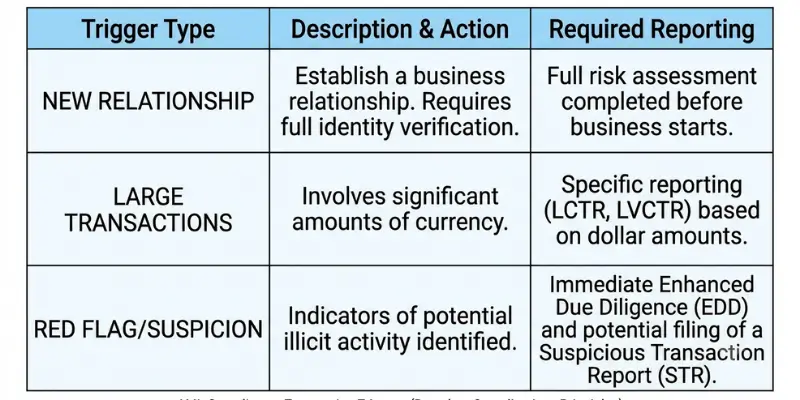
➽ Establishing a Business Relationship: You must complete identity verification before you open an account or provide professional services.
➽ Large Transaction Thresholds: Certain transactions trigger automatic requirements. For example, receiving $10,000 or more in cash or virtual currency, or processing an electronic funds transfer of $1,000 or more, triggers specific reporting obligations.
➽ Suspicion: If you have any knowledge or even a suspicion of money laundering or terrorist financing, you must apply full CDD measures, regardless of the transaction size.
➽ Data Doubt: If you suspect that the identification data you previously collected is no longer accurate or reliable, you are obligated to refresh those records. Firms cannot rely on historic checks indefinitely. If a long-standing client’s activity changes significantly, or new risk factors emerge, updated due diligence is required.
3. The "Risk-Based Approach": Tailoring Your Defense
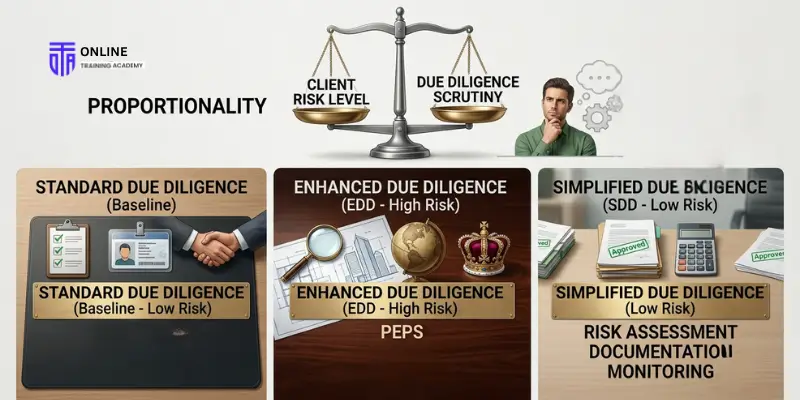
Canadian law does not mandate an identical approach for every client. Instead, it mandates a risk-based approach (RBA). This means your level of scrutiny must be proportionate to the risk the client poses.
Standard Due Diligence
For most low-risk clients, standard measures suffice: identity verification, beneficial ownership checks, and a clear understanding of the business relationship. This is your baseline.
Enhanced Due Diligence (EDD)
➽ Politically Exposed Persons (PEPs): Individuals who hold influential public positions or their close associates.
➽ High-Risk Jurisdictions: Clients operating in countries known for weak AML controls or high levels of corruption.
➽ Complex Structures: Clients using layered corporate entities, trusts, or offshore shell companies that make it difficult to identify the true controller.
EDD isn’t just about asking for more documents. It involves deeper research into the Source of Funds (SoF) and Source of Wealth (SoW). You need to be able to answer: Is it reasonable for this person to have this amount of money based on their stated occupation? If the answer is “no,” you must investigate further and document your findings.
Simplified Due Diligence (SDD)
You can reduce the depth of your checks, but only if you have a documented risk assessment proving the client is genuinely low-risk. You cannot apply SDD simply because a client is a “nice person” or a long-time acquaintance. The decision must be based on a documented risk assessment, not an assumption. Even with SDD, you must still monitor the relationship. SDD reduces the depth; it does not remove the obligation.
4. Ongoing Monitoring and Record-Keeping
Compliance does not end at the “onboarding” stage. Once a client is in your system, you are obligated to monitor them continuously.
Monitoring for Deviations
You must periodically review transactions to ensure they align with the profile you built at onboarding. If a client who claimed to be a small-town retailer suddenly starts receiving massive international wires, your system should flag it. Monitoring intensity should reflect the customer’s risk rating; higher-risk relationships require more frequent review and deeper scrutiny.
Record-Keeping Obligations
FINTRAC expects you to keep records for at least five years from the end of the business relationship or the date of an occasional transaction. This includes:
- Copies of identity verification documents.
- Beneficial ownership information.
- Risk assessments and due diligence notes.
- Transaction records.
The 30-Day Rule is critical: records must be organized in a way that allows you to provide them to FINTRAC within 30 days of a request. If your records are scattered across various email threads, personal folders, or desk drawers, you will fail that test. Documentation serves two purposes: it allows you to reconstruct transactions if requested, and it provides evidence to regulators that your due diligence was conducted properly. Poor documentation is one of the most common weaknesses identified in regulatory reviews.
5. AML for Small Canadian Businesses

“We’re too small to be a target” is the most dangerous myth in AML compliance. Criminals often target smaller firms precisely because they assume these firms lack sophisticated monitoring tools and have “looser” processes.
If you are a small business, focus on these five pillars:
1.Risk Assessment: Conduct and maintain a documented firm-wide risk assessment. You must know your firm’s specific vulnerabilities.
2.Policies and Procedures: Implement written AML policies and procedures tailored to your services. “Informality” is not a defense; even if you are a team of three, roles and responsibilities must be defined.
3.Appoint a Compliance Officer: Even in a small firm, one person must be ultimately responsible for the compliance program. They must understand the PCMLTFA and ensure that policies are actually being followed.
4.Training: Staff training is non-negotiable. Your team needs to know what a “red flag” looks like, as they are your first line of defense.
5.Clear Reporting Lines: Establish clear internal reporting lines so that concerns can be escalated to the compliance officer promptly.
6. Common Weaknesses: Why Firms Fail Audits
Regulatory inspections across Canada frequently identify recurring weaknesses in due diligence processes. These issues often arise from over-simplification rather than deliberate non-compliance.
Common problems include:
➽ Over-reliance on automated tools: Relying solely on electronic verification without asking if the customer’s activity makes commercial sense.
➽ Failing to look “Behind the Curtain”: Inadequate verification of beneficial ownership, particularly where ownership structures are layered or overseas.
➽ One-Size-Fits-All Risk Ratings: Applying identical risk ratings to all clients without performing an individual assessment.
➽ Lack of Justification: Failing to record the reasoning behind enhanced due diligence decisions. Regulators want to see the “why,” not just the “what.”
Effective compliance depends less on the volume of documents you collect and more on the judgement you apply to those documents, supported by rigorous documentation.
Quick Reference: The "Big Three" Triggers
Conclusion: Compliance as a Competitive Advantage
KYC and CDD are often viewed as “business killers”—administrative hurdles that slow down the deal. But viewed through a different lens, they are a hallmark of a professional, trustworthy organization.
Strong due diligence prevents your firm from being used to facilitate crime. It saves you from the devastating reputational damage and the heavy administrative fines associated with a FINTRAC enforcement action. It is the bedrock upon which you build a reputation for integrity in the Canadian marketplace.
Don’t settle for a “tick-box” culture. Build a compliance program that understands the who, the how, and the why of your clients. By focusing on quality over volume, you aren’t just meeting a legal requirement—you are protecting your business and contributing to the security and integrity of the entire Canadian financial system.
FAQs
KYC is a component of CDD. CDD is the broader framework that includes identity verification, beneficial ownership checks, risk assessment, and the continuous monitoring of the relationship.
EDD is required whenever higher risk is identified—such as the involvement of Politically Exposed Persons (PEPs), connections to high-risk jurisdictions, or the presence of unusually complex ownership structures.
Yes. While FINTRAC acknowledges that controls should be proportionate to the scale and complexity of the business, the underlying legal obligation remains identical regardless of firm size.
Only in limited, exceptional circumstances where a delay would interrupt normal business operations, and provided that the risk is effectively managed and verification is finalized as soon as possible. Any such delay must be documented and justified.
There is no fixed “expiry date” for customer info. Updates should be based on the customer’s risk level, significant changes in their business activity, or “trigger events” (e.g., a client changing their corporate structure).
Learn More





Get a FREE Course
- Learn useful skills online free
- Get CPD accredited certificate
- Add it to your CV today!