

A client wants to complete a property purchase quickly. Funds arrive from multiple overseas accounts. The buyer avoids face-to-face meetings and becomes defensive when asked for additional documents. Nothing appears obviously illegal. Yet this is exactly how many money laundering cases begin.
In the UK, AML compliance is built on one central principle: identify risk early and act before criminal property enters the system. The law does not expect businesses to eliminate all risk. It requires them to understand it, assess it, and control it.
This article explains the four core AML risk categories under UK regulations, the most common red flags, and how firms are expected to document and manage risk in practice.
AML Risk Categories and Red Flags in the UK
AML risk categories and red flags in the UK help organisations identify potential money laundering activities. Understanding customer, geographic, product, and transaction risks enables businesses to recognise suspicious behaviour and apply appropriate measures to support compliance and reduce financial crime risks.
Table of Contents
What Are the 4 Core AML Risk Categories in the UK?
Under the UK’s risk-based approach, businesses must assess exposure across four primary categories. These categories form the backbone of a firm-wide risk assessment.
1. Customer Risk
Customer risk relates to who you are dealing with. Certain characteristics increase the likelihood that funds may represent criminal property.
Examples include:
- Politically exposed persons (PEPs)
- Complex or opaque ownership structures
- Adverse media or regulatory history
- Reluctance to provide identification documents
- Unusual urgency or secrecy
High customer risk does not automatically prohibit a business relationship. It requires enhanced due diligence and stronger monitoring.
2. Geographic Risk
Geographic risk considers where funds originate, where customers are based, and where transactions flow.
Risk indicators include:
- Jurisdictions subject to UK financial sanctions
- Countries with weak AML controls
- Regions associated with corruption or organised crime
- Unusual routing of funds through multiple countries
Firms must stay aware of sanctions lists and high-risk country designations. Geographic exposure can transform an otherwise low-risk transaction into a high-risk one.
3. Product and Service Risk
Some products and services carry inherent vulnerability to abuse.
Higher-risk characteristics include:
- Services that enable anonymity
- High-value asset transactions (property, luxury goods)
- Rapid movement of funds
- Complex corporate structures
- Cash-intensive business models
For example, estate agency work often carries elevated risk because property can integrate illicit funds into legitimate markets.
4. Transaction and Delivery Channel Risk
The way a transaction is conducted can increase exposure.
Red flags include:
- Non-face-to-face onboarding
- Third-party payments without clear explanation
- Rapid fund transfers followed by immediate withdrawal
- Overpayments followed by refund requests
- Unusual changes in transaction pattern
Technology has increased convenience, but it has also increased opportunities for concealment. Delivery channel risk must be evaluated carefully.
What Are Common AML Red Flags in the UK?
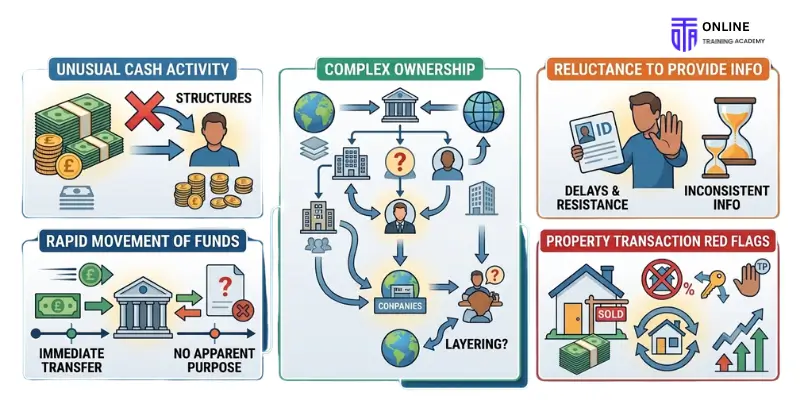
Red flags are warning signs that may indicate potential money laundering. A single red flag does not confirm wrongdoing. However, patterns or combinations require closer scrutiny.
Unusual Cash Activity
- Large cash deposits inconsistent with customer profile
- Frequent small deposits structured to avoid attention
- Cash used in sectors where electronic transfer is standard
Even without a reporting threshold, unusual cash patterns should prompt further questioning.
Complex Ownership Structures
- Companies with layers of shareholders across multiple jurisdictions
- Nominee directors with no clear commercial rationale
- Trust structures lacking transparency
Businesses must identify beneficial owners and understand control structures.
Reluctance to Provide Information
- Delays in submitting identification documents
- Inconsistent explanations
- Aggressive resistance to routine compliance checks
This behaviour alone does not prove wrongdoing, but it elevates risk.
Rapid Movement of Funds
- Funds received and transferred immediately
- No apparent commercial purpose
- Transactions inconsistent with stated business activity
Such patterns may indicate layering — a stage where funds are moved to obscure their origin.
Property Transaction Red Flags
In the UK property sector, warning signs include:
- Purchases made without mortgage financing where buyer profile suggests otherwise
- Repeated buying and selling of property at increasing prices
- Payments made from unrelated third parties
Given the value involved, property remains a preferred channel for integration of criminal funds.
Sector-Specific AML Risk in the UK
Risk exposure is not uniform across the regulated sector. Each industry faces distinct vulnerabilities based on the nature of its services, transaction types, and customer base. Regulators expect firms to understand how criminal property could realistically pass through their specific business model.
Legal and Accountancy Services
Firms providing legal and financial structuring services face elevated risk because they often sit at the entry point to the UK financial system. Higher-risk activities include:
- Company formation and corporate restructuring
- Creation and administration of trusts
- Management of client accounts
- Property conveyancing
- Tax advisory involving complex or offshore arrangements
These services can be misused to layer or integrate criminal proceeds through seemingly legitimate structures. Professionals must go beyond identity checks and understand the commercial rationale behind transactions. A structure that lacks economic purpose, uses nominee shareholders, or involves unexplained overseas funding should trigger enhanced scrutiny.
High-Value Dealers
Businesses that accept large cash payments for goods — such as vehicles, jewellery, precious metals, art, or luxury watches — operate in environments where placement risk is high. Cash can be introduced into the legitimate economy through high-value purchases and later resold to generate “clean” funds.
Key vulnerabilities include:
- Repeated high-value purchases paid in cash
- Customers attempting to split payments across multiple transactions
- Immediate resale of purchased goods
- Third-party payments with no clear connection to the buyer
High-value dealers must apply customer due diligence and maintain records, even if their core business is not financial in nature.
Money Service Businesses and Bureaux de Change
Currency exchange and remittance services are particularly vulnerable due to the speed and volume of transactions. Criminals may use structuring techniques to move funds in smaller amounts across multiple transfers.
Common risk indicators include:
- Multiple transfers just below internal monitoring thresholds
- Frequent transfers to high-risk jurisdictions
- Use of different senders for the same beneficiary
- Rapid currency exchanges without commercial explanation
Given the transactional nature of this sector, robust monitoring systems, clear escalation procedures, and strong staff training are essential. Even short delays in identifying suspicious patterns can allow illicit funds to move beyond recovery.
Understanding sector-specific risk allows firms to tailor controls effectively rather than applying generic compliance measures that fail to address real exposure.
How to Conduct a Firm-Wide AML Risk Assessment
Under the UK Money Laundering Regulations, every regulated business must maintain a written firm-wide risk assessment. This is a legal requirement, not a best practice recommendation. Supervisors expect it to reflect how your business actually operates — not a generic template downloaded online.
A credible risk assessment explains where your exposure lies, how serious it is, and what you are doing about it.
Step 1: Identify Inherent Risk
Start by mapping your exposure across the four core categories:

- Customer risk – PEPs, complex ownership, adverse media, high-net-worth clients with opaque wealth sources
- Geographic risk – customers or funds linked to sanctioned or high-risk jurisdictions
- Product and service risk – high-value transactions, company formation, trust services, client accounts
- Transaction and delivery risk – non-face-to-face onboarding, third-party payments, rapid fund movement
This stage focuses on inherent risk — the level of exposure before controls are applied.
Step 2: Assess Likelihood and Impact
Not all risks are equal. You must evaluate:
- How likely is this risk to occur in your business model?
- What would the impact be if it materialised?
Impact may include regulatory investigation, financial penalty, reputational damage, or criminal liability. A structured scoring system (low, medium, high) helps create consistency and defensibility.
Step 3: Document Mitigating Controls
Next, explain how you reduce identified risks. Controls may include:
- Customer due diligence procedures
- Enhanced due diligence triggers
- Transaction monitoring systems
- Internal reporting lines
- Staff training programmes
- Independent compliance review
Controls must be realistic and operational. If a policy exists but is not applied consistently, regulators will treat the risk as uncontrolled.
Step 4: Determine Residual Risk
Residual risk is the level of risk that remains after controls are applied. Some exposure will always exist. The purpose of the assessment is to show that residual risk is understood, proportionate, and actively managed.
If residual risk remains high in certain areas, you must justify why the business model supports that exposure and what additional safeguards are in place.
Step 5: Obtain Senior Management Approval
The risk assessment must be reviewed and approved at senior management level. This demonstrates governance oversight and accountability. In regulated firms, the board or equivalent leadership body should formally sign off on it. Regulators view AML risk as a governance issue, not merely a compliance function task.
Step 6: Review and Update Regularly
The assessment must be reviewed:
- At least annually
- When launching new services
- When entering new markets
- After regulatory changes
- Following internal compliance failures
An outdated risk assessment weakens the entire AML framework.
Make It a Living Document
A firm-wide risk assessment should influence:
- Written AML policies
- Staff training focus
- Monitoring thresholds
- Internal audit priorities
- Resource allocation
If the document sits unused in a compliance folder, it will not satisfy regulatory expectations. Supervisors assess whether your operational decisions align with the risks you have identified.
A meaningful risk assessment does not eliminate exposure. It demonstrates that your business understands where risk exists and is taking proportionate steps to control it.
How Regulators Evaluate AML Risk Controls
Supervisors such as the Financial Conduct Authority and HM Revenue and Customs assess more than written policies. They evaluate implementation.
They typically review:
- Customer due diligence files
- Evidence of enhanced due diligence
- Suspicious activity reporting procedures
- Staff training records
- Ongoing monitoring systems
- Governance oversight
A well-written policy cannot compensate for poor execution.
When Does a Red Flag Become a Reporting Obligation?
A red flag becomes a reporting obligation when it develops into knowledge or suspicion of money laundering under the Proceeds of Crime Act 2002. The legal test is not proof. It is whether, based on the information available, you suspect that criminal property may be involved.
A red flag on its own may justify further checks. Suspicion arises when the explanation provided does not resolve the concern, or when multiple warning signs point to the same risk.
For example:
- Funds are received from an unexpected third party and the client cannot provide a clear reason.
- The source of wealth is vague, inconsistent, or unsupported by documents.
- The transaction appears unnecessarily complex without commercial logic.
Once suspicion forms, a Suspicious Activity Report must be submitted to the National Crime Agency through your firm’s internal reporting process.
You do not need evidence strong enough to prove a crime. However, you should record why suspicion arose. Clear notes of the facts observed and the reasoning behind your decision protect both the business and the individual employee.
In short, a red flag triggers scrutiny. Suspicion triggers reporting.
Conclusion
AML compliance in the UK is not built on rigid rules alone. It is built on judgement, supported by structured risk assessment. The four core risk categories provide the framework. Red flags provide early warning.
When risk assessment is treated as a genuine control tool — not a regulatory formality — it becomes one of the most effective safeguards against criminal exposure. The cost of ignoring risk is not only regulatory scrutiny. It is reputational damage, operational disruption, and potential criminal liability. Strong AML practice starts with recognising risk before it becomes a reportable suspicion.
FAQs
No. They are indicators that require further review.
No. High risk requires enhanced due diligence. Reporting is required only if knowledge or suspicion arises.
At least annually, and whenever there are significant changes in business model or risk exposure.
Not automatically. It depends on geographic and customer risk factors.
Learn More




Get a FREE Course
- Learn useful skills online free
- Get CPD accredited certificate
- Add it to your CV today!