


The schedule says 9:00 a.m. The day has other plans.
A meeting may run longer than expected. A family may need help with something that was not on the original agenda. A referral may need follow-up, or new information may change what needs attention first.
That is what makes a Family Support Worker role different from a job that follows the same routine every day. The work combines family contact, planning, referrals, communication, documentation and plenty of adaptability.
In Canada, the exact duties depend on the employer, workplace and position. Family Support Workers may work with families through community organisations, social services, schools and other support settings. The day can look very different from one role to another.
Table of Contents
Family Support Worker
The Family Support Worker course develops practical knowledge of supporting families, safeguarding children, child development, health and safety, legislation, family issues, and child protection, including awareness of coronavirus prevention and care.
What Does a Family Support Worker Actually Do During a Typical Day?

There is no single schedule that applies to every Family Support Worker. A typical day may include preparing for meetings, speaking with parents or caregivers, connecting families with services, coordinating with other organisations and completing follow-up work.
The important detail is that not all of the work happens face to face.
Starting the Day: Reviewing Priorities
The day may begin with reviewing appointments, previous notes and outstanding tasks.
Before meeting a family, the worker may need to understand what was discussed previously, check what follow-up is required and prepare any relevant information or resources.
This preparation helps the worker arrive informed rather than starting from scratch.
The First Family Contact Sets the Tone
A meeting might involve discussing a parent’s concerns, reviewing progress, identifying priorities or exploring available support.
The worker’s job is not simply to provide answers. Listening carefully can reveal what the family actually needs and what may be getting in the way.
The conversation may also lead to a different next step than originally planned.
The Work Continues After the Meeting
Once the conversation ends, the worker may need to record important information, update follow-up tasks, contact a service or prepare for another meeting.
So, a family meeting may take one hour, but the work connected to it can continue well beyond that hour.
What Happens Between Family Meetings?
This is the part of the job people often overlook.
A Family Support Worker may spend part of the day working behind the scenes to keep support moving.
Following Up With Services and Agencies
Depending on the role, follow-up may involve contacting community organisations, clarifying referral information or communicating with other people involved in a family’s support.
Canadian occupational information for social and community service workers includes helping clients access resources, coordinating services and working with other agencies.
The goal is not simply to give a family a list of services. It is often about helping them navigate what comes next.
Keeping Documentation Up to Date
Documentation is another regular part of the working day.
A worker may need to record what was discussed, note relevant observations, document actions taken and identify follow-up.
Good documentation should be clear and factual. Instead of writing that a parent was “uncooperative,” for example, it is more useful to record what actually happened and what the parent said.
Preparing for the Next Conversation
Before another appointment, the worker may review previous information, identify outstanding questions and consider what needs attention.
This preparation can make the next conversation more focused and useful.
Why No Two Family Support Worker Days Look Exactly the Same
A planned schedule provides structure, but family support rarely follows a perfect timetable.
When an Appointment Changes
A family may cancel, arrive late or need to discuss something different from what was expected.
The worker may need to reorganise the rest of the day rather than simply moving on to the next task.
When Something Unexpected Takes Priority
New information can change what needs attention first.
A worker may need to pause a lower-priority task, consult the appropriate person or follow an established workplace process.
The ability to adapt matters because being organised does not mean being rigid.
Organisation and Flexibility Work Together
A good schedule helps a worker manage appointments and follow-up. Flexibility allows them to respond when circumstances change.
That balance is a big part of the role.
Where Can a Family Support Worker Spend Their Working Day in Canada?
The workplace can make a noticeable difference to the daily routine.
Community and Social Service Settings
A day may include family meetings, resource navigation, referrals, follow-up and communication with community organisations.
Some work may happen in an office, while other responsibilities may take place within the community, depending on the position.
School-Based Family Support
In a school setting, the worker may communicate with families, support connections between home and school, and help families access appropriate community resources.
The exact responsibilities depend on the school, employer and position.
Outreach and Community-Based Work
Some roles involve meeting people outside a traditional office environment.
This can mean travelling to different locations, attending community meetings or providing support where families are more comfortable accessing services.
Because settings vary, working hours can vary too. Some positions may follow regular daytime schedules, while others can include evenings, weekends or shifts.
Who Does a Family Support Worker Work With?
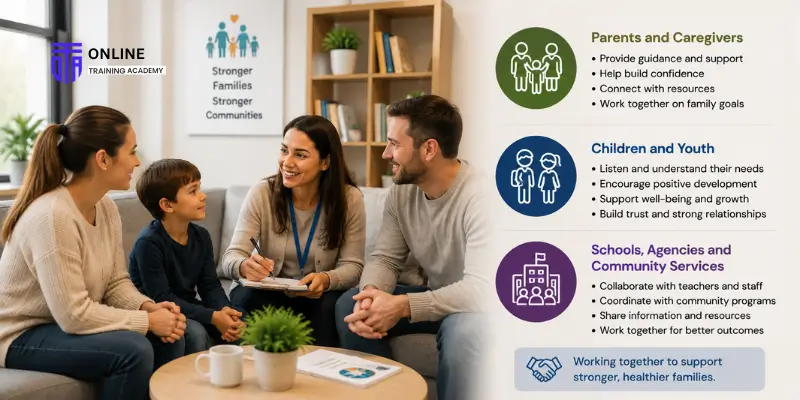
Family support rarely happens in isolation. A Family Support Worker may work directly with parents and caregivers, children and youth, as well as schools, community organisations and other services involved in a family’s support. The exact mix depends on the employer, setting and responsibilities of the role.
Parents and Caregivers
Parents and caregivers are often at the centre of the work. A Family Support Worker may listen to concerns, discuss family goals, identify available resources and help parents understand their options. The focus is on working with the family rather than making every decision for them. This can involve regular conversations, follow-up, referrals and helping parents feel more confident about taking the next step.
Children and Youth
Some Family Support Worker positions also involve direct contact with children or youth. This may include listening to their concerns, observing their needs, supporting communication or helping connect them with appropriate services. Other positions may focus mainly on parents and caregivers, so the amount of direct work with children varies by employer and role.
Schools, Agencies and Community Services
Supporting a family can also mean working alongside other people and organisations. A Family Support Worker may communicate with school staff, community agencies or other service providers when appropriate. Good coordination helps avoid duplicated efforts, keeps support moving and makes it easier for families to understand where to go for additional help.
What Does Supporting a Family Actually Look Like?
“Support” can sound vague until you see what it means in practice.
Helping Families Understand Their Options
A worker may explain available resources, help a family identify possible next steps or provide information that makes a difficult decision easier to understand. The aim is not to make every decision for the family.
Connecting Families With Services
A family may need help finding an appropriate community resource, understanding a referral or following up after an initial connection. The worker can help make that process easier to navigate.
Helping Families Build Confidence
Good support should not create unnecessary dependence. Where appropriate, the worker can help families develop their own ability to find information, use resources and take the next step themselves. That makes the support more sustainable.
The Emotional Reality of a Family Support Worker's Day
The practical tasks are only one part of the job.
Difficult Conversations Are Part of the Work
Family Support Workers may hear frustration, worry or disagreement during the day. Staying calm, listening carefully and keeping appropriate boundaries can help prevent a difficult conversation from becoming more difficult.
Moving From One Case to Another
A challenging meeting can stay on your mind. But the next family still deserves your full attention. Being able to reset between conversations is important, especially when several emotionally demanding situations happen in one day.
Knowing When to Seek Support
Workers do not have to manage every difficult situation alone. Depending on the workplace, supervision, team discussions and guidance from appropriate colleagues can help when a situation becomes complex or emotionally demanding.
What Does the End of a Family Support Worker's Day Look Like?
The last meeting does not always mean the work is finished.
Completing Notes and Follow-Up
There may be documentation to complete, referrals to follow up and actions to record. Leaving these tasks until later can quickly create a backlog, so keeping information current matters.
Reviewing What Still Needs Attention
Before finishing, the worker may check which tasks remain outstanding, what needs follow-up and whether anything needs to be discussed with a supervisor or colleague.
Preparing for Tomorrow
A quick review of the next day’s priorities can make the following morning easier. It also helps ensure that important follow-ups do not get lost among everything else that happened during the day.
What a Family Support Worker Does—and What They Usually Do Not Do
The role can sometimes be confused with social work, counselling or therapy.
Support Is Not Automatically Therapy
Some Family Support Worker roles may involve supportive conversations, but that does not mean every worker provides clinical counselling or therapy.
Responsibilities depend on the position, employer and qualifications.
Support Is Not About Solving Every Problem
A Family Support Worker may help a family understand options, access resources and take appropriate next steps.
They are not expected to personally solve every housing, financial, parenting, health or social challenge a family may face.
The Role Has Boundaries
Knowing what falls within the role is just as important as knowing what does.
When something requires another service, professional or workplace process, the worker should follow the appropriate pathway rather than acting outside their responsibilities.
A Realistic Family Support Worker Day: Planned vs. Actual

Imagine the day begins with three clear tasks: a morning family meeting, a referral call and an afternoon follow-up. By lunchtime, the plan may already look different.
The morning conversation takes longer because the family raises a new concern. The referral needs clarification. The afternoon meeting has to be adjusted. This is where organisation and adaptability come together.
The worker still has responsibilities to complete, but priorities may need to change. The aim is not to finish every task in exactly the planned order. It is to make sensible decisions about what needs attention now and what can wait.
Conclusion
The real working day of a Family Support Worker is rarely just a series of appointments. There are conversations, referrals, phone calls, documentation, coordination and unexpected changes happening around them.
The schedule may provide a plan, but the families they support determine what needs attention.
That is what makes the role both structured and flexible: knowing what needs to be done, while being ready to change course when a family’s situation requires it.
FAQs
A typical day can include meeting families, discussing concerns, connecting people with resources, making referrals, coordinating with other services, completing documentation and following up on previous support.
Depending on the position, Family Support Workers may work in community organisations, social service agencies, schools and other family or community support settings.
Hours depend on the employer and setting. Some roles follow regular daytime hours, while others may include evenings, weekends or shifts.
Some do, while others work mainly with parents and caregivers. The amount of direct contact with children depends on the specific position.
Not necessarily. Some roles involve supportive conversations, but clinical counselling or therapy is not automatically part of every Family Support Worker’s responsibilities.
Communication, active listening, organisation, adaptability, coordination, documentation and problem-solving can all form part of the daily work.
No. Appointments and regular tasks provide structure, but cancellations, new concerns, referrals and changing family needs can quickly change the day’s priorities.
Learn More





Get a FREE Course
- Learn useful skills online free
- Get CPD accredited certificate
- Add it to your CV today!