

Reading begins long before children learn the alphabet or start phonics. Everyday conversations, storytelling, songs, and play help build the speech and language skills that form the foundation for reading, writing, and learning.
Speech and Language Therapy (Literacy and Language Development) strengthens these essential communication skills by improving vocabulary, listening comprehension, phonological awareness, and oral language. Together, these abilities help children become more confident and capable readers.
Whether you’re a parent or educator, understanding the link between language and literacy is key to supporting children’s success. Early support can strengthen reading skills, boost confidence, and create a strong foundation for future learning.
Table of Contents
Speech and Language Therapy (Literacy and Language Development)
Speech and Language Therapy (Literacy and Language Development) explores essential strategies for supporting communication, language, reading, and writing skills, helping learners understand language development and promote effective literacy and communication outcomes.
How Does Speech and Language Therapy (Literacy and Language Development) Build Reading Skills?
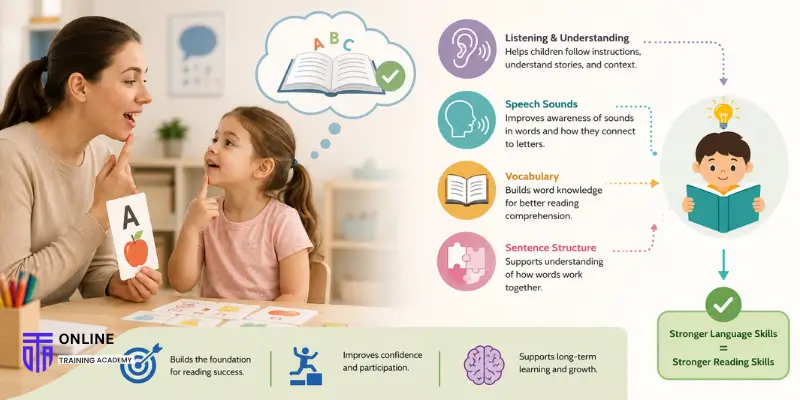
Speech and language therapy helps children develop the communication skills that reading depends on. Reading is about more than recognising letters or sounding out words—it also requires children to understand vocabulary, recognise speech sounds, follow sentence structures, and make sense of what they read.
Through tailored, evidence-informed activities, speech and language therapy strengthens these foundational skills. Children improve phonological awareness, listening comprehension, vocabulary, and oral language, making it easier to connect sounds with letters and understand written text.
Rather than replacing reading instruction, speech and language therapy supports the skills that make learning to read more effective. By building a strong language foundation, it helps children become more confident readers and learners.
Reading Begins with Spoken Language
Before children learn to recognise letters, they develop communication skills through listening and speaking. From birth, everyday conversations, songs, and stories help children build vocabulary, recognise speech sounds, and understand language—all of which support later reading development.
Children with strong oral language skills often find it easier to:
- Learn new vocabulary
- Understand classroom instructions
- Recognise sound patterns
- Retell stories in sequence
- Ask and answer questions
- Understand the meaning of written text
Children who experience ongoing language difficulties may benefit from early support. Speech and language therapy helps strengthen these foundational communication skills, making it easier for children to develop literacy and succeed in school.
The Journey from Speech to Reading
Many people assume reading develops once children begin learning letters. In reality, reading is built through a series of connected stages that begin with spoken language.
Think of literacy development as a pathway rather than a single milestone.
Stage 1: Hearing and Producing Speech Sounds
Children first learn to recognise the sounds used in their language. They begin babbling, copying words, and experimenting with speech while listening to conversations around them.
These experiences help children distinguish between similar sounds such as “b” and “p,” an important skill for later reading.
Stage 2: Developing Phonological Awareness
As children’s language develops, they become more aware of how words are made up of smaller sounds.
They learn to:
- recognise rhyming words
- clap syllables
- identify beginning sounds
- blend sounds together
- separate words into individual sounds
These phonological awareness skills are among the strongest predictors of future reading success.
Stage 3: Connecting Sounds to Letters
Once children begin school, they learn that speech sounds correspond to written letters.
Because they already understand how sounds work within spoken language, connecting those sounds to printed symbols becomes much easier.
Speech and language therapy often strengthens this stage by helping children hear subtle sound differences and practise sound manipulation activities.
Stage 4: Recognising Words More Easily
As decoding improves, children begin recognising familiar words automatically.
Instead of concentrating on every letter, they read more smoothly and confidently.
Reading becomes less about figuring out words and more about understanding ideas.
Stage 5: Reading with Fluency and Understanding
Eventually, strong language skills allow children to focus on comprehension.
Rather than simply reading aloud correctly, they can:
- understand characters
- predict outcomes
- infer meaning
- connect ideas
- explain information in their own words
This is the ultimate goal of literacy—reading to learn, not simply learning to read.
Why Early Language Skills Predict Later Reading Success
Early language development plays a vital role in a child’s future reading success. Skills such as vocabulary, listening comprehension, sentence understanding, and sound awareness provide the foundation children need to recognise words, understand text, and develop strong literacy skills.
Children develop at different rates, but ongoing difficulties with understanding language, producing speech sounds, or recognising sound patterns can make learning to read more challenging. Identifying these challenges early allows children to receive the support they need before literacy difficulties become more established.
Because young children’s brains are highly responsive to language learning, early intervention can have a lasting impact. By strengthening communication skills from an early age, speech and language therapy helps build the confidence and foundations needed for reading, writing, and lifelong learning.
Which Language Skills Have the Biggest Impact on Reading Development?
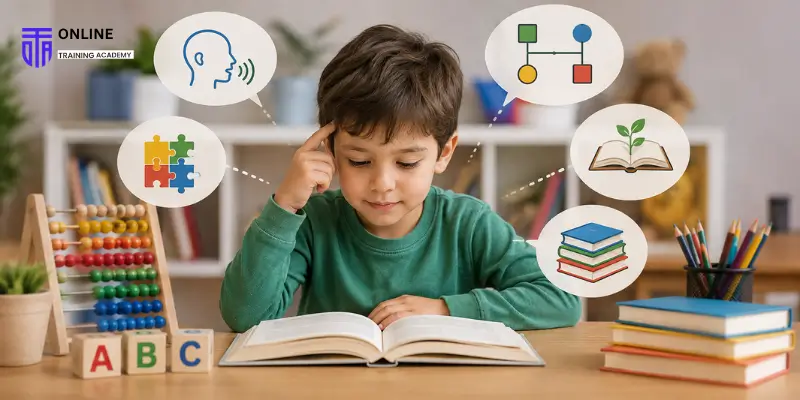
When people think about learning to read, they often picture children sounding out letters or practising phonics. While these skills are important, they are only one part of the process. Reading development relies on a combination of language abilities that work together. If one area is weaker, learning to read can become more challenging.
Speech and language therapy focuses on strengthening these core language skills so children can build confidence as readers. Rather than teaching isolated reading techniques, therapists help children develop the communication abilities that support literacy throughout their education.
Let’s explore the language skills that have the greatest influence on reading success.
Phonological Awareness: The Foundation of Decoding
One of the strongest predictors of reading success is phonological awareness—the ability to recognise and manipulate the sounds within spoken words.
Before children can match letters to sounds, they first need to hear that words are made up of smaller sound units. For example, they learn that “cat” and “hat” rhyme, or that “sun” begins with the same sound as “sand.”
As their skills develop, children begin to:
- Identify beginning and ending sounds
- Break words into syllables
- Blend individual sounds into complete words
- Separate words into individual speech sounds
- Recognise rhyming patterns
These activities may seem like simple games, but they prepare children for phonics instruction and make decoding much easier.
Speech and language therapists often use playful activities such as rhyming games, sound matching, songs, and word-building exercises to strengthen phonological awareness. These engaging approaches help children develop the listening skills needed to recognise sound patterns before they encounter them in print.
Without a solid understanding of speech sounds, children may find it difficult to decode unfamiliar words, affecting both reading accuracy and confidence.
Vocabulary Development and Word Meaning
Knowing how to pronounce a word is only part of reading. Children also need to understand what that word means.
Vocabulary plays a vital role in reading comprehension because readers cannot fully understand a sentence if they don’t know the meaning of its words.
For example, a child might successfully read the sentence:
“The squirrel stored acorns before winter.”
However, if they don’t understand the words “squirrel” or “stored,” the sentence loses much of its meaning.
Speech and language therapy helps children expand both receptive vocabulary (words they understand) and expressive vocabulary (words they use when speaking). Therapists introduce new words through conversation, storytelling, pictures, games, and real-life situations, making vocabulary learning both meaningful and memorable.
A broad vocabulary also helps children:
- Understand classroom discussions
- Follow written instructions
- Make sense of unfamiliar texts
- Learn new subjects more easily
- Express their own ideas clearly
The more words children understand, the easier it becomes to connect new information with what they already know.
Grammar and Sentence Structure
Reading involves much more than recognising individual words. Children must also understand how words work together to create meaning.
Grammar, also known as syntax, helps children understand sentence structure. It allows them to recognise relationships between words, interpret complex ideas, and follow increasingly sophisticated texts.
Consider these two sentences:
- The dog chased the cat.
- The cat chased the dog.
The same words appear in both sentences, but the order changes the meaning completely.
Children who struggle with grammar may find longer sentences difficult to understand, especially as school texts become more complex.
Speech and language therapy helps children improve grammar by developing their understanding of:
- Sentence structure
- Verb tenses
- Pronouns
- Word order
- Question forms
- Complex sentences
These skills not only improve spoken communication but also make reading comprehension more accurate and enjoyable.
Listening Comprehension and Story Understanding
Long before children can read independently, they develop literacy through listening.
When adults read stories aloud, children practise listening, following sequences, predicting events, and understanding characters’ actions. These experiences build listening comprehension, an essential skill that later supports reading comprehension.
Children with strong listening skills can often:
- Follow multi-step instructions
- Retell stories in the correct order
- Answer questions about what they have heard
- Make predictions
- Explain cause and effect
- Identify the main idea
Speech and language therapists frequently use books and storytelling activities to strengthen these abilities. Instead of simply reading a story, they encourage children to discuss what happened, describe characters, predict endings, and explain why events occurred.
These conversations deepen language understanding while preparing children to become thoughtful, active readers.
As reading materials become more advanced, listening comprehension continues to support literacy by helping children understand increasingly complex ideas and vocabulary.
Morphological Awareness: An Often-Overlooked Reading Skill
One language skill that receives far less attention than it deserves is morphological awareness.
Morphology refers to understanding the smallest meaningful parts of words, known as morphemes. These include prefixes, suffixes, and root words.
For example:
- un + happy = unhappy
- teach + er = teacher
- play + ed = played
- care + ful = careful
Recognising these patterns helps children understand unfamiliar vocabulary without needing to memorise every word individually.
Imagine a child encountering the word “carelessly.” Even if they have never seen it before, understanding the root word “care,” the suffix “-less,” and “-ly” allows them to work out its likely meaning.
Morphological awareness becomes increasingly important as children move beyond simple storybooks and begin reading informational texts in science, history, and other subjects.
Speech and language therapy may include activities that help children:
- Identify root words
- Recognise prefixes and suffixes
- Understand how words change meaning
- Build new vocabulary through word families
Although this area is often overlooked in general reading discussions, it can significantly improve vocabulary growth and reading comprehension as children progress through school.
Why These Skills Work Together
It can be helpful to think of reading as a puzzle made up of several connected pieces.
A child with excellent phonological awareness but limited vocabulary may decode words accurately without fully understanding them.
Another child may have an extensive vocabulary but struggle to distinguish speech sounds, making decoding difficult.
Strong reading develops when these language skills support one another:
- Phonological awareness helps children hear and manipulate sounds.
- Vocabulary gives meaning to the words they read.
- Grammar helps them understand sentence structure.
- Listening comprehension supports understanding of stories and information.
- Morphological awareness helps unlock unfamiliar vocabulary.
Speech and language therapy recognises that literacy is built through this combination of skills rather than a single approach. By identifying which areas need additional support, therapists can provide targeted interventions that strengthen the foundations of reading in a way that matches each child’s individual needs.
Children rarely become confident readers by mastering just one skill. Instead, they develop through the steady growth of many interconnected language abilities that support learning throughout their lives.
Is There a Link Between Speech, Language, Communication Skills, and Literacy?
The link between speech, language, communication, and literacy is stronger than many people realise. These skills develop together throughout childhood, with spoken language forming the foundation for reading and writing.
As children listen, build vocabulary, form sentences, and express their ideas, they also develop the skills needed to recognise words, understand stories, and comprehend written text. Strong oral language often makes learning to read easier.
Not every child with a speech or language difficulty will experience reading challenges. However, persistent communication difficulties can increase the risk of literacy struggles, making early support important for building strong reading skills and long-term learning success.
Understanding the Difference Between Speech and Language
One common misconception is that speech and language mean the same thing. Although they work together, they refer to different aspects of communication.
Speech is the physical production of sounds. It involves how clearly a child pronounces words and whether others can understand what they are saying.
For example, speech includes:
- Producing sounds correctly
- Speaking clearly
- Voice quality
- Fluency, such as speaking without significant stuttering
A child who says “wabbit” instead of “rabbit” may have a speech sound difficulty.
Language, on the other hand, is about understanding and using words to communicate meaning. It includes vocabulary, grammar, sentence structure, storytelling, and comprehension.
For example, a child may pronounce words clearly but struggle to:
- Follow instructions
- Understand questions
- Build complete sentences
- Explain events in sequence
- Learn new vocabulary
These are language difficulties rather than speech difficulties.
Reading relies heavily on language skills. While clear speech can support communication, strong language skills are often even more important for understanding books, learning new concepts, and developing literacy.
Speech and language therapists assess both areas because they frequently work together but may require different types of support.
Why Communication Skills Affect Reading and Writing
Communication involves much more than speaking. It includes listening, understanding, expressing ideas, asking questions, and participating in conversations. These everyday interactions help children develop the language skills needed for reading and writing.
For example, discussing a story after reading aloud encourages children to recall details, organise their thoughts, predict what happens next, understand cause and effect, and learn new vocabulary. These same skills later support reading comprehension, writing, and classroom learning.
Speech and language therapy strengthens communication by improving vocabulary, sentence structure, and expressive language. As children become more confident communicators, they are better equipped to understand what they read, express their ideas clearly, and succeed in school.
Common Signs a Child May Need Extra Support
Every child develops at their own pace, and occasional mistakes are a normal part of learning. However, some communication difficulties persist beyond what is typically expected for a child’s age and may benefit from further assessment.
Parents and educators may notice signs such as:
- Difficulty understanding age-appropriate instructions
- Limited vocabulary compared with peers
- Trouble putting words together into complete sentences
- Difficulty telling or retelling simple stories
- Frequent frustration when trying to communicate
- Challenges recognising rhyming words or beginning sounds
- Difficulty remembering or learning new words
- Limited interest in books or storytelling
- Problems following classroom discussions
- Ongoing struggles with early reading despite regular practice
These signs do not automatically indicate a speech or language disorder, but they may suggest that additional support could be beneficial.
Early identification allows children to receive targeted intervention before communication difficulties begin affecting confidence, classroom participation, or literacy development.
When Language Difficulties Can Affect Academic Progress
As children progress through school, reading becomes more than recognising words—it becomes the foundation for learning across all subjects. Understanding new vocabulary, following complex instructions, and making sense of increasingly advanced texts all depend on strong language skills.
Children with ongoing language difficulties may find these growing demands more challenging. They may struggle with reading comprehension, classroom discussions, or expressing their ideas, which can gradually affect both academic progress and confidence.
Speech and language therapy helps strengthen the language skills needed for success in school by improving vocabulary, listening comprehension, and communication. With early support, children can build the confidence and literacy skills they need to participate more fully in learning and everyday classroom activities.
How Parents and Educators Can Help Build Reading Skills Every Day
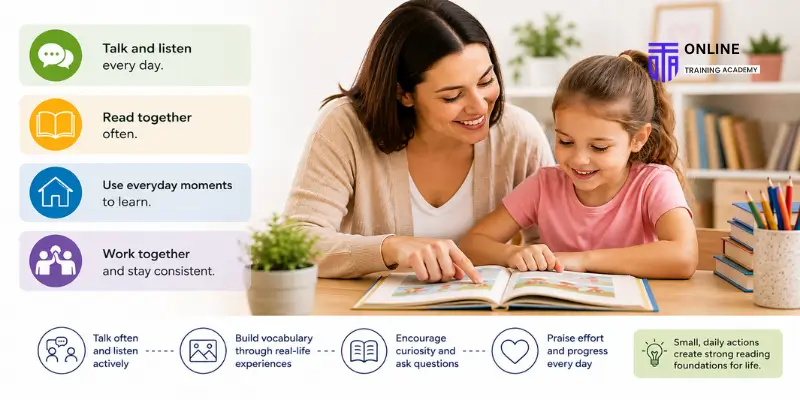
Speech and language therapy provides valuable support, but the development of strong reading skills doesn’t happen only during therapy sessions. Children learn language every day through conversations, play, books, and shared experiences. This means parents, caregivers, and educators all have an important role in creating opportunities for literacy development.
The good news is that many of the most effective strategies are simple, enjoyable, and can be incorporated into everyday routines.
Create a Language-Rich Environment
Children learn best when they are surrounded by meaningful language. Talking about everyday activities—whether you’re preparing a meal, walking to school, or shopping for groceries—helps expand vocabulary and strengthen communication skills.
Instead of asking questions that only require a “yes” or “no” answer, encourage longer conversations by asking open-ended questions such as:
- What do you think will happen next?
- Why do you think that happened?
- Can you describe what you see?
These discussions encourage children to organise their thoughts, learn new words, and build confidence in expressing themselves.
Read Together Every Day
Reading aloud remains one of the most effective ways to support literacy development, regardless of a child’s age.
Rather than focusing on finishing the book quickly, make reading interactive by:
- Asking questions about the story
- Discussing new vocabulary
- Predicting what might happen next
- Encouraging children to retell the story in their own words
- Connecting the story to real-life experiences
These conversations strengthen listening comprehension, vocabulary, and critical thinking while making reading an enjoyable shared activity.
Turn Everyday Moments into Learning Opportunities
Many literacy skills develop naturally through play and daily routines.
Simple activities include:
- Singing nursery rhymes and songs
- Playing rhyming and word games
- Naming objects during walks
- Sorting items by categories
- Encouraging storytelling through play
- Practising letter sounds during everyday conversations
These activities reinforce speech and language skills without feeling like formal lessons.
Work Together to Support the Child
When children receive speech and language therapy, progress is often greatest when families, educators, and therapists work together.
Parents can share observations from home, teachers can identify classroom challenges, and therapists can recommend activities that reinforce therapy goals in everyday settings.
This collaborative approach creates consistency across different environments and helps children apply their communication skills in real-life situations rather than only during structured sessions.
Conclusion
Strong reading skills begin with strong communication skills. Long before children learn to read, they develop the language abilities that help them recognise sounds, understand words, and make meaning from text.
Speech and Language Therapy (Literacy and Language Development) strengthens these essential skills by improving phonological awareness, vocabulary, listening comprehension, grammar, and communication. With early support, children can build the confidence and literacy foundations they need to succeed in school and beyond.
Whether you’re a parent or an educator, supporting speech and language development is one of the best ways to encourage lifelong reading success. Every conversation, story, and learning opportunity helps children take another step towards becoming confident readers.
FAQs
Yes. Speech and language therapy strengthens the communication skills that support reading, including phonological awareness, vocabulary, listening comprehension, grammar, and oral language. These foundational skills make it easier for children to develop decoding and reading comprehension.
Speech and language development begins from birth. Babies start learning language by listening to voices, responding to sounds, and interacting with the people around them. Supporting communication from an early age helps lay the foundation for later literacy development.
Not necessarily. Some children with speech delays develop reading skills without significant challenges. However, persistent speech or language difficulties may increase the risk of literacy challenges, particularly if they affect phonological awareness or language comprehension.
Parents can support literacy by reading with their children regularly, encouraging conversations, introducing new vocabulary, singing songs, playing word games, and creating opportunities for storytelling during everyday activities.
If a child consistently struggles to understand language, communicate effectively, follow instructions, or shows ongoing difficulties with early literacy skills compared with their peers, it may be helpful to discuss these concerns with a qualified speech and language therapist or another appropriate healthcare or educational professional.
Learn More





Get a FREE Course
- Learn useful skills online free
- Get CPD accredited certificate
- Add it to your CV today!