
Introduction
Choosing a CCTV Operator Course might seem as simple as comparing prices or picking the shortest program. But a course that’s inexpensive or quick to complete isn’t always the one that best prepares you for a career in security. The right training should help you build knowledge, confidence, and workplace-ready skills—not just award a certificate.
With so many providers offering similar courses, it can be difficult to know which one genuinely delivers value. Some focus heavily on theory, while others include practical scenarios, incident reporting, and real-world security procedures that better reflect the responsibilities of a CCTV operator.
This checklist will help you compare CCTV Operator Courses more effectively. You’ll learn what to look for, which questions to ask before enrolling, and how to identify a program that supports both your immediate learning needs and your long-term career goals.
Table of Contents
CCTV Operator Course
Gain practical knowledge of CCTV operations, surveillance techniques, security procedures, incident reporting, and legal responsibilities. This CCTV Operator Course helps learners develop the essential skills needed to monitor, record, and support effective security operations confidently.
How Do You Choose the Right CCTV Operator Course?
Choosing the right CCTV Operator Course isn’t about finding the cheapest or fastest option—it’s about finding a program that prepares you for the role you want. A quality course should help you understand surveillance procedures, develop practical security skills, and build confidence before entering the workplace.
Rather than relying on marketing claims, compare each course based on what you’ll actually learn, how you’ll learn it, and how well it aligns with your career goals.
Start With Your Career Goal
Before comparing providers, ask yourself why you’re taking the course.
For example, are you hoping to:
- Start a career as a CCTV operator?
- Move into the wider security industry?
- Add surveillance knowledge to your existing role?
- Build skills that support future career progression?
Your answer will help you identify the type of training that best fits your needs. Someone entering the security industry for the first time may benefit from a comprehensive beginner-friendly course, while someone with experience may be looking to strengthen specific skills.
Compare Quality, Not Just Price
A lower course fee may seem attractive, but cost alone doesn’t tell you how much value you’ll receive. Two CCTV Operator Courses can have similar prices while offering very different learning experiences.
Instead of focusing only on price, compare factors such as:
- The depth of the curriculum
- Practical learning opportunities
- Quality of learning materials
- Assessment methods
- Student support
- Course flexibility
A well-structured course often provides greater long-term value because it prepares you more effectively for real workplace responsibilities.
Think Beyond Certification
Receiving a certificate is an important achievement, but it shouldn’t be the only reason for choosing a course.
Employers are often more interested in whether you understand surveillance procedures, can communicate professionally, write accurate incident reports, and follow security protocols confidently.
A strong CCTV Operator Course helps you build these skills while providing a recognised record of your learning. That’s a much stronger foundation than simply completing a course for the certificate alone.
Know Your Career Goals Before Comparing Courses
What Type of Security Role Interests You?
Not every CCTV Operator Course is designed with the same learner in mind. Before you begin comparing providers, it’s worth taking a step back and thinking about what you want to achieve. Having clear career goals makes it much easier to identify a course that supports your future plans instead of simply checking a box.
A CCTV Operator Course can support a variety of security careers. While many learners plan to work in surveillance, others use the knowledge they gain to strengthen their skills in related security roles.
Ask yourself where you’d like your training to take you. Are you interested in monitoring surveillance systems, working in a security control room, supporting retail loss prevention, or building a broader career in the security industry? Understanding your direction will help you prioritise courses that focus on the skills most relevant to your goals.

Match the Course to Your Career Plans
Once you’ve identified your goal, compare each course with that destination in mind. A quality program should clearly explain what learners will study and how those topics relate to real workplace responsibilities.
Look for courses that include:
- CCTV surveillance procedures
- Observation and situational awareness
- Incident reporting
- Communication during security incidents
- Control room operations
- Decision-making in realistic scenarios
If a course description is vague or focuses only on basic theory, it may not provide the preparation you’re looking for.
Questions to Ask Yourself Before Enrolling
Before making your final decision, ask yourself a few simple questions:
- Why do I want to take a CCTV Operator Course?
- Does this course match my current experience level?
- Will the skills I learn support my long-term career goals?
- Does the curriculum reflect real workplace responsibilities?
- Will I feel confident applying what I've learned after completing the course?
Taking a few minutes to answer these questions can make it much easier to choose a course that fits your ambitions rather than selecting one based solely on convenience or cost.
Does the Course Cover the Skills You'll Actually Use?
One of the easiest ways to compare CCTV Operator Courses is to look beyond the module titles. A course may sound comprehensive, but the real question is whether it teaches the skills you’ll use in a professional security environment.
A quality program should help you understand not only what a CCTV operator does but also how to perform those responsibilities confidently in the workplace.
Does It Cover Core CCTV Duties and Responsibilities?
Before enrolling, review the course curriculum carefully. It should cover the everyday responsibilities of a CCTV operator rather than focusing only on surveillance equipment.
Look for topics such as:
- Monitoring CCTV systems effectively
- Identifying suspicious or unusual behaviour
- Following security procedures
- Responding to alarms and incidents
- Recording and reporting events accurately
- Communicating with security teams
If these essential responsibilities are missing or only briefly mentioned, the course may not provide the practical knowledge employers expect.
Does It Balance Theory With Practical Learning?
Understanding CCTV systems is important, but reading about surveillance isn’t the same as knowing how to apply it in real situations.
A stronger course should include learning activities that help you think like a CCTV operator. For example, you may work through scenarios that involve assessing suspicious behaviour, deciding how to respond to an alert, or documenting an incident accurately.
These practical elements make it easier to connect theory with workplace responsibilities and build confidence before entering the security industry.
Does It Develop the Skills Employers Value?
Employers look beyond technical knowledge when hiring CCTV operators. They want people who can remain focused, communicate clearly, and make sound decisions under pressure.
As you compare courses, check whether they help you develop skills such as:
- Observation and attention to detail
- Situational awareness
- Incident reporting
- Communication
- Decision-making
- Professional judgement
A course that develops these workplace skills will often provide greater long-term value than one that focuses only on CCTV equipment or terminology.
Compare Our Course Against This Checklist
As you review different CCTV Operator Courses, use these points as your benchmark. If you’re looking for a program that combines CCTV operations, incident reporting, observation techniques, communication skills, and practical workplace scenarios, take a look at our CCTV Operator Course. Its curriculum is designed around the same skills employers expect, helping you build confidence alongside your knowledge.
Explore the course curriculum to see how it matches the checklist above.
Does the Course Meet Qualification and Industry Expectations?
Choosing a course that matches industry expectations can help you feel more confident about your learning and better prepared for future opportunities.
Is the Course Suitable for Your Experience Level?
Some CCTV Operator Courses are designed for complete beginners, while others assume learners already have security experience.
Before enrolling, check whether the course clearly explains:
- Who it's designed for
- Any recommended knowledge or experience
- The learning outcomes you can expect
Starting with a course that matches your current level helps create a smoother learning experience and allows you to build your skills progressively.
Does the Certification Reflect Meaningful Learning?
A certificate is an important milestone, but it should represent more than simply completing a course.
Look for a program that combines structured learning with assessments that allow you to demonstrate your understanding. This gives you greater confidence that you’ve developed useful knowledge rather than simply worked through course materials.
What Employers Notice Beyond the Certificate
While certification can strengthen your CV, employers often pay equal attention to the skills and attitude you bring to the role.
During recruitment, they’re likely to value candidates who demonstrate:
- A clear understanding of CCTV operations
- Strong communication skills
- Attention to detail
- Professional judgement
- The ability to follow procedures consistently
- A willingness to continue learning
A well-designed CCTV Operator Course should help you build these qualities alongside your technical knowledge, giving you a stronger foundation as you begin your career.
Does the Course Prepare You for Real Security Work?
Completing a CCTV Operator Course should leave you feeling ready to apply your knowledge in a real security environment. While every workplace is different, the course should introduce situations and responsibilities that reflect what CCTV operators experience on the job.
When comparing courses, ask yourself whether the learning goes beyond theory and prepares you for practical decision-making.
Does It Explain How CCTV Control Rooms Operate?
A CCTV control room is where surveillance information is monitored, assessed, and communicated. Understanding how this environment works helps you appreciate the role you’ll play as part of a wider security team.
A quality course should explain:
- How CCTV monitoring supports security operations
- The purpose of control room procedures
- How operators respond to alarms and incidents
- How information is shared with security personnel
This knowledge helps bridge the gap between classroom learning and workplace expectations.
Does It Include Workplace Scenarios?
One of the best ways to prepare for a security role is through realistic examples.
Look for courses that include scenario-based learning, such as:
- Responding to suspicious behaviour
- Assessing security alerts
- Handling unauthorised access
- Recording incidents accurately
- Following reporting procedures
These activities encourage you to think critically and understand how your decisions affect security operations.
Does It Teach Incident Reporting?
Monitoring CCTV footage is only part of the job. Operators also need to create clear, factual, and accurate reports that document what happened during an incident.
A well-rounded course should teach you how to:
- Record objective observations
- Write accurate incident reports
- Maintain organised surveillance records
- Follow workplace reporting procedures
These reporting skills are highly valued because they support investigations and help maintain accurate security records.
Does It Explain How CCTV Operators Work With Security Guards?
Although CCTV operators and security guards have different responsibilities, they work closely together in many organisations.
A quality course should explain how these roles complement each other. For example, a CCTV operator may identify suspicious activity through surveillance cameras, while a security guard responds on-site. Understanding this partnership gives you a clearer picture of how security teams operate and helps prevent confusion about each role.
Compare Learning Format, Cost, and Student Support

Once you’ve narrowed down your options, compare how each course is delivered and the support you’ll receive throughout your learning journey.
Online vs Classroom Learning
Both learning formats have advantages, so the right choice depends on your circumstances.
Online learning is often ideal if you need flexibility. It allows you to study at your own pace and fit learning around work, family, or other commitments.
Classroom learning may suit learners who prefer face-to-face interaction and structured schedules.
Neither format is automatically better—the key is choosing one that matches your learning style and availability.
Compare Overall Value—Not Just the Price
It’s tempting to choose the lowest-priced course, but value comes from what you receive, not simply what you pay.
As you compare providers, consider:
- Course content and depth
- Practical learning opportunities
- Assessment methods
- Learning resources
- Flexibility
- Student support
A course that provides comprehensive training and ongoing support often offers greater long-term value than one chosen purely because it’s inexpensive.
Student Support Can Make a Big Difference
Learning becomes much easier when support is available if you need it.
Before enrolling, check whether the provider offers:
- Access to tutors or instructors
- Helpful learning materials
- Assessment guidance
- Technical support for online learners
Good support can improve your learning experience and help you stay motivated from enrolment through to course completion.
Warning Signs of a Poor CCTV Operator Course
Not every CCTV Operator Course provides the same quality of training. Learning to recognise potential warning signs can help you avoid investing your time and money in a program that doesn’t meet your expectations.
Vague Course Descriptions
If a course provides very little information about what you’ll actually learn, it’s difficult to know whether it covers the knowledge and skills you need.
A quality provider should clearly outline the curriculum, learning outcomes, and key topics included in the course.
Unrealistic Career Claims
Be cautious of providers that promise immediate success or suggest a certificate alone guarantees employment.
A reputable course helps you build knowledge and skills, while recognising that career growth also depends on practical experience, continued learning, and employer requirements.
Limited Practical Learning
Courses that focus entirely on theory may leave learners unprepared for real workplace situations.
Look for programs that include:
- Workplace examples
- Scenario-based learning
- Incident reporting practice
- Security procedures
- Realistic case studies
These elements help you understand how your knowledge is applied in everyday security operations.
Little Information About Assessments or Support
Before enrolling, check how you’ll demonstrate your learning and what support is available if you need assistance.
If assessment methods, learner support, or course guidance aren’t clearly explained, consider asking the provider for more information before making your decision.
Course Comparison Checklist
After comparing different CCTV Operator Courses, it helps to evaluate them side by side. A comparison table makes it easier to identify which program offers meaningful training and which may leave important gaps in your learning.
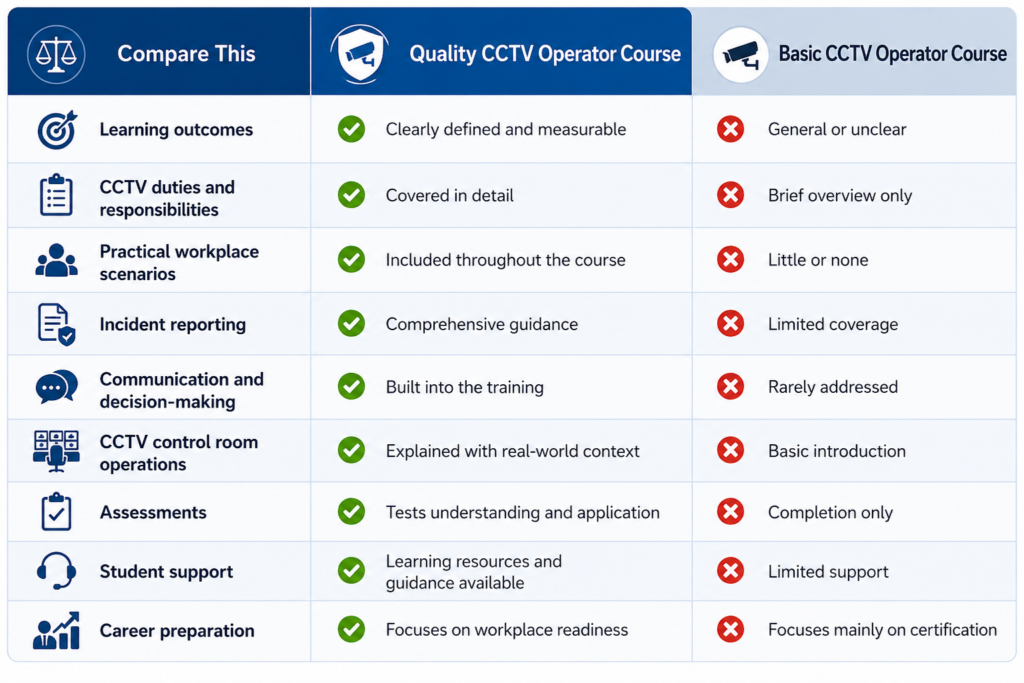
A quality course isn’t necessarily the longest or the most expensive—it’s the one that equips you with the knowledge and confidence to apply your skills in a real security environment.
Final CCTV Operator Course Checklist
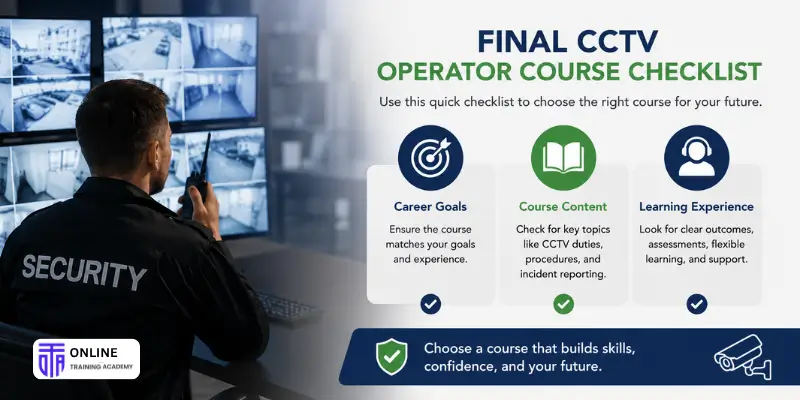
Before you enrol, use this checklist to compare your shortlisted courses. If you can answer “Yes” to most of these questions, you’re likely looking at a well-rounded program.
Career Goals
✔ Does the course match my career objectives?
✔ Is it suitable for my current experience level?
Course Content
✔ Does it cover CCTV duties and responsibilities?
✔ Does it explain surveillance procedures and control room operations?
✔ Does it teach observation, communication, and incident reporting?
✔ Does it include practical workplace scenarios?
Learning Experience
✔ Are the learning outcomes clearly explained?
✔ Are assessments included to test understanding?
✔ Is the course flexible enough for my schedule?
✔ Is learner support available if I need help?
Long-Term Value
✔ Will the skills I learn be useful beyond this course?
✔ Will I feel more confident performing CCTV operator responsibilities after completing the training?
If several answers are “No”, it may be worth comparing other providers before making your decision.
Looking for a CCTV Operator Course That Ticks Every Box?
By now, you’ve seen that choosing the right course is about much more than price or certification. A quality program should give you the knowledge, confidence, and practical understanding needed to take your first steps into the security industry.
When evaluating any CCTV Operator Course, look for one that offers:
- A structured, beginner-friendly curriculum
- Coverage of CCTV duties and workplace procedures
- Practical examples and realistic security scenarios
- Training in observation, communication, and incident reporting
- Flexible learning that fits your schedule
- Ongoing learner support
- A recognised certificate upon successful completion
If our CCTV Operator Course meets the criteria on your checklist, it may be the right fit for your learning goals. Rather than simply helping you complete a course, it’s designed to build the knowledge and workplace-ready skills that support long-term growth in the security industry.
Conclusion
Choosing the right CCTV Operator Course isn’t about finding the fastest or cheapest option—it’s about selecting training that genuinely prepares you for the responsibilities of the role. By comparing course content, practical learning opportunities, assessments, and learner support, you’ll be far more likely to choose a program that delivers lasting value.
If you’ve used this checklist and are looking for a course that meets those standards, our CCTV Operator Course is built around the same principles discussed throughout this guide. From surveillance procedures and incident reporting to workplace-focused learning and flexible online study, it’s designed to help you develop the knowledge and confidence needed to begin your journey in the security industry.
Take the next step today—explore our CCTV Operator Course and start building the skills that support a successful career in security.
FAQs
A worthwhile course should provide more than a certificate. Look for one that covers CCTV responsibilities, surveillance procedures, practical workplace scenarios, and the skills employers value, such as observation, communication, and incident reporting.
Compare the curriculum, learning outcomes, assessments, practical training, flexibility, and learner support. Choosing a course based on overall quality rather than price alone often leads to a better learning experience.
Compare the curriculum, learning outcomes, assessments, practical training, flexibility, and learner support. Choosing a course based on overall quality rather than price alone often leads to a better learning experience.
Yes. Online courses are a popular choice for learners who need flexibility. They allow you to study at your own pace while balancing work, family, or other commitments. The key is choosing a course with comprehensive content and reliable learner support.
A strong course should help you develop observation, situational awareness, communication, incident reporting, decision-making, and an understanding of CCTV control room procedures.
Yes. While certification demonstrates that you’ve completed training, employers also value practical knowledge, professionalism, communication skills, and the ability to follow security procedures confidently.
Use a checklist rather than relying on marketing claims. Compare the curriculum, practical learning opportunities, assessments, learner support, flexibility, and how well each course prepares you for real workplace responsibilities.
For many people, yes. A beginner-friendly course provides the foundation needed to understand CCTV operations and security procedures. As you gain workplace experience, you’ll continue developing your skills and confidence.
Learn More


Get a FREE Course
- Learn useful skills online free
- Get CPD accredited certificate
- Add it to your CV today!