


Most dog owners master the basics of pet care quickly: feeding schedules, daily walks, fresh water, and plenty of affection. But when you step behind the leash with a professional dog walker or step into a home with an experienced pet sitter, you immediately notice a profoundly different approach to animal husbandry. They do not rely on magic tricks, dominance theory, or sheer force. Instead, they rely on hyper-observation, environmental management, canine psychology, and a deep understanding of ethology (the study of animal behavior).
Professionals see things the average owner misses. They read stress before it escalates into aggression, they prevent leash reactivity through spatial awareness, and they build unbreakable trust using methods that often run counter to human intuition.
This comprehensive guide breaks down the practical, science-backed secrets that professionals use to elevate a dog’s safety, behavior, and physiological well-being. By adopting these strategies, you can transform your relationship with your dog from basic ownership to true partnership.
The Physiology of Safety: Beyond the Weather Forecast
Amateur walkers check the sky; professional walkers check the ground. One of the most critical, yet frequently ignored, safety protocols in professional dog care is the management of environmental extremes.
The 5-Second Pavement Rule
While humans wear rubber-soled shoes, a dog’s paw pads absorb the full, brutal brunt of the pavement. Though paw pads are made of tough, keratinized epithelium, they are not immune to thermal damage.
The standard protocol is the 5-second rule: place the back of your bare hand flat on the pavement. If you cannot comfortably hold it there for five full seconds, it is too hot for a dog to walk on.
Air temperature is a highly deceptive metric. Asphalt and concrete absorb and trap solar radiation, meaning ground temperatures can easily be 40 to 60 degrees hotter than the ambient air.
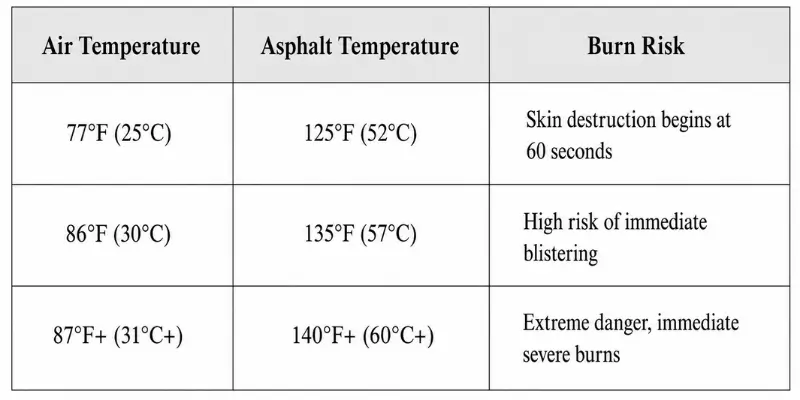
To mitigate this, professionals shift walks to dawn or dusk, map out grassy or dirt trails, and understand that indoor mental stimulation can replace a forced outdoor march on a sweltering day. They also monitor for hyperthermia (heatstroke). Dogs do not sweat through their skin; they cool themselves through panting and vasodilation in their paws. If a dog is panting frantically with a thick, spoon-shaped tongue, or if their gums turn brick red, a professional knows to stop immediately, find shade, and cool the dog down.
Winter Hazards and Equipment Checks
The same vigilance applies in winter. Professionals watch for toxic ice-melt chemicals (which dogs lick off their paws, causing gastrointestinal distress) and ice balls forming between the toes.
Furthermore, a professional never assumes equipment is safe. Before every walk, they check the leash for fraying, ensure harness buckles are secure, and verify the collar is tight enough that the dog cannot back out of it (the “two-finger rule” applies: you should only be able to fit two fingers flat between the collar and the neck).
Advanced Pet Sitting and Dog Walking
Learn the essential knowledge and practical techniques for professional pet sitting and dog walking, including animal behaviour, safe handling, routine care, and responsible pet management. This course helps learners build confidence in providing safe and effective care for pets."
Table of Contents
The Art of Observation: Advanced Canine Body Language
Many owners label a dog as “stubborn,” “naughty,” or “spiteful” when the dog is actually overwhelmed, fearful, or overstimulated. Professionals operate on a concept called trigger stacking.
Imagine a game of Jenga. Each stressor a dog encounters—a loud garbage truck, a strange dog staring at them, a tight leash, a child running past—pulls a block from the tower. Individually, the dog can handle them. But when these triggers stack up in a short timeframe, the tower collapses, resulting in a reactive outburst, a bite, or a complete behavioral shutdown.
The Canine Ladder of Aggression
Skilled handlers watch for micro-signals of stress long before a growl or a bark occurs. They understand the Canine Ladder of Aggression, which outlines how a dog escalates when their subtle pleas for space are ignored:
➽ Displacement Behaviors: The dog performs normal behaviors completely out of context. This includes sudden scratching when they aren’t itchy, shaking off as if wet when they are dry, or suddenly sniffing the ground intensely as a trigger approaches.
➽ Calming Signals: Described by canine behaviorist Turid Rugaas, these include lip licking, sudden yawning (when not tired), and turning the head away to break eye contact. The dog is trying to pacify a perceived threat and calm themselves.
➽ Avoidance: Trying to physically walk away or hide behind the handler’s legs.
➽ Physical Tension: “Whale eye” (showing the whites of the eyes), a tightly tucked tail against the stomach, piloerection (raised hackles along the spine), a hard stare, or sudden freezing in place.
➽ Vocalization and Action: Growling, snapping, and finally, biting.
When an owner says a dog bit “out of nowhere,” a professional knows the dog likely gave dozens of warnings that went unnoticed. Spotting these early signs allows a professional to increase physical distance from the trigger, bringing the dog back under their emotional threshold.
Deconstructing the Walk: Olfaction and Spatial Pressure
A profound mistake inexperienced owners make is treating a dog walk purely as a cardiovascular workout for humans. For a dog, a walk is primarily an information-gathering mission.
The "Sniffari" and the Olfactory Bulb
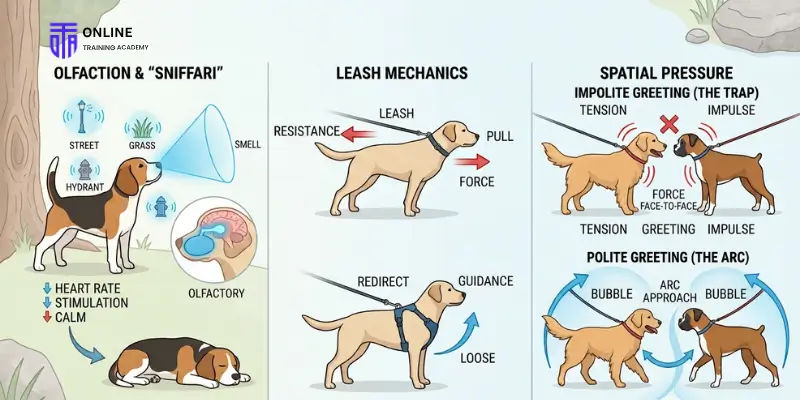
Dogs process the world largely through olfaction. A dog’s sense of smell is 10,000 to 100,000 times more sensitive than a human’s, and a massive portion of their brain is dedicated to analyzing odors. They also possess the vomeronasal organ (Jacobson’s organ) in the roof of their mouth, which allows them to detect pheromones.
Allowing a dog to engage in a “sniffari”—a walk driven by sniffing and exploration rather than distance and speed—actively lowers their heart rate and provides immense mental fatigue. Twenty minutes of intense, focused sniffing can tire a high-energy dog out more effectively than a two-mile fast-paced jog. Professionals build “sniff breaks” into their routes to decompress the dog.
The Physics of Leash Pulling
Why do dogs pull so hard? Aside from walking at a naturally faster pace than humans, dogs have an innate opposition reflex. When they feel pressure pulling them backward (via a tight leash on their neck), their natural neurological response is to lean forward and pull against it.
Professionals counteract this by using front-clip harnesses, which turn the dog’s center of gravity back toward the handler when they pull, and by stopping completely when the leash goes tight. The dog learns that a tight leash means the walk stops, and a loose leash means forward momentum.
Managing the Spatial "Bubble"
Professionals are fiercely protective of a dog’s spatial bubble. They almost never allow on-leash greetings with unfamiliar dogs. Leashes restrict natural canine movement, forcing dogs into head-on, face-to-face approaches. In dog body language, a direct, prolonged head-on approach is incredibly rude and highly confrontational.
Furthermore, leashes prevent the “fight or flight” response. If a dog feels they cannot flee (because they are tethered), they will resort to fighting (barking, lunging) to create distance. This is called barrier frustration or leash reactivity. Instead, pros utilize the “arc approach”—walking in a wide curve around other dogs to mimic polite, natural canine behavior and keep the leash entirely slack.
Inside the Home: The Psychology of Pet Sitting
When a professional pet sitter takes over care inside a home, their priority is establishing predictability. Dogs thrive on routine; chaos and unpredictability breed profound anxiety.
Arousal Management Upon Entry
When an owner comes home, they often engage in high-pitched, excited greetings. This spikes the dog’s arousal levels and reinforces jumping and frantic behavior. When a professional sitter enters a home, they often practice active ignoring. They do not make eye contact, speak to, or touch the dog until the dog has completely settled and offered a calm behavior (like sitting or keeping all four paws on the floor). This teaches the dog that calmness, not hysteria, unlocks human attention.
Dogs process the world largely through olfaction. A dog’s sense of smell is 10,000 to 100,000 times more sensitive than a human’s, and a massive portion of their brain is dedicated to analyzing odors. They also possess the vomeronasal organ (Jacobson’s organ) in the roof of their mouth, which allows them to detect pheromones.
Allowing a dog to engage in a “sniffari”—a walk driven by sniffing and exploration rather than distance and speed—actively lowers their heart rate and provides immense mental fatigue. Twenty minutes of intense, focused sniffing can tire a high-energy dog out more effectively than a two-mile fast-paced jog. Professionals build “sniff breaks” into their routes to decompress the dog.
Resource Guarding Prevention
Professionals never take items directly out of a dog’s mouth unless it is a life-threatening emergency. Taking things by force teaches the dog that humans are thieves, leading to resource guarding (growling or biting when someone approaches their food, toys, or bed).
Instead, professionals use the art of the “trade.” If a dog has a stolen shoe, the sitter offers a high-value treat (like a piece of chicken). The dog drops the shoe to eat the chicken, the sitter calmly secures the shoe, and the dog learns that giving things up results in a massive reward.
Canine Communication: How to Actually Speak "Dog"
Dogs do not understand English vocabulary; they understand acoustics, tone, and consistency.
Classical vs. Operant Conditioning
Professionals use the science of learning to communicate. If you want a dog to understand a word, it must be taught through operant conditioning (learning that an action has a consequence).
The secret is not what word you say, but how consistently you use it. If you say “come,” “come here,” and “get over here right now” interchangeably, the dog hears three entirely different acoustic patterns and becomes confused. Professionals pick one distinct word, use a neutral, confident tone, and pair it with a “marker” word.
The Power of the Marker Word
A marker word is a distinct, sharp sound (often the word “Yes!” or a physical clicker) that tells the dog, “What you are doing at this exact millisecond is correct, and a reward is coming.” It bridges the gap between the behavior and the delivery of the treat.
Avoid "Poisoning the Cue"
A hallmark of amateur handling is repeating a command. “Sit. Sit. Sit down. I said sit.”
To a dog, you have just taught them that the command is not “Sit.” The command is actually the entire phrase “Sit-sit-sit-sit.” If a professional gives a cue and the dog does not comply, the professional does not repeat the word. They evaluate why the dog didn’t comply (Is it too loud? Are they scared? Are they too distracted?) and help guide the dog into the position, preventing the cue from losing its meaning.
Love, Affection, and What Annoys Dogs

We often project human emotional needs onto our dogs, which can lead to stress. Humans show affection through restraint (hugging and kissing). In the canine world, placing limbs over another animal is an assertion of control or a prelude to wrestling.
The Consent Test
Professionals practice the “3-Second Rule” or a consent test for physical affection. They will pet a dog gently on the chest or side of the neck for three seconds, then stop and pull their hands away.
- If the dog leans in, nudges the hand, or paws at them, the dog is saying, "Yes, please continue."
- If the dog looks away, yawns, shakes off, or simply stands still, the dog is saying, "I am tolerating this, but I do not want it."
Respecting this choice builds monumental trust. You say “I love you” in dog language by providing security, maintaining routines, offering contact resting (letting them sleep pressed against your leg), and giving them slow, soft eye blinks.
Environmental Annoyances
Dogs possess hyper-sensitive sensory systems. Things humans barely notice can be overwhelming to a dog.
➽ Olfactory assault: Strong citrus scents, vinegar, bleach, ammonia, and heavy essential oils or perfumes are physically overwhelming and irritating to a dog’s nasal passages.
➽ Auditory stress: High-pitched electronics, loud arguments, or erratic noises can cause chronic stress.
➽ Interrupted rest: Dogs are polyphasic sleepers; they need 12 to 14 hours of sleep a day. Waking a sleeping dog abruptly can trigger a startle reflex. Professionals ensure dogs have a quiet, undisturbed safe space to retreat to.
Conclusion
The “secrets” of professional dog walkers and pet sitters are not hidden techniques restricted to an elite few; they are habits of deep observation, scientific understanding, and profound empathy for a different species. Professionals succeed because they stop expecting dogs to act like humans in fur coats.
They read body language before behavior escalates. They manage the environment to prevent failure, rather than punishing the dog for reacting to it. They build a foundation of predictability and trust through small, consistent, daily actions. By slowing down, watching your dog closely, and applying these professional principles, you can provide a level of care that ensures a safer, calmer, and vastly happier life for your canine companion.
FAQs
Most walks should last 30 to 60 minutes, but it depends heavily on the individual dog. High-energy working breeds (like Malinois or Huskies) often need 60–90 minutes with added mental stimulation. Conversely, puppies, senior dogs, and flat-faced breeds (like Pugs) usually max out at 15–20 minutes of slow-paced walking. For any breed, sniffing and mental engagement matter more than sheer distance.
Professionals manage reactivity by immediately increasing distance from the trigger until the dog calms down. Instead of leash-popping or yelling—which only increases fear—they use high-value treats to build a positive association with the trigger from afar. They keep the leash completely loose to avoid transferring their own tension to the dog.
No, most dogs do not like hugs. In canine body language, placing arms over a dog’s neck or back feels restrictive and threatening. While some dogs tolerate it for their owner’s sake, hugs often cause silent stress. Watch for signs of discomfort: lip licking, stiffening muscles, flattened ears, or leaning away.
Because a dog’s nose is up to 100,000 times more sensitive than ours, strong odors can be overwhelming. Dogs strongly dislike citrus, vinegar, ammonia, rubbing alcohol, and bleach. Furthermore, certain essential oils used in diffusers—like tea tree, eucalyptus, wintergreen, pennyroyal, and pine—are actively toxic and can cause respiratory or neurological issues if inhaled.
Freezing is rarely stubbornness; it usually indicates fear, overstimulation, or physical pain. The dog may have spotted a scary trigger (like a skateboarder), heard an ultrasonic noise you can’t detect, or might be experiencing harness chafing or hot pavement. Never drag a dog by the neck; pause, assess the environment, and read their body language to find the cause.
Yes, dogs can literally smell stress. When you become anxious, your body releases hormones like cortisol and adrenaline, which dogs can detect instantly. They are also masters of reading micro-tensions in your body language and sensing a tightened leash, which signals to them that there is a threat in the environment.
Learn More





Get a FREE Course
- Learn useful skills online free
- Get CPD accredited certificate
- Add it to your CV today!