

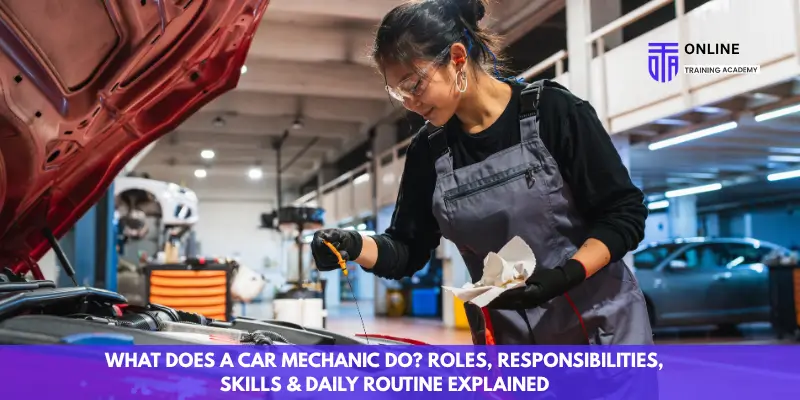
Most people only think about a car mechanic when something goes wrong. A strange noise, a check-engine light, or—in the middle of a harsh Canadian winter—a car that simply won’t start; suddenly, the mechanic becomes the most important person in the room.
But what actually happens behind the scenes? What does a professional mechanic really do all day? It is not just about turning wrenches or changing oil. It is about diagnosing complex computer-controlled systems, making critical safety decisions under pressure, and keeping vehicles reliable on the road. Whether you are considering a career in the trades or simply want to understand the value of the service you are paying for, knowing what a Canadian automotive professional does offers a new perspective on the machine that keeps you moving.
Table of Contents
Car Mechanic
A Car Mechanic Training course provides the knowledge and practical skills needed to inspect, maintain, diagnose, and repair vehicles safely and efficiently. It covers essential topics such as engine systems, brakes, suspension, steering, electrical components, diagnostics, routine servicing, and the correct use of workshop tools. The course also emphasises workplace safety, problem-solving, and industry best practices, helping learners build the confidence required for a career as a professional car mechanic or automotive technician.
What Is a Car Mechanic Called?
In Canada, the terminology can be broad, and you will often hear several names used interchangeably.
Different Names for the Profession
You might encounter terms like automotive service technician, vehicle technician, mechanic, or auto shop mechanic. While these are often used synonymously in casual conversation, there is a professional distinction. In the Canadian trade system, the formal designation is typically Automotive Service Technician (AST).
Is a Vehicle Technician the Same as a Mechanic?
In modern shops, the term “technician” has become the standard. A vehicle technician is often viewed as someone who focuses heavily on advanced diagnostics, computerized engine management, and electronic systems. A “mechanic,” in the traditional sense, is often associated with heavy mechanical repairs (like engine rebuilds or suspension work). Today, the roles are deeply integrated. Because Canadian vehicles are increasingly packed with sophisticated software, nearly every modern mechanic must also be a highly skilled technician.
What Does a Car Mechanic Actually Do?
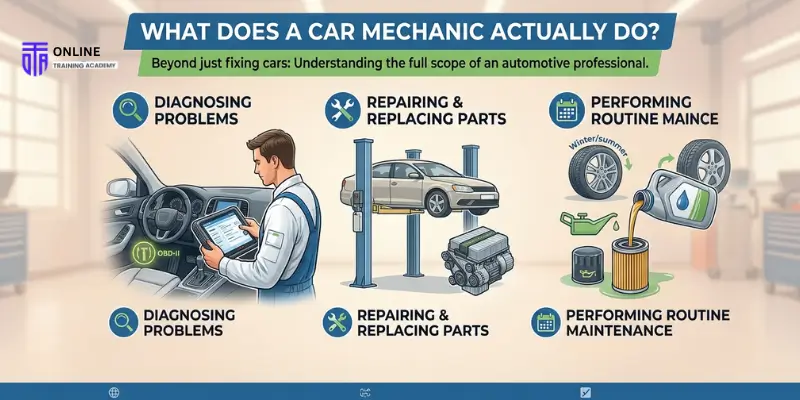
At its core, the job of an automotive professional is to maintain the safety, reliability, and efficiency of vehicles.
Diagnosing Problems
Before a single bolt is turned, a mechanic must be a detective. This involves listening to the customer’s description of the issue, performing a physical inspection, and plugging in sophisticated diagnostic scanners to read the vehicle’s On-Board Diagnostics (OBD-II) codes. It is a process of elimination: identifying the root cause rather than just treating the symptom.
Repairing and Replacing Parts
Once the issue is identified, the repair begins. This might be a simple fix, such as replacing a worn serpentine belt, or a complex operation, like diagnosing a transmission failure or addressing a hybrid-electric battery fault.
Performing Routine Maintenance
A significant portion of a shop’s daily workflow is preventive. In Canada, where extreme temperature fluctuations take a massive toll on rubber, fluid, and metal, routine maintenance is vital. Oil changes, seasonal tyre swaps, cooling system flushes, and filter replacements are the lifeblood of a healthy vehicle.
What Are the Main Responsibilities of a Car Mechanic?
The responsibilities of an automotive professional go far beyond “fixing things.” Every job has a level of liability that directly impacts the safety of the driver, their passengers, and the public on Canadian roads.
Ensuring Vehicle Safety
Safety is the guiding principle of the trade. Every repair—from changing a headlight bulb to replacing brake rotors—must be executed to manufacturer specifications. In Canada, where road conditions can change from clear pavement to black ice in minutes, a well-maintained braking or steering system is the difference between a safe stop and a collision. Mechanics follow rigid protocols, utilize torque wrenches to ensure bolts are tightened correctly, and perform “road tests” to verify the vehicle’s safety.
Communicating with Customers
A huge part of the day involves “service advising.” Many customers find cars intimidating and expensive. A good mechanic must be able to translate complex mechanical problems into clear, plain-language explanations. They must explain why a repair is necessary and, just as importantly, distinguish between a safety-critical repair (like leaking brake lines) and a future maintenance item (like a worn cabin air filter). Building this trust is how a shop stays in business.
Managing Time and Workload
Auto shops are fast-paced. A mechanic might have three different vehicles assigned to them at once: one waiting for parts, one in the middle of a teardown, and one scheduled for a quick maintenance check. The ability to manage these jobs efficiently is called “flat-rate” performance in many shops—meaning the ability to complete high-quality work within the allotted time. It requires discipline, organization, and the ability to maintain quality even when the phone is ringing and customers are waiting.
A Day in the Life of a Canadian Auto Technician
No two days are the same, but the rhythm of the shop is constant.
The Morning Routine The day usually starts at 7:30 or 8:00 AM. Mechanics review the day’s “work orders,” which list the tasks assigned to them. They check if the necessary parts have been ordered, organize their tools, and prepare the bay.
Business Hours: Getting Hands-On The bulk of the day is spent in the shop. This is physical, labor-intensive work. A mechanic might spend the morning on their feet performing a full-vehicle inspection, followed by an afternoon using a hoist to lift a vehicle to perform a transmission swap. It is mentally draining as well, especially when hunting for an intermittent electrical short that refuses to show up on a scanner.
End-of-Day Tasks Before the shop closes, the mechanic must document every step of the work performed. This documentation is crucial for the vehicle’s history and warranty records. They also clean their workspace, ensure the shop is hazard-free for the next morning, and put away specialized tools.
The Three Types of Mechanics
As vehicles evolve, so does the specialization within the trade.
1.General Mechanics: The backbone of the shop, handling everything from routine maintenance to general repairs.
2.Specialist Mechanics: Technicians who focus on specific systems, such as engine performance, drivelines, or specialized heavy-duty diesel engines.
3.Diagnostic Technicians: The “masterminds” of the modern shop. They focus entirely on identifying complex, computer-related faults that generalists might struggle to pin down.
Why Specialization Matters in Canada Modern vehicles are essentially computers on wheels. With the rapid rise of Electric Vehicles (EVs) and Hybrid-Electric Vehicles (HEVs) in the Canadian market, the need for technicians trained in high-voltage safety and battery management has never been higher. Specialization is what allows a shop to keep up with these technological shifts.
What Skills Make a Great Car Mechanic?
The best mechanics aren’t necessarily the ones who work the fastest; they are the ones who combine logic, precision, and physical stamina.
1. Technical Knowledge
A deep understanding of physics, electricity, and mechanics is non-negotiable. You need to know how fuel combustion, hydraulic pressure, and voltage interact. Because modern cars are complex, this also means staying updated with software updates and manufacturer service bulletins. In Canada, this often means pursuing continuous education through organizations like the Canadian Apprenticeship Forum.
2. Problem-Solving Ability
When a car doesn’t start, the answer isn’t always the battery. A good mechanic uses a logical process: gather data, form a hypothesis, test it, and verify the result. They don’t just throw parts at the car hoping it fixes the problem; they use their mind to narrow down the fault.
3. Attention to Detail
A misplaced bolt or a sensor that wasn’t clipped in properly can cause a car to fail on the highway. High-level technicians follow the “measure twice, cut once” philosophy. They adhere strictly to the vehicle manufacturer’s torque specs and service procedures.
4. Physical and Mental Stamina
The job is tough on the body—bending, lifting, standing on concrete, and working in freezing temperatures in unheated shops. But the mental stamina is equally important. You must stay focused on the details of an engine repair even after four hours of work, knowing that a single lapse could be dangerous.
The Evolution of the Trade: Digital Transformation
In the last two decades, the mechanic’s toolbox has expanded from iron and steel to include high-end laptops, oscilloscopes, and cloud-based diagnostic software. In Canada, shops are investing heavily in training for technicians to handle the influx of advanced driver-assistance systems (ADAS) like lane-keep assist and automatic emergency braking. Understanding these systems is now a core requirement of the job, moving the profession into a space that is as much about data analysis as it is about mechanical assembly.
This digital shift has also changed how mechanics learn. Instead of relying solely on physical manuals, Canadian technicians now spend a significant portion of their professional development time in online modules, watching manufacturer webinars, and participating in virtual training sessions to understand new hybrid architectures.
The Reality of Shop Safety
Safety in a Canadian garage is a serious legal and ethical commitment. Because technicians work with heavy loads, high-voltage batteries, and hazardous materials like used motor oil and refrigerant, the Occupational Health and Safety (OHS) standards are incredibly strict. Mechanics are responsible for wearing proper Personal Protective Equipment (PPE), ensuring hoists are inspected annually, and disposing of hazardous waste according to provincial environmental regulations. This responsibility requires a mindset of vigilance that stays “switched on” from the moment the shop opens until the last tool is cleaned.
Why You Should Appreciate Your Local Technician
When you drop your car off, you are paying for more than just a part swap. You are paying for:
➽Decades of acquired experience: The ability to “hear” what is wrong with an engine based on the sound it makes.
➽Expensive infrastructure: The cost of the lifts, diagnostic computers, and specialty tools required to work on your specific vehicle.
➽Accountability: The legal guarantee that the work has been performed to safety standards, keeping you and your family safe on high-speed Canadian highways.
A mechanic who does their job well is the guardian of your mobility. They ensure that when you turn the key or push the start button, you reach your destination without incident.
Career Path and Opportunities in Canada
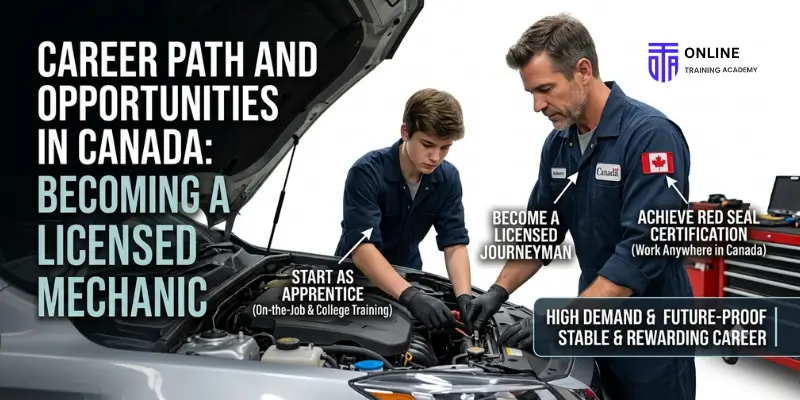
In Canada, the trade is highly respected and well-structured.
➽Apprenticeship: Most mechanics begin as apprentices, working under a licensed Journeyman. This is a combination of on-the-job training and technical schooling at a community college.
➽Red Seal Certification: This is the national standard in Canada. Achieving a Red Seal endorsement allows a mechanic to work anywhere in the country with recognized credentials. It is the gold standard for job mobility and wage potential.
➽Advancement: From apprentice, you can become a Journeyperson, a Shop Foreman, a Service Manager, or eventually open your own independent repair facility.
With a massive shortage of skilled tradespeople across Canada, there has never been a better time to enter this field. The career is future-proof, stable, and highly rewarding for those with the right work ethic.
Conclusion
A car mechanic’s job is often underestimated—at least until you find yourself stranded on the side of a Canadian highway in February.
Behind every successful repair is a complex blend of theoretical knowledge, deep experience, and structured problem-solving. It is a profession that demands lifelong learning, as cars are evolving faster than almost any other consumer technology.
It is a career that offers stability, a constant challenge, and the satisfaction of knowing you are keeping your neighbors safe. So, the next time you drop your keys at the service desk, remember that you are handing them over to a highly trained professional who is tasked with keeping the lifeline of our country—our vehicles—running smooth and safe. Knowing what happens on the other side of the garage door doesn’t just make you a better customer; it helps you appreciate the skill, discipline, and dedication required to keep the world in motion. This trade is not just about fixing machines; it is about providing the security and freedom that comes with reliable transportation.
FAQs
In Canada, the most professional title is Automotive Service Technician (AST).
“Technician” usually implies a focus on electronics and diagnostics, while “mechanic” is a broader term. Neither is better; they are different specializations within the same trade.
They diagnose issues, manage parts inventories, execute mechanical repairs, perform scheduled maintenance, and document all work for customer records.
Yes, extremely. The automotive trade is currently experiencing a labor shortage, and skilled technicians with Red Seal certification are highly sought after by dealerships and independent shops.
Yes. It involves heavy lifting, prolonged standing, working in awkward positions, and dealing with extreme temperatures. It requires a high level of physical fitness.
Yes. You can specialize in transmission repair, heavy-duty diesel engines, electrical systems, or the growing field of Electric Vehicle (EV) servicing.
A good mechanic will always show you the old parts, provide an itemized estimate before starting work, and explain the “why” behind the repairs in language you can understand.
While not mandatory in every province to work on cars, Red Seal certification is the standard for professionalism, higher pay scales, and inter-provincial recognition in Canada.
Learn More





Get a FREE Course
- Learn useful skills online free
- Get CPD accredited certificate
- Add it to your CV today!