


Most people assume that working in a Canadian kitchen—whether it’s a bustling Vancouver sushi bar, a classic Montreal diner, or a high-end Toronto bistro—is something you just learn on the job. You watch the head chef, copy the seasoned line cooks, and you’re good to go. It feels practical, fast, and deeply ingrained in restaurant culture. But this informal “shadowing” approach is precisely why foodborne illness outbreaks continue to challenge the Canadian hospitality and food service sectors.
Learning strictly by observation means you are inheriting habits—both the good and the incredibly dangerous. You might see a task being performed, but you rarely learn the why behind it. You follow the steps, but you don’t understand the microscopic risks that those steps are meant to mitigate. This creates critical gaps in safety. Small oversights might not cause an immediate issue, but over time, they lay the groundwork for a major public health incident.
Food handling is not just a routine task of chopping, cooking, and plating; it is a highly controlled scientific process where every single action affects consumer safety. The way raw poultry is stored in a walk-in fridge, the exact internal temperature a burger reaches, the precise dilution of the sanitizing spray—each step plays a foundational role in preventing contamination. Missing or misunderstanding even one of these steps introduces risks that are completely invisible to the naked eye.
This is exactly why formal, government-approved training is not just beneficial—it is legally essential in Canada. Training provides a rigid structure where guesswork and “kitchen lore” usually exist. It explains the biological and chemical reasons behind the rules. Instead of merely mimicking actions, trained food handlers understand the complex system they are working within. Certification takes this a step further. It sets a national and provincial standard. It creates accountability, ensuring that before a worker ever touches a customer’s meal, they have proven they understand how to keep that customer safe.
If you are looking to build a career in the Canadian food industry, understanding the landscape of Food Handler Certification is your very first step.
Food Handler Certification
Learn the essential principles of food safety, hygiene, and safe food handling practices to help reduce contamination risks and maintain clean food preparation environments. This course provides practical knowledge for handling, storing, and preparing food safely.
Table of Contents
The Canadian Legal Landscape: CFIA, SFCR, and Provincial Laws
To understand food safety in Canada, you must understand how the laws are structured. Unlike some countries that rely on a single national rulebook for every restaurant, Canada operates on a tiered regulatory system.
At the federal level, organizations like Health Canada and the Canadian Food Inspection Agency (CFIA) set the overarching standards. They dictate the macro-level rules through the Safe Food for Canadians Regulations (SFCR). This federal legislation governs food that is imported, exported, or traded across provincial borders. It mandates strict traceability, recall procedures, and the implementation of Preventive Control Plans (PCPs).
However, if you are working in a standard retail environment—like a restaurant, cafe, catering company, or food truck—your day-to-day operations are governed by provincial and municipal public health laws. These are the laws that strictly dictate who needs a Food Handler Certificate, how many certified staff must be on-site, and how public health inspectors will grade your establishment.
Provincial Breakdown: Who Needs to be Certified?
Because health regulations are provincial, the exact legal requirements for Food Handler Certification vary depending on where in Canada you live and work.
➽ Ontario: Under the stringent Ontario Regulation 493/17 (Food Premises), every operator of a food service premise must ensure that there is at least one food handler or supervisor on the premise who has completed an approved food handler training program during every single hour the premise is operating. If the certified person goes on a lunch break or ends their shift, another certified person must take their place.
➽ British Columbia: BC’s Food Premises Regulation under the Public Health Act mandates that every operator of a food business must hold an approved certificate. Furthermore, whenever the operator is absent, at least one employee present must hold a valid BC-approved food safety training certificate.
➽ Alberta: The Alberta Food Regulation requires food businesses to employ staff who have obtained an Alberta-approved Food Handler Certification. If there are six or more food handlers working at once, at least one person with a valid certificate must be present.
➽ Manitoba and Saskatchewan: Similar to BC and Ontario, these provinces require the person in charge to be certified. In Winnipeg, specifically, if there are more than five employees on duty, a certified supervisor must be present during all operating hours.
➽ The Maritimes and Territories: Provinces like Nova Scotia and Newfoundland & Labrador require that anyone who comes into direct contact with food must be trained to a level appropriate for their activity, and inspectors can demand proof of this training on the spot.
Regardless of your province, the trend is clear: Canadian health authorities are cracking down on uncertified kitchens. Having a fully certified staff is no longer a bonus; it is the baseline for keeping your doors open.
Core Food Safety Concepts Every Canadian Food Handler Must Understand
Canadian food handler training is incredibly comprehensive. It goes far beyond “wash your hands.” To pass the certification exam, you must demonstrate a deep understanding of the following core concepts, which are tailored to Health Canada’s strict guidelines.
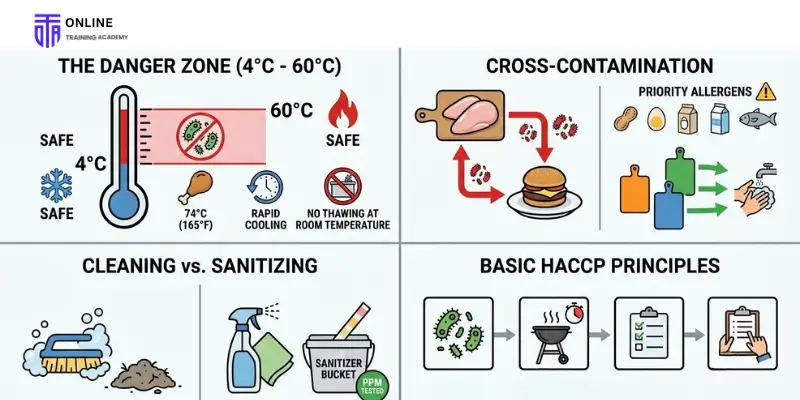
1. Time and Temperature Control (The Danger Zone)
In Canada, the “Temperature Danger Zone”—the range in which harmful bacteria multiply the fastest—is strictly defined as being between 4°C and 60°C (40°F and 140°F). Food handlers must learn how to rapidly cool hot foods to get them out of this zone quickly, how to properly thaw frozen meats (never on the counter at room temperature!), and the specific internal cooking temperatures required for different proteins. For instance, in Canada, a whole piece of chicken must reach a minimum internal temperature of 74°C (165°F) to be considered safe.
2. Cross-Contamination and Priority Allergens
Cross-contamination happens when harmful bacteria or allergens transfer from one surface or food item to another. In a busy Canadian kitchen, this is the leading cause of foodborne illness. Handlers are trained on the strict separation of raw and ready-to-eat foods, including the use of color-coded cutting boards and designated prep stations. Furthermore, Health Canada recognizes specific priority allergens, including peanuts, tree nuts, sesame, milk, eggs, seafood (fish, crustaceans, and shellfish), soy, wheat, and mustard. A certified food handler understands how to prevent allergen cross-contact, which can cause fatal anaphylactic reactions.
3. Cleaning vs. Sanitizing
Many uncertified workers use these terms interchangeably. They are not the same. Cleaning removes visible dirt, grease, and food debris using soap and water. Sanitizing reduces the number of invisible microscopic bacteria to safe levels using chemicals (like quaternary ammonium or chlorine bleach) or extremely hot water. Canadian health inspectors will frequently test a kitchen’s sanitizer buckets using chemical test strips to ensure the parts-per-million (PPM) concentration meets provincial standards.
4. HACCP Principles
Hazard Analysis and Critical Control Point (HACCP) is an internationally recognized system that is heavily integrated into the Canadian food industry. While full HACCP certification is its own massive undertaking, basic food handler training introduces the concept of identifying “critical control points”—such as the exact moment a burger finishes cooking on the grill—and establishing strict limits to ensure safety at that exact moment.
What Skills Do You Need to Be a Food Handler?
Passing a multiple-choice exam is only the beginning. To truly succeed as a food handler in Canada, you must translate theoretical knowledge into rapid, high-pressure execution.
Technical Skills:
➽ Thermometer Calibration: Knowing how to properly calibrate a probe thermometer using the ice-water method to ensure your temperature readings are legally accurate.
➽ FIFO Inventory Management: “First In, First Out.” You must possess the organizational skills to rotate stock effectively, ensuring older ingredients are used before newer deliveries to prevent spoilage.
➽ Chemical Handling: Understanding Workplace Hazardous Materials Information System (WHMIS) basics to safely mix, dilute, and store commercial cleaning chemicals without contaminating the food supply.
Behavioural and Soft Skills:
➽ Unyielding Consistency: A food handler must maintain their safety standards even when the restaurant is slammed with a Friday night rush. Cutting corners when you are busy is how outbreaks happen.
➽ Clear Communication: Kitchens are loud and chaotic. You must be able to clearly communicate when a surface has been contaminated, when an allergen order is on the line, or when a fridge’s temperature is dropping.
➽ Professional Courage: If you see a senior chef drop a piece of fish on the floor, rinse it off, and try to serve it, you must have the professional integrity to speak up. Accountability is the cornerstone of a food safety culture.
How to Get Your Food Handler Certificate in Canada (Step-by-Step)
The process of becoming a certified food handler in Canada is accessible, relatively inexpensive, and highly structured. Here is how you do it:
Step 1: Choose an Approved Training Provider You cannot just take any random course you find online. The course must be approved by your specific Provincial Ministry of Health or local Public Health Unit. You can often take the course directly through your municipal public health office (e.g., Toronto Public Health, Vancouver Coastal Health), or through a federally recognized private provider like Canadian Food Safety or FoodSafetyTraining.ca.
Step 2: Complete the Coursework Most Canadian certification courses take between 6 to 8 hours to complete. The curriculum will cover microbiology, personal hygiene, receiving and storing food, preparation, serving, and facility sanitation.
Step 3: Pass the Proctored Exam This is a critical point: under Canadian government regulations, the final certification exam must be proctored. If you take the course online, you will usually have to complete the final exam via a live webcam with an authorized proctor watching you to ensure no cheating occurs. You typically need a score of 70% or higher to pass.
Step 4: Maintain Your Certification In Canada, a Food Handler Certificate is not valid for life. In almost all provinces, the certification expires after five years. Once it expires, you must undergo a recertification process or challenge the exam again to ensure your knowledge reflects the most current Health Canada guidelines.
Online vs. In-Person Training: Which is Better?
Since the pandemic, the landscape of food safety training in Canada has shifted heavily toward digital platforms, but both methods have distinct advantages.
Online Training offers incredible flexibility. Recognized providers offer government-approved courses that you can complete 24/7 on your smartphone or laptop. This is ideal for busy hospitality workers pulling erratic shift hours. The modern online modules use interactive videos, quizzes, and digital flashcards to keep the material engaging.
In-Person Training, often hosted by local public health units or community colleges, provides tangible, hands-on experience. You get to hold a calibrated thermometer, practice using chemical test strips, and ask complex, scenario-based questions directly to a certified public health inspector. If you are someone who struggles with self-paced digital learning, an in-person, one-day intensive classroom session is the superior choice.
Career Growth in the Canadian Food Industry

A Food Handler Certificate is frequently viewed as an entry-level requirement, but it is actually the foundation for significant career upward mobility within the Canadian food sector.
With a few years of practical experience and this baseline certification, a line cook or server can easily transition into lucrative leadership roles. You can become a Kitchen Manager or Sous Chef, roles that demand strict oversight of the restaurant’s entire food safety protocol.
If you want to step away from the physical demands of the kitchen, this knowledge base is the perfect springboard to become a corporate Food Safety Auditor for large restaurant franchises, or to work as a Quality Assurance (QA) technician in Canada’s booming food manufacturing and processing sector. Ultimately, if your goal is to open your own restaurant, bakery, or food truck, mastering these regulations is non-negotiable; public health inspectors will not grant you an operating license if you cannot prove you know how to protect the public.
Common Training Mistakes in Canadian Kitchens
The biggest failure in the Canadian food industry is not a lack of training; it is a lack of application. Many workers treat the certification as a one-time bureaucratic hoop to jump through. They memorize the temperatures, pass the webcam exam, get the PDF certificate, and immediately revert to their old, unsafe habits.
Another massive mistake is complacency due to experience. Often, the most dangerous people in a kitchen are the veterans who have “been doing it this way for twenty years without making anyone sick.” They rely on anecdotal luck rather than scientific standards. Food safety laws evolve. The pathogens we face today (like antibiotic-resistant strains of Salmonella) are different than they were two decades ago.
Finally, kitchens often fail by treating food safety as a solo endeavor. Training only works when it becomes the shared culture of the establishment. If management praises speed and punishes the time it takes to properly sanitize a station, the training is rendered utterly useless. The culture must dictate that safety always overrides speed.
Conclusion
Training turns the chaotic, high-pressure environment of a commercial kitchen into a space of controlled, deliberate action. It replaces dangerous guesswork with structured, scientific thinking, where every step has a distinct purpose and every decision is rooted in clear safety principles. Instead of relying on blind habit or assumption, a certified Canadian food handler works with profound awareness—understanding both the immediate task and the severe public health risks hiding just out of sight.
Most food safety failures in Canada do not happen maliciously. They happen because well-meaning, overworked people fail to recognize a risk in the moment. Training builds that instant recognition. It teaches you to see what others completely overlook—a subtle temperature drop in a fridge, a risky cutting board placement, a minor hygiene gap—and empowers you to correct it before it becomes an outbreak.
In the fast-paced world of Canadian hospitality, possessing knowledge is simply not enough. Information without immediate action is useless. What matters is your discipline to apply that knowledge during a chaotic Saturday night dinner rush. Discipline ensures that the correct, legal process is followed every single time, not just when a health inspector is standing in the room. By pursuing your certification and taking it seriously, you are not just getting a piece of paper; you are becoming an active guardian of public health.
FAQs
Generally, yes, but with caveats. Because the core principles of food safety are universal, many provinces have reciprocity agreements and will recognize a certificate issued by another Canadian provincial health authority. However, you should always check with your local municipal health inspector, as some strict municipalities may require you to challenge their specific local exam.
It is highly affordable. Depending on the provider, an online course and proctored exam typically cost between $25 and $50 CAD. In-person classes run by public health units usually cost between $40 and $80 CAD.
Yes. To accommodate Canada’s diverse hospitality workforce, many approved providers and public health units offer the course and the exam in French, Mandarin, Punjabi, Spanish, Tagalog, and Arabic.
Yes. The exam is designed to rigorously test your knowledge. However, most online providers in Canada offer unlimited free retakes of the exam if you do not achieve the mandatory 70% passing grade on your first attempt.
Learn More





Get a FREE Course
- Learn useful skills online free
- Get CPD accredited certificate
- Add it to your CV today!