

You scroll through job listings on Canadian education portals like Make A Future or ApplyToEducation, and you keep seeing the same title: Educational Assistant (EA) or Special Education Assistant (SEA). The school-year hours—generally 8:30 AM to 3:30 PM with summers off—look incredibly manageable. The work itself feels deeply meaningful. But one question stops you every single time: How do you actually get started in a Canadian school board?
This is where the vast majority of people get stuck. Many prospective applicants assume you need a four-year Bachelor of Education degree or years of specialized, high-level childcare experience. Others look at international advice from the US or the UK, where you can often walk into a Teacher’s Aide role with nothing more than a high school diploma and a clean background check.
The truth is that the Canadian public education system operates under strict, heavily unionized standards. School boards across the country are certainly looking for reliable, empathetic people who can manage complex classroom behaviours. But they also require specific certifications, clearances, and a deep understanding of how to support diverse learning needs.
If you are looking to transition from retail, healthcare, corporate administration, or hospitality into the Canadian school system, your soft skills—patience, de-escalation, and teamwork—are exactly what principals are desperate for. But you still have to navigate the structural requirements of provincial education ministries.
This comprehensive guide breaks down exactly what the role demands, what you actually earn, and the precise, step-by-step path to securing a permanent position as an Educational Assistant in Canada.
Teaching Assistant Course
Learn the key responsibilities, skills, and best practices of an Educational Assistant, including how to support students, promote inclusive learning, and contribute to a positive educational environment. Discover how Educational Assistants work alongside teachers to help create engaging, supportive, and effective learning experiences for all students.
Table of Contents
What Does an Educational Assistant Actually Do?
To understand how to get the job, you first need to understand the realities of the modern Canadian classroom. Over the last two decades, Canadian provinces have aggressively adopted an “inclusive education” model. This means that students with severe cognitive, behavioural, physical, and emotional challenges are integrated into mainstream classrooms alongside their peers, rather than being separated into dedicated special-education facilities.
Because a single classroom teacher cannot possibly deliver the curriculum while simultaneously managing the intensive, one-on-one needs of students with severe exceptionalities, the Educational Assistant becomes the structural backbone of the classroom.
An Educational Assistant is not a “teacher in training,” and you are not responsible for designing the curriculum, grading papers, or delivering whole-class lectures. Instead, your primary directive is to execute the Individualized Education Plan (IEP) for specific students.
Your day-to-day responsibilities will generally fall into three distinct categories:
1. Academic Support and Scaffolding
While the teacher delivers a math lesson to a class of twenty-five students, you might be sitting at a pod with three students who process information differently. You will break down the teacher’s instructions into manageable steps, utilize visual aids, help students use speech-to-text software, or quietly re-direct a student with ADHD who has lost focus. You are the bridge that allows a student to actually access the curriculum.
2. Behavioural and Emotional De-escalation
This is often the most challenging and critical aspect of the role. Many students you work with will have exceptionalities such as Autism Spectrum Disorder (ASD), Fetal Alcohol Spectrum Disorder (FASD), or Oppositional Defiant Disorder (ODD). When a student becomes overstimulated or frustrated, it is the EA’s job to recognize the triggers before a meltdown occurs. You will employ trauma-informed strategies to de-escalate situations, remove students to sensory rooms, and keep the rest of the classroom safe during behavioural outbursts.
3. Physical Care and Life Skills
Depending on the specific assignment within the school board, EAs frequently assist students with severe physical disabilities or developmental delays. This can include assisting a student who uses a wheelchair to navigate the school, helping students with physical therapy exercises, or assisting with personal care routines such as feeding, dressing, and toileting.
The real value of an EA is found in the emotional labour. You are the person who notices when a student is quietly struggling. You are the trusted adult that a frustrated child feels safe enough to talk to. It is incredibly demanding work, both physically and emotionally, but it offers a level of direct, daily impact that very few professions can match.
Navigating the Canadian Landscape: Titles, Provinces, and Unions
Education in Canada is a provincial responsibility, not a federal one. Because of this, the terminology, requirements, and union structures change depending on where you live.
➽ Ontario, Alberta, and Manitoba: The role is almost universally referred to as an Educational Assistant (EA). In Ontario, EAs are heavily represented by the Canadian Union of Public Employees (CUPE), which dictates seniority, hiring practices, and wage scales. In Alberta, EAs are employed by public boards like the Calgary Board of Education (CBE) and the Edmonton Public School Board (EPSB), often supported by the Alberta Union of Provincial Employees (AUPE) or local staff associations.
➽ British Columbia: The role is most commonly referred to as a Special Education Assistant (SEA) or sometimes an Education Assistant (EA). British Columbia has incredibly strict certification requirements, particularly in major districts like the Surrey School District or the Vancouver School Board, where a specific, recognized SEA certificate is absolutely mandatory for public board employment.
➽ Quebec: The role is often referred to as a Special Education Technician or Attendant to Handicapped Students. The requirements here often align with specific CEGEP diplomas in Special Care Counselling.
Regardless of the province, working in a public school board means you are stepping into a unionized environment. This is crucial to understand because it dictates how you apply, how you are interviewed, and how you eventually secure a permanent job. You do not simply hand a resume to a principal and get hired full-time. You must follow the unionized hiring grid, which heavily prioritizes seniority.
Do You Need a Degree? (The Certification Reality)
One of the biggest misconceptions prospective EAs have is that they need a Bachelor’s degree in Education or Psychology. You do not.
However, you do need post-secondary education. The days of walking into a Canadian public school and getting a job as an EA with just a high school diploma and a friendly demeanor are largely over. While highly remote northern school districts (such as in Nunavut or the Northwest Territories) or certain private schools might hire uncertified individuals as “relief” staff due to extreme shortages, the vast majority of urban and suburban Canadian school boards require a formal credential.
What you need is an Educational Assistant Certificate or Diploma from a recognized public community college or an accredited private vocational college.
These programs are highly practical and are designed specifically for the realities of the Canadian classroom. Over the course of your studies, you will dive deeply into:
- Childhood and adolescent cognitive development.
- Understanding specific exceptionalities (Autism, Down Syndrome, FASD, learning disabilities).
- Augmentative and alternative communication (AAC) technology.
- Trauma-informed practice and crisis intervention.
- The legalities of education in your province (privacy laws, reporting child abuse, and human rights).
These programs are accessible. Many community colleges offer them as one-year (two-semester) certificate programs, or two-year diploma programs. Furthermore, recognizing that many people transition into this career later in life, colleges frequently offer these programs part-time, online, or in the evenings to accommodate adults who are currently working full-time in other industries.
The 5-Step Blueprint to Becoming an EA in Canada
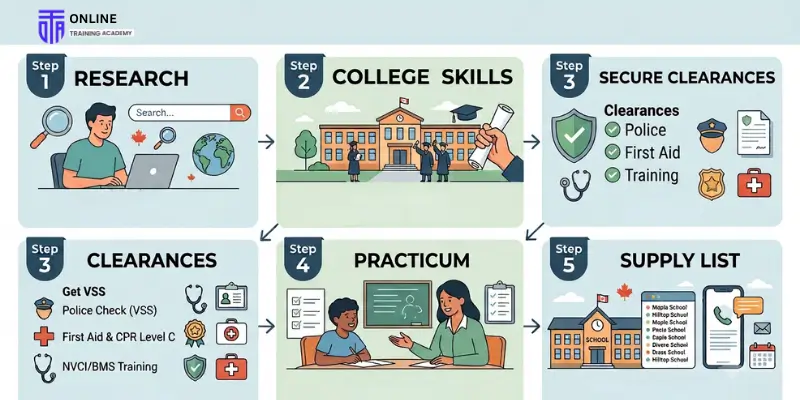
If you have decided that this is the career for you, here is the exact, chronological roadmap to moving from a complete beginner to a hired Educational Assistant in a Canadian school board.
Step 1: Research Your Local Board’s Specific Requirements
Before you spend a single dollar on tuition, you must determine exactly what the school boards in your area demand. Go to the careers page of your local public and Catholic school boards (for example, the Peel District School Board in Ontario, or the Burnaby School District in BC). Look for current job postings for “Educational Assistant” or “Casual EA.”
Read the “Required Qualifications” section meticulously. The board will list exactly which college programs they recognize. If you live in an area with multiple school boards (which is common in Canada, where public, Catholic, and sometimes Francophone boards overlap), ensure the college program you select is recognized by all of them to maximize your future employment options.
Step 2: Complete an Accredited College Program
Enroll in a recognized Educational Assistant or Special Education Assistant program. Public community colleges (like Seneca College in Ontario, Bow Valley College in Alberta, or Langara College in BC) are generally the gold standard. Private vocational colleges also offer accelerated programs, but you must verify that your local school board accepts their specific diploma before enrolling.
Throughout the program, focus heavily on the practical courses. Pay special attention to behaviour management modules. When you eventually interview with a school board, they will rarely ask you about educational theory; they will ask you scenario-based questions like, “A student has thrown a chair across the room and is refusing to leave the classroom. Walk us through your exact next steps.” Your college coursework is what prepares you to answer those questions safely and professionally.
Step 3: Secure Your Clearances and Certifications
You cannot step foot in a Canadian classroom—even as a student doing a practicum—without satisfying strict legal and safety clearances. You will need to gather these documents before you finish your program:
➽ Police Information Check with a Vulnerable Sector Search (VSS): This is a specialized, deep-level criminal background check conducted by your local police service or the RCMP. It searches for federal pardons for sexual offences. It is a non-negotiable legal requirement for anyone working with children in Canada. Note that processing times can take anywhere from two weeks to two months depending on your municipality, so apply early.
➽ First Aid and CPR Level C: You must hold a current, valid certificate from a recognized provider like the Red Cross or St. John Ambulance.
➽ Non-Violent Crisis Intervention (NVCI) or Behaviour Management Systems (BMS): These are specialized, hands-on training courses that teach you how to verbally de-escalate aggressive behaviour and, only as an absolute last resort, how to safely physically restrain a student who is a danger to themselves or others. Many college programs include this in their curriculum; if yours does not, you will likely need to acquire it independently.
Step 4: Dominate Your Practicum Placement
Nearly all accredited EA programs conclude with a practicum—a multi-week, unpaid placement inside a local elementary or secondary school.
Do not view this simply as a graduation requirement; view it as a month-long job interview. The teachers, resource staff, and principals you interact with during your practicum are the people who will write your references. School board hiring managers lean heavily on practicum evaluations.
To succeed in your practicum, show relentless initiative. Do not wait for the teacher to tell you what to do. If a student drops their pencils, help them pick them up. If a group is struggling with a worksheet, pull up a chair and offer to read the questions aloud. Ask the teacher questions about the students’ IEPs. Show that you are reliable, punctual, and eager to take the load off the classroom teacher.
Step 5: Apply to the "Casual" or "Supply" List
In the Canadian public school system, you almost never apply for a permanent, full-time job right out of college. Because of union rules, permanent positions are awarded internally based on seniority.
To get into the system, you must apply to the board’s “Casual” or “Supply” EA list. When an EA calls in sick, takes a maternity leave, or goes on a specialized training day, the board uses the casual list to fill that absence.
Working as a supply EA can be intimidating at first. You will be sent to different schools, working with different students, and navigating different school cultures every day. However, this is the ultimate proving ground. By taking consistent supply shifts, you introduce yourself to various principals across the district. When a long-term position (like a maternity leave cover) opens up at a school where you have supplied regularly and proven your competence, the principal will often request you specifically. Accumulating hours as a casual EA builds your union seniority, which eventually allows you to successfully bid on permanent, full-time positions.
The Financial Reality: Salary, Benefits, and Pensions
If you are entering this field, you must go in with a clear understanding of the financial realities. Being an Educational Assistant in Canada provides incredible job security and world-class benefits, but it is not a high-income profession.
The Wage Scale
According to current data from the Government of Canada’s Job Bank for 2026, wages vary significantly depending on the province and the specific school board.
➽ Entry-Level / Low End: Approximately $18.00 to $21.00 per hour (More common in Atlantic Canada or rural districts).
➽ Median Range: Approximately $25.00 to $28.00 per hour (Standard for urban boards in Ontario, Alberta, and Manitoba).
➽ High End: $30.00 to $34.00+ per hour (Common for experienced EAs in British Columbia, the Northwest Territories, or specialized behavioural EAs at the top of their grid).

The 10-Month Pay Structure
This is the most critical financial factor to understand: Educational Assistants are only paid for the hours they work, and school is only in session for 10 months of the year.
Even if you make a highly competitive $29.00 per hour, you are typically only working 6.5 to 7 hours a day, for roughly 194 school days a year. This means a permanent EA’s gross annual salary generally lands between $35,000 and $45,000 CAD.
You are not paid for the two months of summer vacation, the two weeks of winter break, or the week of March break. To survive this financially, many EAs rely on one of two strategies:
➽ Employment Insurance (EI): Because the layoff over the summer is out of the employee’s control, permanent EAs in Canada are generally eligible to collect federal Employment Insurance during July and August.
➽ Summer Employment: Many EAs take on summer jobs working in municipal summer camps, private tutoring, or respite care for families with children who have special needs, leveraging their specialized skills for premium private rates.
The Hidden Financial Value: Benefits and Pension
While the annual take-home pay is modest, the total compensation package is exceptional due to union negotiations. Permanent EAs in Canadian public boards receive robust extended health care, dental, and vision benefits that cover everything from prescription drugs to massage therapy and orthotics.
Furthermore, EAs are enrolled in municipal or provincial government pension plans (such as OMERS in Ontario or the Municipal Pension Plan in BC). These are defined-benefit pension plans—some of the most secure and lucrative retirement vehicles available in the modern economy. The long-term financial security provided by these pensions often offsets the lower annual salary for many professionals.
Is Being an Educational Assistant Right For You?
This is not a job you take simply because you want summers off. The burnout rate for Educational Assistants is high precisely because people underestimate the physical and emotional toll of the work.
You will be kicked, yelled at, and challenged by students who lack emotional regulation. You will spend hours trying to teach a foundational concept to a child, only to have them forget it the next day. You will feel the heartbreak of seeing brilliant, wonderful children struggle against systemic barriers and their own neurological challenges.
But you will also be the person who witnesses the breakthrough. You will be there the day a non-verbal student uses their communication tablet to tell a joke for the first time. You will be the reason a student with severe anxiety feels safe enough to walk through the front doors of the school. You will watch students you have supported for years walk across the stage at graduation, knowing with absolute certainty that they would not have made it there without your daily, relentless support.
If you possess a deep well of patience, a thick skin, and a genuine desire to advocate for vulnerable youth, becoming an Educational Assistant is one of the most fundamentally vital roles in the Canadian workforce.
Conclusion: Is the EA Path Right for You?
Choosing to become an Educational Assistant in Canada is a decision to trade the pursuit of a high-salary corporate career for a life of direct, human-centric impact. It is a path defined by profound challenges, but for those who find fulfillment in advocacy and student growth, it is a deeply rewarding vocation.
The journey requires a strategic commitment—completing a college program, navigating provincial certification, and building your reputation within the unionized structure of a public school board. It requires resilience, as you will work on the front lines of student crisis, academic frustration, and complex emotional landscapes. You must be prepared for the financial realities of a term-time role, including the need to manage your income during the summer months.
However, the rewards are equally substantial: a pension that secures your future, a benefits package that protects your health, and the daily satisfaction of being the bridge between a student and their potential.
If you are someone who thrives on patience, possesses a gift for de-escalating tension, and finds purpose in supporting the most vulnerable members of the next generation, you are exactly the person Canadian school boards are waiting for. The shortage of qualified support staff is critical, and the schools need people like you—not perfect candidates, but reliable, informed, and compassionate ones—to step into the classroom.
Your next step is simple: research the EA diploma program at your local community college, check the specific certification requirements for your provincial school boards, and begin the process of obtaining your Vulnerable Sector Check. The gap between your current role and a permanent position in a Canadian school is simply a matter of focused, step-by-step preparation.
FAQs
Yes. There is a chronic, nationwide shortage of qualified EAs across almost every public school board in Canada. The push toward inclusive education over the last decade drastically increased the need for support staff, and boards are constantly recruiting for their casual supply lists to keep up with daily absences and growing student needs. Once you are certified and cleared, finding consistent work is rarely an issue.
Yes, provided they meet immigration requirements. International students studying an Educational Assistant program at an accredited Canadian college must ensure their study permit allows for off-campus work to complete the mandatory practicum. Furthermore, the college must be a Designated Learning Institution (DLI) that qualifies for the Post-Graduation Work Permit (PGWP) program, allowing the student to legally work for a school board upon graduation.
Absolutely. Canada is a bilingual country, and French Immersion programs are incredibly popular across all English-speaking provinces. School boards frequently struggle to find EAs who are fluent in both English and French to support students within these immersion programs. If you possess business-level fluency in French, you will often bypass the long wait times on the casual list and secure long-term or permanent roles much faster than unilingual candidates.
While being an EA gives you incredible classroom experience, it does not legally qualify you to teach in Canada, nor does it count as credit toward a teaching degree. To become a teacher, you must hold a recognized undergraduate degree and then complete a Bachelor of Education (B.Ed.) to become certified by your provincial College of Teachers (e.g., the OCT in Ontario). However, many universities view EA experience highly favourably when reviewing B.Ed. admissions applications.
While the EA role itself is often viewed as a destination career, the experience is highly transferable. Many EAs use their school board experience to transition into roles such as Speech-Language Pathologist Assistants (SLPA), Occupational Therapist Assistants (OTA), specialized Behaviour Interventionists (BI) working privately with families, or Child and Youth Care Workers (CYW) dealing with severe behavioural interventions at the district level.
Learn More





Get a FREE Course
- Learn useful skills online free
- Get CPD accredited certificate
- Add it to your CV today!