


The traditional model of administrative employment has fundamentally broken down. In the current Canadian corporate landscape, hiring a permanent, full-time employee to manage administrative tasks is frequently an operational bottleneck rather than a solution. For small-to-medium enterprises (SMEs), high-growth startups, real estate brokerages, and independent consultancies across Canada, traditional hiring introduces heavy fixed overhead, complex labor liabilities, and rigid structural friction.
Virtual Assistant (VA) and Virtual Personal Assistant (PA) services have transitioned from a tactical outsourcing trend into a core operational strategy. They offer access to elite fractional talent, predictable cost structures, and elastic scalability without the long-term commitments of standard payroll.
However, navigating the Canadian virtual support market requires more than simply hiring the cheapest resource on a global freelance board. It requires a deep understanding of structural sourcing options, precise cost-benefit ratios, data security compliance under Canadian law, and systematic onboarding. This comprehensive master guide analyzes the reality of utilizing Virtual PA systems within Canada to drive true organizational leverage.
The Macro Shifts: Why Canadian Enterprises are Embracing Fractional Admin Support
The acceleration of the virtual administrative economy is driven by shifting corporate dynamics, rising operational costs, and the evolution of cloud-based business architecture.
1. The Cost of Local Corporate Infrastructure
Operating a brick-and-mortar office in major Canadian metropolitan centers like Toronto, Vancouver, Calgary, or Montreal carries an immense premium. Beyond real estate leases, equipping an in-house assistant with enterprise-grade hardware, dedicated desk space, and office utilities escalates the baseline cost of an administrative seat far beyond their stated wage. Virtual PAs eliminate physical infrastructure costs entirely; they supply their own secure workstations, redundant high-speed internet connections, and localized remote environments.
2. The Rise of the Fractional Executive Assistant
Many executives and business owners do not require a full 40-hour-a-week administrative resource. Often, their actual high-impact administrative workload amounts to 10, 15, or 20 hours per week.
In a traditional hiring model, this results in paying for “empty hours”—idle time where an employee is clocked in but underutilized. The virtual model introduces the concept of fractional support, allowing organizations to purchase highly concentrated, expert administrative hours tailored precisely to their operational volume.
3. The Shift from Generalists to Specialists
An in-house administrative generalist may be highly capable of handling calendar management and physical office organization, but they may lack the technical proficiency required to manage advanced tech stacks. The virtual PA market allows companies to pivot between specialized skill sets seamlessly. A business can utilize a dedicated executive scheduler on Mondays, an experienced QuickBooks bookkeeper on Wednesdays, and a tech-savvy CRM manager on Fridays, often through a single managed agency.
Virtual Assistant
Explore the essentials of Virtual PA and VA services in this comprehensive guide, covering costs, hiring models, key benefits, operational strategies, and scaling systems. Learn how businesses can improve efficiency, streamline administrative tasks, and choose the right virtual support solution to meet their evolving needs.
Table of Contents
Strategic Financial Architecture: The True Cost of In-House vs. Virtual Support
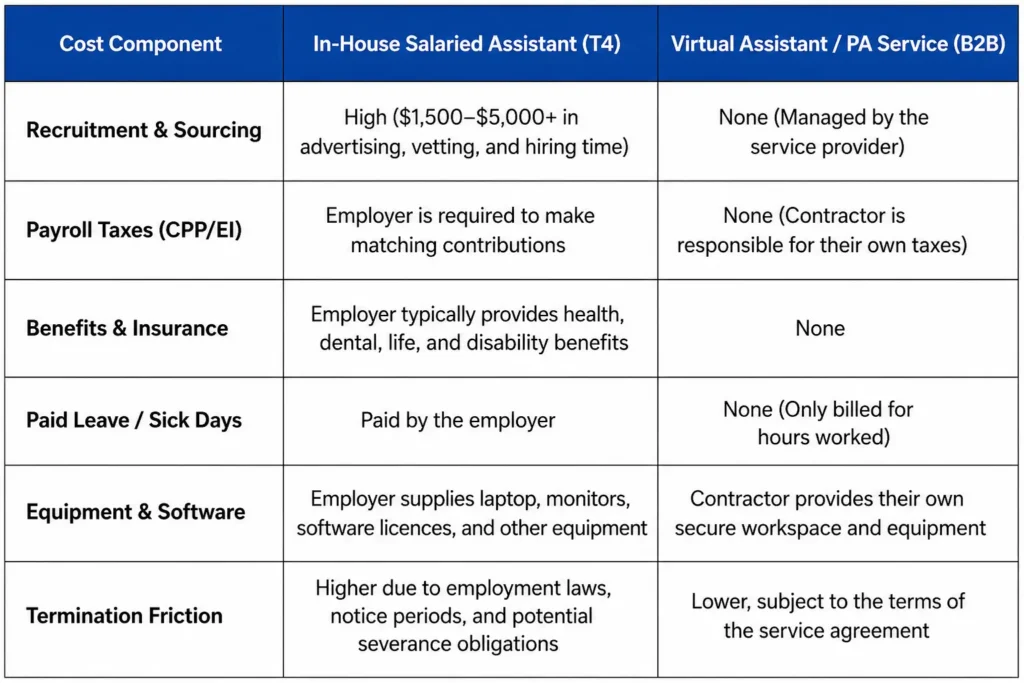
To make an objective operational decision, Canadian business owners must move past simple hourly wage comparisons and calculate the Fully Burdened Cost of Labor. When you hire a T4-salaried employee in Canada, their stated salary represents only a fraction of their true cost to the business.
The True Burden of a Salaried Canadian Employee
When an employee is added to a Canadian payroll, the employer is legally and structurally responsible for multiple mandatory contributions and overhead costs:
➽ Canada Pension Plan (CPP): Employers must match the employee’s CPP contributions, which scale with the Year’s Maximum Pensionable Earnings (YMPE).
➽ Employment Insurance (EI):Employers pay $1.4\times$ the employee’s premium rate.
➽ Provincial Workers’ Compensation: Mandated fees to provincial bodies such as WSIB in Ontario, WorkSafeBC, or WCB Alberta to cover workplace injury liabilities.
➽ Paid Time Off (PTO) & Statutory Holidays: Legally mandated vacation pay (typically 4–6% minimum) plus statutory holiday pay across provinces.
➽ Severance & Legal Liabilities: The financial risk associated with termination notices, common-law severance, and potential wrongful dismissal claims.
➽ Extended Health Benefits: Corporate health, dental, and vision insurance premiums required to attract competitive local talent.
The Virtual Assistant Financial Model
A virtual assistant operates as an independent contractor or through a business-to-business (B2B) corporate agency. This structurally shifts the financial framework:
$$\text{Fully Burdened In-House Cost} = \text{Base Salary} + \text{CPP/EI Matches} + \text{Benefits} + \text{PTO} + \text{Hardware/Office Overhead}$$
$$\text{Virtual Support Cost} = \text{Stated B2B Rate} \times \text{Productive Hours Worked}$$
Under the virtual framework, you pay exclusively for productive minutes spent executing tasks. There is no payment for coffee breaks, social interactions, or idle desk time. If a task takes 42 minutes, you are billed for exactly 42 minutes.
Core Operational Capabilities: What a Premium Virtual PA Executes
The modern Virtual PA is an operations coordinator capable of managing complex, digital workflows.
Executive Administration & Information Triage
At the foundational level, a Virtual PA acts as an executive gatekeeper. They manage high-volume email inboxes using custom labels, sorting rules, and urgent-escalation protocols.
They coordinate executive diaries across conflicting calendars, protecting focus blocks while ensuring high-priority client meetings are seamlessly integrated. This includes tracking time differentials for national operations stretching across Canada’s six time zones.
Financial Administration & Bookkeeping Support
Premium VAs are frequently certified in modern cloud accounting applications like QuickBooks Online or Xero. Working under the high-level guidance of your company’s corporate CPA, they manage the day-to-day financial pipeline:
- Reconciling bank accounts and corporate credit card statements.
- Generating, dispatching, and following up on accounts receivable invoices.
- Organizing accounts payable schedules to optimize corporate cash flow.
- Categorizing receipts and expenses to simplify end-of-year corporate tax filings and input tax credit (ITC) claims for GST/HST.
Specialized Canadian Industry Workflows
Unlike general overseas data-entry clerks, specialized Canadian Virtual PAs possess deep domain expertise tailored to local regulatory environments:
➽ Real Estate Operations: VAs operating within the Canadian real estate sector are trained to manage compliance documentation required by provincial regulators (such as RECO in Ontario or BCFSA in British Columbia). They handle web-based transaction management software like Lone Wolf, draft standard OREA or BCREA forms, and coordinate listing inputs on local MLS systems (TRREB, REBGV).
➽ FINTRAC Compliance Assistance: In fields like real estate, finance, and legal services, VAs assist in compiling and auditing Identity Verification and Third-Party Determination forms to ensure rigorous adherence to federal Anti-Money Laundering (AML) regulations.
➽ Bilingual Client Relations: Operating across Canada requires navigating the linguistic realities of the country. Bilingual Virtual PAs offer fluent, business-level execution in both English and French, allowing companies based in western or central Canada to seamlessly support clients throughout Quebec and New Brunswick.
Analyzing the Sourcing Market: Sourcing Models for Canadian Businesses

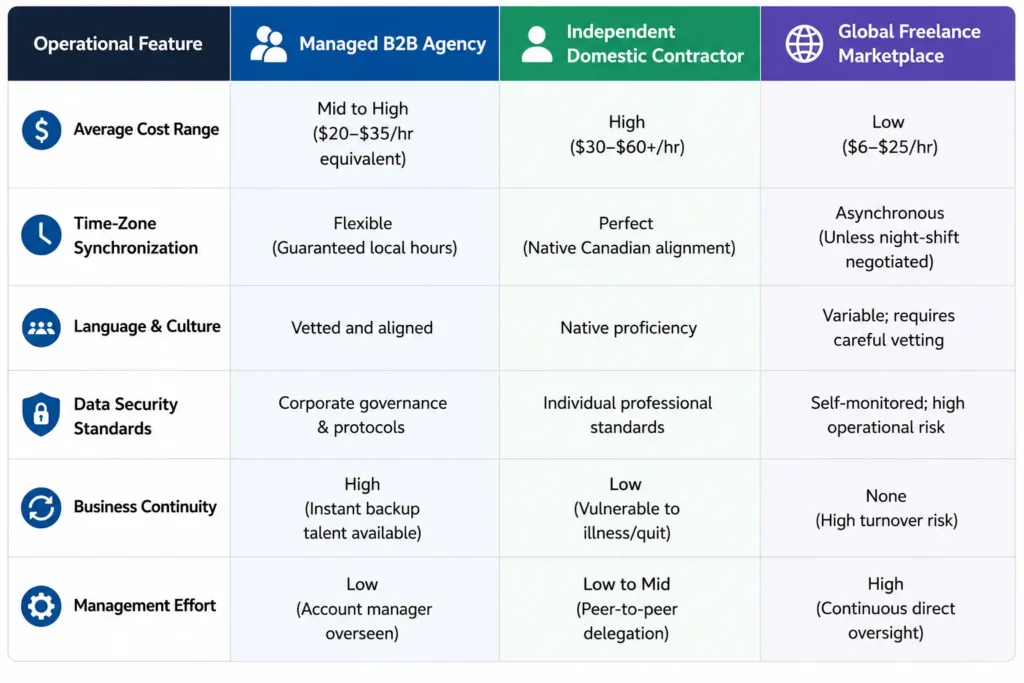
When integrating virtual support into your organizational structure, you must select from three distinct sourcing models. Each possesses explicit trade-offs regarding cost, management investment, and operational security.
1. Managed B2B Virtual Assistant Agencies
Under this model, you contract with an established corporate entity that acts as an intermediary. The agency recruits, background-checks, and directly employs the assistant. They match you with a VA based on your technical requirements and oversee performance metrics.
➽ The Pricing Structure: Typically structured as structured monthly retainers ranging from $1,000 to $3,500+ CAD per month, depending on whether you require a part-time (10–20 hours/week) or full-time (40 hours/week) dedicated resource.
➽ The Pros: Highest operational reliability. If your assigned assistant falls ill, takes vacation, or departs the company, the agency is contractually obligated to immediately insert a fully trained, vetted replacement without disrupting your business continuity. They provide built-in management oversight and enforce device-level security protocols.
➽ The Cons: Higher cost per hour compared to direct offshore hiring due to the agency’s management and infrastructure markup.
2. Independent Domestic Canadian Contractors
These are individual administrative professionals running independent sole proprietorships or incorporated freelance businesses within Canada. Many are former corporate executive assistants or project coordinators who have chosen to operate remotely.
➽ The Pricing Structure: Standardized hourly consulting rates generally ranging from $30 to $60+ CAD per hour, often sold in monthly blocks (e.g., a 20-hour monthly package).
➽ The Pros: Deep cultural, legal, and operational alignment. They possess a natural understanding of Canadian business etiquette, provincial regulations, and localized banking or tax logistics. There are zero language barriers, and they work synchronously within your local time zone.
➽ The Cons: High premium pricing. Additionally, because you are dealing with an individual sole proprietor, there is no built-in structural redundancy—if they take time off or experience a personal emergency, your support halts immediately.
3. Global Freelance Marketplaces (Upwork, Fiverr, Hubstaff Talent)
This model involves using international digital platforms to source independent offshore contractors directly, primarily located in regions such as the Philippines, Latin America, or Eastern Europe.
➽ The Pricing Structure: Extreme cost elasticity, with hourly rates spanning from $6 to $25 CAD per hour.
➽ The Pros: Unbeatable cost reduction. Allows lean startups and solo entrepreneurs to scale out repetitive, high-volume data entry and technical sorting tasks with minimal capital allocation.
➽ The Cons: Maximum management overhead. You assume 100% of the risk associated with vetting skills, managing daily output, monitoring data security, and navigating cultural or linguistic nuances. Churn rates are historically high, requiring continuous reinvestment in training.
Data Security, Governance, and Risk Mitigation under Canadian Law
A major operational failure when outsourcing tasks to a remote worker is neglecting data governance. When you grant an external virtual assistant access to your corporate servers, client databases, and communication channels, you expose your firm to strict liability if a data breach occurs.
Maintaining PIPEDA Compliance
In Canada, the collection, usage, and storage of consumer data are governed by the federal Personal Information Protection and Electronic Documents Act (PIPEDA), alongside distinct provincial frameworks like Alberta’s PIPA, BC’s PIPA, and Quebec’s stringent Law 25 (formerly Bill 64).
Under PIPEDA, your organization remains directly accountable for personal identifiable information (PII) even when it is transferred to a third-party contractor or global agency. PII includes names, home addresses, personal email addresses, credit history, and medical records.
➽ The Principle of Least Privilege: Never grant an assistant root administrative access to your entire digital infrastructure. Use role-based access controls to isolate their workspace strictly to the folders and software tools required to complete their daily assignments.
➽ Centralized Credential Governance: Under no circumstances should you email or text raw passwords to a virtual assistant. Utilize enterprise password orchestration vaults like 1Password or LastPass. This allows you to securely share access to applications (like your corporate LinkedIn, CRM, or scheduling engine) without exposing the underlying plaintext passwords. Access can be instantly revoked with a single click.
➽ Multi-Factor Authentication (MFA): Enforce mandatory multi-factor authentication across all cloud accounts. If a virtual assistant accesses your Google Workspace or Microsoft 365 environment, the login must be validated via an authenticator app, preventing unauthorized access if credentials are leaked.
➽ Secure Infrastructure: Mandate that your virtual assistant connect to your systems via a secure, encrypted Virtual Private Network (VPN). Ensure their local hardware features active firewalls and updated antivirus protocols. If utilizing a managed agency, verify that their remote operations centers enforce physical and digital security audits.
➽ Legal Protections: Before exchanging data, execute a binding, cross-border Non-Disclosure Agreement (NDA) and a clear Data Processing Addendum that outlines liability, ownership of intellectual property, and immediate data-destruction protocols upon termination of the contract.
Sourcing Model Comparison Matrix
Choosing the right structure requires balancing budget against risk and management capacity.
Conclusion
Virtual PA and Assistant services have evolved from a basic cost-cutting alternative into a sophisticated mechanism for building a lean, hyper-efficient corporate structure. By treating remote administrative talent not merely as an isolated task resource, but as an integrated operational system, modern Canadian organizations can unlock significant leverage.
The formula for success requires a disciplined approach: choose a sourcing model that matches your risk tolerance, protect your company data with strict privacy controls, and delegate assignments via well-documented standard operating procedures. When executed correctly, a virtual assistant stack allows you to eliminate administrative friction, control your operational overhead, and redirect your executive focus toward strategy and growth.
FAQs
Yes. Fees paid to a Virtual PA service or an independent virtual contractor are classified as an eligible operating expense by the Canada Revenue Agency (CRA). These expenses are fully deductible against your gross corporate or self-employment income, typically filed under “Subcontracting Fees,” “Management Fees,” or “Office Expenses” on your T2 corporate tax return or Form T2125 for sole proprietors. If hiring a domestic contractor, ensure they provide proper invoices detailing their business registration and GST/HST numbers where applicable, allowing you to claim corresponding Input Tax Credits (ITCs).
The CRA monitors independent contractor relationships closely to prevent “personal services business” misclassification. The distinction rests on four pillars:
- Control: Do you dictate exactly how, when, and where the work is performed, or do they control their own methodology?
- Ownership of Tools: Does the assistant use your company-provided computer and software accounts, or do they supply their own hardware infrastructure?
- Chance of Profit / Risk of Loss: Is their income fixed regardless of efficiency, or do they manage their own operational expenses and profitability margins?
- Integration: Is their role fundamentally embedded in your core business structure, or do they operate as an independent external service provider with multiple clients?
A properly structured Virtual PA relationship through a B2B agreement or independent contractor contract safely isolates your business from retroactive payroll liabilities.
Yes, a global or offshore virtual assistant can manage your day-to-day transaction logging, expense categorization, and receipt organization inside cloud platforms like QuickBooks or Xero. However, they should act strictly as an administrative clerk. They cannot provide specialized Canadian tax advice or execute corporate tax filings. Your final accounting review, financial statement preparation, and annual CRA returns should always be executed by a designated Canadian CPA to ensure full compliance with provincial and federal tax codes.
You should consider transitioning to an in-house employee when your administrative workflows require a consistent, physical presence or specialized on-site touchpoints. Key indicators include:
- The role involves handling physical mail, managing local office infrastructure, or overseeing local inventory.
- The position requires hosting face-to-face corporate events or providing in-person hospitality to high-net-worth clients.
- Your daily operational volume requires deep, real-time integration into your local office culture and immediate, physical cross-departmental collaboration.
If your administrative workflows are fully digital, cloud-native, and executable asynchronously, a virtual model can scale with your business indefinitely.
Many premium global agencies based in regions like the Philippines explicitly operate on a night-shift schedule to provide seamless, real-time coverage during Canadian business hours (EST, PST, MST, etc.). If you are hiring an independent contractor directly through a freelance platform, you must explicitly negotiate time-zone synchronization during the vetting process. For tasks like inbox management or customer service triage, real-time alignment is critical; for data entry, research, or content design, an asynchronous workflow can operate successfully.
Independent domestic Canadian VAs generally establish their operational schedules based on their home province’s statutory calendar. For instance, an assistant based in Toronto will observe Ontario statutory holidays (such as Family Day or Civic Holiday), while an executive based in Vancouver might operate on a different schedule. Ensure your service level agreement explicitly outlines which provincial statutory holidays will be observed to prevent scheduling friction or unexpected service pauses during critical operations.
Learn More





Get a FREE Course
- Learn useful skills online free
- Get CPD accredited certificate
- Add it to your CV today!