


Most organisations do not lose customers because of one major failure. They lose them through a pattern of small, repeated friction points that signal inefficiency, inconsistency, or lack of attention. A delayed response here, a vague answer there, a request to repeat information across channels—these moments accumulate and shape perception far more than any single positive interaction.
Customers today evaluate service with a different standard. They expect speed, but also clarity. They expect convenience, but also relevance. They expect systems to work, but also people to understand them. Delivering excellent customer service is no longer about isolated interactions. It is about building a connected system where skills, processes, channels, and technology work together to reduce effort and increase confidence at every stage.
This article examines how to deliver excellent customer service in practice, focusing on execution rather than theory. It breaks down the capabilities required, the systems that support them, and the structural decisions that separate average service from high-performing service operations.
What Does It Mean to Deliver Excellent Customer Service?
Delivering excellent customer service means consistently enabling customers to achieve their goals with minimal effort, while reinforcing trust through clarity, reliability, and responsiveness. It is not defined by friendliness alone, nor by speed alone. It is defined by how effectively a business reduces uncertainty and resolves friction across the customer journey.
Operational Excellence vs Perceived Excellence
A business may have efficient internal processes, but if the customer experiences delays or confusion, the service is perceived as poor. Excellence must be measured from the customer’s perspective, not internal metrics alone.
Consistency as a System, Not an Outcome
Consistency is not achieved through intention. It is achieved through systems, training, and clearly defined standards. Without these, service quality varies between agents, channels, and situations.
Effort Reduction as a Core Principle
Customers evaluate service based on how easy it is to get help. Reducing effort—fewer steps, less repetition, faster resolution—has a direct impact on satisfaction and loyalty.
How to Deliver Excellent Customer Service: Skills, Channels, Automation and Future Trends
Excellent customer service combines strong communication, multiple support channels, and smart automation to meet customer needs. Future trends such as AI, personalisation, and digital support continue to shape customer experiences. Understanding these developments helps organisations deliver consistent and effective customer service.
Table of Contents
How to Deliver Great Customer Service in Practice
Execution is where most businesses struggle. Delivering excellent service requires translating principles into repeatable actions.
Accurate Problem Identification
Many service failures begin with incorrect diagnosis. Agents respond to what is said rather than what is meant. Effective service requires identifying the root issue, not just the visible symptom. This reduces repeated contact and shortens resolution time.
Structured and Outcome-Focused Communication
Customers do not need lengthy explanations. They need clarity. Effective communication follows a structure: acknowledge the issue, explain the cause if relevant, present the solution, and define the next steps. This approach reduces ambiguity and builds confidence.
Ownership and Resolution Accountability
Customers expect a clear point of responsibility. When ownership is unclear, issues are passed between teams, leading to delays and frustration. Assigning ownership ensures that the issue is tracked and resolved without unnecessary handoffs.
Closing the Interaction Loop
Resolution is not complete until the customer understands and confirms it. Follow-ups, confirmations, and clear closure reduce uncertainty and prevent re-contact.
Customer Service Channels: Building an Effective Channel Strategy
Channels are not just communication tools. They define how customers access support and how efficiently issues are resolved.
Channel Selection Based on Interaction Type
Different channels serve different purposes. Complex issues often require phone or live interaction. Simple queries can be handled through chat or self-service. Aligning channel use with issue complexity improves efficiency.
Avoiding Channel Fragmentation
When channels operate independently, customers are forced to repeat information. This increases effort and reduces satisfaction. Integration ensures continuity across interactions.
Designing for Omnichannel Consistency
Customers expect a clear point of responsibility. When ownership is unclear, issues are passed between teams, leading to delays and frustration. Assigning ownership ensures that the issue is tracked and resolved without unnecessary handoffs.
Customer Service Automation: Strategic Use, Not Replacement

Automation is often misunderstood as a replacement for human interaction. Its real value lies in supporting efficiency while preserving service quality.
Where Automation Adds Value
Automation is effective for repetitive, predictable tasks such as answering common questions, routing requests, and providing instant updates. It reduces workload and improves response speed.
Where Automation Fails
Automation lacks contextual understanding and emotional awareness. It struggles with complex, unique, or sensitive issues. Over-reliance leads to frustration.
Hybrid Service Models
The most effective systems combine automation with human support. Automation handles volume, while human agents handle complexity. This balance improves both efficiency and experience.
Key Skills Required for High-Quality Customer Service
Skills determine how effectively systems are used. Without strong skills, even well-designed processes fail.
Advanced Communication Skills
Communication must be precise, structured, and adaptable. It should remove ambiguity and guide the customer clearly toward resolution.
Analytical Thinking and Problem Diagnosis
Agents must assess situations quickly and identify root causes. This reduces resolution time and improves accuracy.
Emotional Intelligence Under Pressure
Service interactions often involve frustration or urgency. Managing these situations requires composure, empathy, and controlled responses.
Decision-Making Within Boundaries
Agents must balance company policies with customer needs. Effective decision-making ensures fair and efficient outcomes without unnecessary escalation.
Process Design: The Hidden Driver of Service Quality

Many customer service issues are often attributed to individual performance, but in reality, they stem from poorly designed processes. Even highly skilled teams struggle to deliver consistent service when workflows are unclear, overly complex, or disconnected. Strong process design creates the foundation for reliable, efficient, and high-quality service delivery.
Reducing Process Complexity
Complicated procedures increase both handling time and customer effort. When customers are required to follow multiple steps, provide repeated information, or navigate unclear instructions, frustration builds quickly. Simplifying processes—by removing unnecessary steps and making actions more intuitive—improves efficiency and creates a smoother experience for both customers and service teams.
Standardising Without Over-Scripting
Standardisation helps ensure consistency across interactions, but rigid scripts can limit flexibility. Customers expect responses that reflect their specific situation, not generic replies. Effective process design provides clear guidelines while allowing service agents to adapt their approach based on context. This balance maintains consistency without reducing quality.
Eliminating Repeat Contact Drivers
Recurring issues often indicate deeper process failures rather than isolated incidents. When customers repeatedly contact support for the same problem, it signals that the root cause has not been addressed. Identifying these patterns and resolving the underlying issues reduces contact volume, shortens resolution time, and improves overall satisfaction.
Designing for First-Contact Resolution
An effective process aims to resolve issues in a single interaction whenever possible. This requires clear access to information, decision-making authority for agents, and well-structured workflows. First-contact resolution reduces effort for the customer and improves operational efficiency.
Continuous Process Evaluation
Customer expectations evolve, and processes must adapt accordingly. Regular evaluation of workflows, based on data and feedback, ensures that service delivery remains efficient and relevant. Continuous improvement prevents processes from becoming outdated or inefficient over time.
The Future of Customer Service
Customer service is evolving rapidly, shaped by advances in technology and rising customer expectations. What was once reactive and channel-based is becoming predictive, connected, and experience-driven. Businesses that adapt to these changes will be better positioned to deliver consistent and efficient service at scale.
AI-Driven Support Systems
Artificial intelligence is increasingly handling routine interactions such as answering common questions, routing requests, and providing instant responses. This improves speed and allows businesses to manage higher volumes without compromising availability. However, AI works best when supporting human agents rather than replacing them. Complex, sensitive, or unique situations still require human judgement and understanding.
Predictive and Proactive Service Models
Customer service is shifting from reactive problem-solving to proactive support. Businesses are beginning to identify potential issues before customers report them, using data and behavioural insights. For example, notifying a customer about a delay before they ask reduces frustration and builds trust. This approach focuses on preventing problems rather than just resolving them.
Hyper-Personalisation
With access to more customer data, businesses can deliver more tailored interactions. Service agents can understand past behaviour, preferences, and previous interactions, allowing them to respond more effectively. This improves relevance and reduces the need for customers to repeat information, making interactions smoother and more efficient.
Integration Across Systems
Future service models will prioritise seamless integration across all platforms and channels. Customers expect to move between chat, email, phone, and other touchpoints without losing context. Integrated systems ensure that all customer data and interaction history are accessible, reducing repetition and improving continuity.
Balance Between Automation and Human Interaction
As technology advances, the challenge will be maintaining the right balance between automation and human support. While automation increases efficiency, human interaction remains essential for building trust and handling complex situations. The most effective service models will combine both in a way that enhances the overall experience.
Common Barriers to Delivering Excellent Customer Service
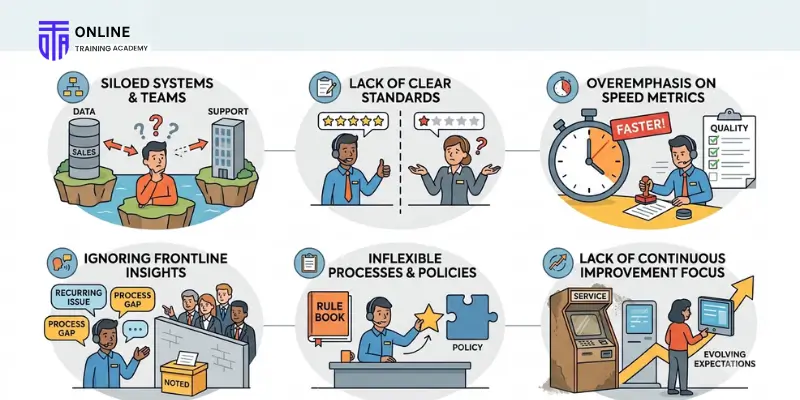
Understanding what prevents excellence is as important as knowing what enables it. Many organisations invest in tools and training, yet still struggle to deliver consistent service because underlying structural issues remain unaddressed. These barriers often operate quietly but have a direct impact on customer experience.
Siloed Systems and Teams
Disconnected systems create fragmented experiences and inefficiencies. When customer data, communication history, and service channels are not integrated, customers are forced to repeat information across interactions. This increases effort and frustration while slowing down resolution. Internally, teams work in isolation, which prevents a complete view of the customer journey and limits coordination.
Lack of Clear Standards
Without defined expectations, service quality varies widely between agents, teams, and channels. Customers may receive excellent service in one interaction and poor service in another, which creates inconsistency and reduces trust. Clear standards for response time, communication style, and resolution approach help ensure a uniform experience.
Overemphasis on Speed Metrics
Focusing only on speed can reduce service quality. Metrics such as response time and handling time are important, but when prioritised without balance, they encourage rushed interactions. This often leads to incomplete solutions and repeat contacts, which ultimately increase workload and lower customer satisfaction.
Ignoring Frontline Insights
Service agents interact with customers daily and have direct visibility into recurring issues, common frustrations, and process gaps. Ignoring their input means losing valuable insights that could improve both service and overall experience. Organisations that actively use frontline feedback are better positioned to identify root causes and implement effective improvements.
Inflexible Processes and Policies
Rigid processes can prevent service teams from adapting to individual situations. When agents are required to follow strict rules without room for judgement, they may deliver responses that are technically correct but practically ineffective. Flexibility within clear boundaries allows for better outcomes and more customer-focused decisions.
Lack of Continuous Improvement Focus
Customer expectations evolve, and service strategies must evolve with them. Organisations that treat customer service as a fixed function often fall behind. Continuous evaluation, feedback analysis, and process refinement are necessary to maintain high service standards over time.
Conclusion
Delivering excellent customer service is not achieved through isolated improvements or one-time efforts. It is the result of a well-aligned system where people, processes, and technology work together to reduce friction, improve clarity, and create consistency across every interaction.
Customers do not evaluate how much effort a business invests behind the scenes. They evaluate how easy it feels to get what they need. When interactions are clear, responses are timely, and transitions between channels are seamless, the experience feels reliable and effortless. That perception is what builds trust over time.
Businesses that succeed in customer service focus on removing unnecessary complexity rather than adding more layers. They listen to customer feedback, refine their processes continuously, and ensure that every interaction contributes to a smoother journey. They also recognise that service is not limited to support teams but extends across the entire organisation.
When customer service is delivered at a high level, it does not draw attention to itself. It simply works. Customers move through their journey without confusion or delay, and that ease becomes the reason they return.
FAQs
By identifying common issues, simplifying processes, and improving response clarity.
Automation improves efficiency but must be combined with human support for complex issues.
Because it saves time and reduces frustration, making the experience smoother.
Poor communication, lack of ownership, slow responses, and disconnected systems.
Learn More





Get a FREE Course
- Learn useful skills online free
- Get CPD accredited certificate
- Add it to your CV today!