
A care worker notices a small change in a resident’s behaviour. It looks minor. Easy to ignore. But that small change could signal a deeper issue. Acting too late can lead to harm. Acting too early without proper understanding can create unnecessary escalation. The difference lies in judgement, training, and confidence.
This is where a Level 3 Diploma in Health and Social Care becomes more than a qualification. It becomes a tool for making the right decisions at the right time.
Table of Contents
Benefits of Taking a Level 3 Diploma in Health and Social Care Certificate
The Level 3 Diploma in Health and Social Care Certificate provides learners with the knowledge and practical skills needed to work effectively in health and social care settings. The course helps develop communication, safeguarding, person-centred care, and professional practice skills while improving career opportunities. It also supports career progression, further education, and the ability to provide high-quality care to individuals in various healthcare and social care environments.
What is a Level 3 Diploma in Health and Social Care?
A Level 3 Diploma in Health and Social Care is a UK-recognised vocational qualification designed to prepare individuals for frontline roles in the care sector. It is equivalent to A-levels and focuses on practical, work-based learning rather than purely academic study.
The qualification develops the knowledge, skills, and behaviours required to support individuals safely and effectively in environments such as care homes, hospitals, and community services. It covers key areas including safeguarding, duty of care, communication, and person-centred support.
Unlike basic training courses, this diploma is structured to ensure learners can apply what they learn in real situations. Assessment is typically based on coursework and practical evidence, reflecting real workplace expectations.
At its core, the qualification bridges the gap between entry-level awareness and professional competence in UK health and social care settings.
What Are the Benefits of Taking a Level 3 Diploma in Health and Social Care Certificate?
This qualification provides a structured pathway into one of the UK’s most essential and regulated sectors. It does not just introduce concepts. It prepares individuals to operate within real care environments where safety, dignity, and accountability are constant priorities.
One of the most immediate benefits is employability. The UK health and social care sector continues to expand, driven by demographic changes and increasing demand for support services. Employers actively look for candidates who understand safeguarding, duty of care, and professional boundaries. This diploma signals that readiness.
It also builds practical capability. Learners develop skills that can be applied from day one in roles such as care assistant or support worker. These include assisting with daily activities, supporting mobility, and recognising changes in an individual’s condition.
Another major advantage is career progression. The qualification acts as a foundation for moving into more advanced roles or further education. Many professionals use it to progress into nursing, social work, or specialised care fields.
Key benefits include:
- Entry into a high-demand UK sector with consistent job opportunities
- Development of practical, job-ready skills
- Clear progression pathways into senior or specialised roles
- Increased confidence in handling real care situations
- Recognition by employers across NHS, private, and local authority settings
The value of the diploma lies in how it combines these benefits into a single structured learning experience.
What Does a Level 3 Diploma in Health and Social Care Cover?
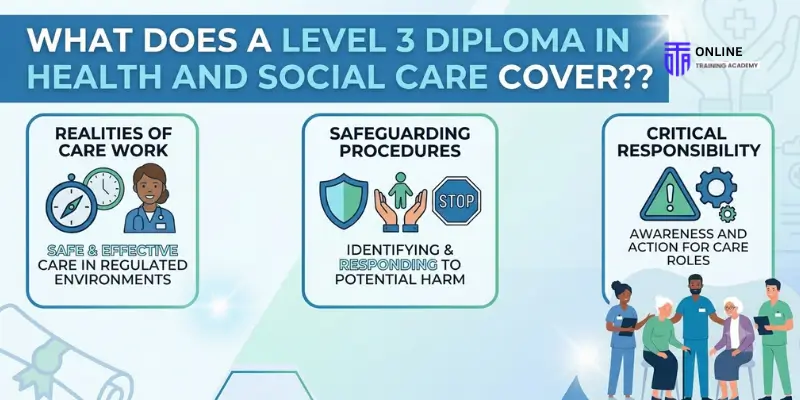
The course is designed around the realities of care work. It focuses on the knowledge and behaviours required to deliver safe and effective care in regulated environments.
Learners are introduced to safeguarding procedures, which involve identifying and responding to potential harm or abuse. This is a critical responsibility in any care role and requires both awareness and action.
Duty of care is another core area. It defines the legal and ethical responsibility to act in the best interests of individuals receiving care. Understanding this concept helps professionals make decisions that align with both policy and human need.
The qualification also emphasises equality, diversity, and inclusion. Care must be delivered in a way that respects each individual’s background, preferences, and rights. This is not optional. It is a requirement in UK care standards.
Core areas typically include:
- Safeguarding and protection in care settings
- Duty of care and legal responsibilities
- Communication in professional relationships
- Health and safety within care environments
- Promoting equality, diversity, and inclusion
Assessment is usually based on coursework and practical evaluation. This approach ensures that learners can demonstrate competence rather than simply recall information.
Why Do Health and Social Care Values Matter?
Values are often misunderstood as abstract ideas. In reality, they shape every action taken in a care setting.
Respect for dignity ensures that individuals are treated as people with choices, not tasks to complete. Confidentiality builds trust, especially when sensitive information is involved. Compassion ensures that care is delivered with understanding rather than routine detachment.
In the UK, regulators such as the Care Quality Commission assess how well these values are applied in practice. Poor application can lead to complaints, investigations, or service failure.
Consider a simple situation. Two professionals provide the same type of support. One focuses on completing the task quickly. The other explains each step, involves the individual, and maintains their dignity. The difference is not in the task, but in the approach.
Core values include:
- Respect for dignity and individuality
- Confidentiality and trust
- Compassion and empathy
- Accountability in professional actions
These values guide behaviour when procedures alone are not enough.
How Does This Diploma Improve Skills and Professional Development?
This qualification develops a combination of technical, behavioural, and cognitive skills. It prepares learners for the complexity of real care environments.
At a practical level, learners gain experience in supporting daily living activities and monitoring health conditions. These skills form the foundation of most care roles.
Decision-making is another critical area. Care professionals often need to respond quickly to changes or concerns. The diploma trains learners to identify risks, assess situations, and take appropriate action.
Emotional intelligence is equally important. Working in care involves regular interaction with individuals who may be vulnerable or distressed. The ability to respond with empathy while maintaining professional boundaries is essential.
The diploma also strengthens professional conduct. This includes maintaining confidentiality, following organisational policies, and documenting actions accurately.
Key skill areas developed:
- Practical care delivery and support techniques
- Risk awareness and safeguarding decision-making
- Emotional intelligence and empathy
- Professional conduct and accountability
Over time, these skills contribute to stronger performance and greater career opportunities.
The Role of Communication Skills in Health and Social Care

Communication is central to safe and effective care. It affects how information is shared, how relationships are built, and how risks are managed.
Poor communication is a common cause of errors in care settings. Misunderstood instructions or incomplete reporting can lead to serious consequences. This makes communication a core focus of the diploma.
Learners are trained to listen actively and adapt their communication style based on the needs of the individual. For example, communicating with someone who has cognitive impairment requires a different approach than communicating with a colleague during a shift handover.
Documentation is also a key aspect. Accurate records ensure continuity of care and provide evidence of actions taken. In regulated environments, this documentation may be reviewed as part of inspections.
Essential communication capabilities include:
- Active listening and clear verbal interaction
- Adapting communication for different individuals
- Accurate reporting and record-keeping
- Recognising and responding to non-verbal cues
Effective communication reduces risk and improves the overall quality of care.
What Career Opportunities Can You Access After Completing the Diploma?
The qualification opens access to a wide range of roles within the UK care sector. It provides both entry points and progression pathways.
Many learners begin in entry-level roles such as care assistant or support worker. These roles are available across residential care, community services, and healthcare settings.
With experience, progression becomes possible. Individuals can move into senior care roles, team leadership positions, or specialised areas such as mental health or disability support.
Typical roles include:
- Care Assistant
- Support Worker
- Healthcare Assistant
- Residential Support Worker
Progression opportunities include:
- Senior Care Worker
- Team Leader roles
- Pathways into nursing or social work
The sector offers long-term stability due to ongoing demand for qualified professionals.
How Flexible Is the Level 3 Health and Social Care Diploma?
Flexibility is a key advantage of this qualification. It is designed to accommodate different lifestyles and commitments.
Many providers offer online or blended learning options. This allows learners to study at their own pace while managing work or personal responsibilities.
Assessment methods are also more flexible than traditional academic courses. Coursework and practical evaluations replace exam-heavy formats, making the qualification more accessible.
Common study formats include:
- Online learning with tutor support
- Blended learning combining theory and practice
- Classroom-based learning for structured environments
This flexibility makes the course suitable for career changers, working professionals, and school leavers.
Why Choose a Health and Social Care Course?
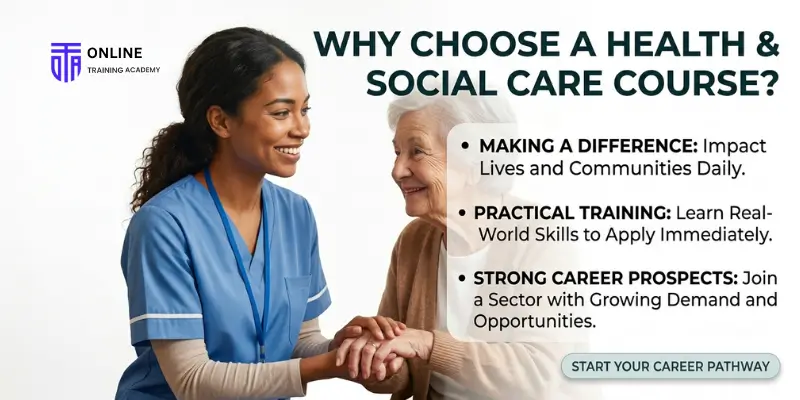
Choosing this course means entering a profession that requires both competence and responsibility. It is not passive work. It involves decision-making, accountability, and direct impact on individuals’ lives.
The course is suitable for those who prefer practical learning and want to develop skills that can be applied immediately. It also offers a clear pathway into a sector with strong demand and long-term opportunities.
Reasons to choose this course include:
- A career with direct human impact
- Clear progression and development pathways
- Stable employment opportunities in the UK
- The ability to make meaningful contributions to individuals’ lives
This combination of purpose and practicality makes it a strong career choice.
Conclusion
A Level 3 Diploma in Health and Social Care prepares individuals for more than employment. It prepares them for responsibility.
It builds the ability to act with confidence, communicate effectively, and deliver care that meets both professional and human standards. It also creates opportunities for long-term growth in a sector that continues to expand.
The real value of this qualification becomes clear in moments that require action. When a situation demands judgement, training becomes the difference between uncertainty and clarity.
That shift is what defines a capable professional in health and social care.
FAQs
Yes, it is equivalent in level but focuses on practical and vocational learning rather than academic study.
Yes, many learners move directly into entry-level roles such as care assistant or support worker.
No, most Health and social care courses are designed for beginners, although some practical placements may be required.
Yes, it is widely recognised across NHS, private, and local authority care providers.
Yes, it can be used as a foundation for further study in nursing, social work, and related fields.
Typically between 6 to 18 months depending on study mode and pace.
It requires commitment and practical understanding, but it is designed to be accessible with proper support.
Learn More



Get a FREE Course
- Learn useful skills online free
- Get CPD accredited certificate
- Add it to your CV today!