
Most people notice workplace safety only when something goes wrong. A worker gets injured. Stress builds until performance drops. An employee struggles to return after illness, and no one knows what support is needed. In these moments, occupational health and safety professionals become essential. They help organisations protect people, manage risk, and make better decisions before small issues become bigger problems.
That is one reason this field attracts so many people. It offers more than a job title. It offers practical impact. You work at the point where health, safety, law, wellbeing, and business operations meet. You help prevent harm, guide employers, support workers, and improve how workplaces function.
This career path also stands out because it is broad. Some professionals focus on health and safety compliance, risk assessment, and accident prevention. Others work in occupational health, supporting employee wellbeing, fitness for work, rehabilitation, and workplace adjustments. In many organisations, these areas overlap. That makes the field both challenging and valuable.
This guide explains why people choose occupational health and safety as a career, how professionals are trained, and what employees can expect from workplace health assessments. It also answers common questions about referrals, appointments, and what happens if someone is found unfit for work.
Table of Contents
Occupational Health and Safety Careers: Training, Qualifications, and What to Expect in Workplace Health Assessments
Occupational health and safety focuses on identifying common workplace hazards such as slips, falls, manual handling injuries, hazardous substances, fire risks, and stress-related issues. By following safety procedures, using protective equipment, receiving proper training, and reporting hazards promptly, employees and employers can create a safer work environment and reduce the risk of accidents and injuries.
Why Choose Occupational Health and Safety as a Career?
Choosing a career in occupational health and safety appeals to those who want work that is both practical and meaningful. It is a field where your decisions directly affect whether people stay safe, healthy, and able to do their jobs effectively.
One of the main reasons people enter this profession is the sense of purpose. You are not just improving systems—you are helping prevent injuries, reduce stress, and support employees in real situations. The impact is visible in both people’s wellbeing and workplace performance.
Another advantage is the variety of roles. Professionals can work across industries such as construction, healthcare, manufacturing, or corporate environments. Some roles are hands-on and site-based, while others focus on policy, compliance, or employee health support.
The field also offers strong career stability and growth. As workplaces become more complex, the demand for expertise in risk management, mental health, and legal compliance continues to increase. This creates clear progression into advisory, management, or consultancy roles.
For many, the biggest benefit is balance. It is a structured, professional career, but it remains people-focused. You are not only managing systems—you are helping create safer, healthier, and more sustainable workplaces.
What Does a Career in Occupational Health and Safety Actually Involve?
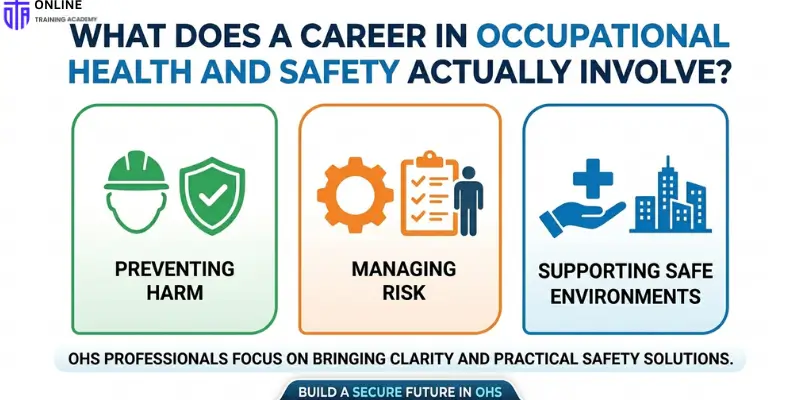
The field of occupational health and safety covers a wide range of roles, so understanding what professionals actually do helps bring clarity. At a practical level, these roles focus on preventing harm, managing risk, and supporting safe working environments.
A health and safety professional typically focuses on the workplace itself. They assess whether systems, tools, and behaviours are safe and compliant with legal standards. Their work often includes:
- Conducting risk assessments to identify hazards
- Carrying out site inspections and safety audits
- Investigating incidents and near-misses
- Delivering safety training to employees
- Developing policies and ensuring legal compliance
In contrast, an occupational health professional focuses more on the connection between work and employee health. Their role is centred around supporting individuals and helping organisations manage health-related situations effectively. This may involve:
- Assessing whether someone is fit for work
- Advising on workplace adjustments
- Supporting employees with physical or mental health concerns
- Managing absence and return-to-work plans
In many workplaces, these roles operate side by side. For example, a safety professional may identify a manual handling risk, while an occupational health adviser supports an employee recovering from a back injury linked to that task.
This overlap means the field requires more than technical knowledge. Professionals need to understand hazards, regulations, and processes, but they also need strong communication skills. They often deal with sensitive situations, explain complex issues clearly, and help turn problems into practical, workable solutions.
In simple terms, this career is about balancing systems and people—making workplaces safer while ensuring individuals are supported to work in a healthy and sustainable way.
How Are Occupational Health and Safety Professionals Trained?
Training in this field usually combines formal study, professional qualifications, workplace learning, and ongoing development. The exact path depends on whether someone moves into occupational safety, occupational health, or a related specialist role.
For health and safety professionals, training often begins with a foundation in workplace risk, legal duties, and hazard control. Many people start with entry-level or intermediate qualifications that teach the basic principles of risk assessment, incident prevention, and safe systems of work. From there, they may move into more advanced certifications or diplomas that develop deeper expertise in compliance, auditing, leadership, and safety management systems.
For occupational health professionals, the route is often different because many come from a clinical background. Occupational health nurses, for example, may train first as nurses and then move into specialist occupational health training. Occupational health physicians usually follow a medical route before specialising further. Their work requires understanding both clinical health issues and how those issues interact with job demands.
What matters across both paths is that training does not stop after qualification. This is a profession shaped by changing regulations, workplace risks, technologies, and expectations around wellbeing. Professionals are expected to keep developing through continuing professional development, practical experience, and regular updating of knowledge.
Training also includes workplace exposure. Reading about risk is not the same as walking through an active site, observing unsafe behaviour, or supporting a manager dealing with a complex absence case. Real-world experience teaches professionals how to apply principles under pressure, where the facts are often incomplete and the decisions have human consequences.
Strong training in this field usually develops five areas at once:
- Technical knowledge of hazards, controls, and work-related health issues
- Legal understanding of employer duties and worker protections
- Assessment skills to evaluate risks and fitness for work
- Communication skills for difficult or sensitive conversations
- Professional judgement to make balanced, evidence-based recommendations
That mix is what turns training into competence.
What Skills Make Someone Good at This Career?
Qualifications matter, but they are not the whole picture. Some of the most effective occupational health and safety professionals stand out because of how they think and communicate.
They tend to be observant. They notice patterns, weak signals, and small issues that others dismiss. They are also calm under pressure, which matters when responding to incidents, difficult health cases, or urgent workplace concerns.
Good professionals in this field are also strong communicators. They need to explain risks clearly, ask the right questions, and give advice that people can actually use. If a recommendation is technically correct but impossible to apply, it loses value.
They also need integrity. Workplace health and safety sometimes involves uncomfortable truths. A professional may need to challenge poor practice, explain legal risk, or say that an employee is not currently fit to perform certain duties. That requires confidence and fairness.
Perhaps most importantly, they need balanced judgement. This field is rarely about simple yes-or-no decisions. It often involves weighing evidence, understanding context, and finding a practical path that protects both people and operations.
Why Would My Employer Refer Me to Occupational Health?
An employer may refer an employee to occupational health when they need clear, professional advice on how health and work are affecting each other. It does not automatically mean something is wrong, and it is not a sign of mistrust. In most cases, it is part of a support process.
One common reason is sickness absence. If someone has been off work for a period of time, the employer may need guidance on when they can return and whether any adjustments are required. Repeated short-term absence can also lead to a referral, especially if there may be an underlying issue.
Referrals also happen when an employee reports a condition such as back pain, stress, anxiety, or fatigue that could affect their ability to work. In these situations, occupational health helps determine what is realistic and safe in terms of duties and workload.
Sometimes, the referral is linked to the role itself. Jobs involving driving, manual handling, shift work, or safety-critical tasks require a certain level of fitness. If there is uncertainty, occupational health can assess whether the employee can perform the role safely.
In simple terms, employers usually refer employees to occupational health to:
- Understand how a health condition affects work
- Support a safe return to work after illness or injury
- Identify reasonable adjustments or practical support
- Manage risks in safety-critical roles
- Get independent advice for absence or capability decisions
A referral should be viewed as a practical and supportive step, not a disciplinary action.
What to Expect in an Occupational Health Appointment

An occupational health appointment is a structured discussion that focuses on how your health relates to your work. It may take place in person, over the phone, or online, depending on the situation.
The session usually begins with a brief explanation of why the referral was made. While the professional may have information from your employer, they will want to hear directly from you to understand your condition in a real-world context.
The conversation typically covers your symptoms, treatment, recovery progress, and how your health affects your ability to perform your job. They will also ask about your role, because the same condition can impact different jobs in very different ways.
In many cases, the discussion also looks at practical support options, such as:
- Phased return to work
- Temporary changes to duties
- Flexible working or reduced hours
- Workplace or ergonomic adjustments
The appointment is not meant to be stressful or confrontational. It is focused and practical, aiming to answer key questions:
- Are you fit for work right now?
- Can you perform all duties or only some?
- Are any adjustments needed?
- Is work contributing to the issue?
After the appointment, a report may be shared with your employer. This report focuses on work capacity and recommendations, not detailed personal medical information
What Questions Do They Ask in Occupational Health?
People often feel uncertain before an occupational health appointment because they do not know what to expect. In reality, the questions are usually clear, relevant, and focused on work, not designed to catch you out.
The discussion typically starts with your current health condition—when it began, how it is being managed, and whether it is improving. The goal is to understand how your health affects your ability to work, not just the condition itself.
You will also be asked about your role. The professional needs to understand what your job involves so they can link your health to your actual work demands. A condition can affect different roles in very different ways, so this part is important.
They may also explore workplace factors such as workload, shift patterns, physical demands, or pressure. If mental health is involved, the conversation may include sleep, focus, and stress levels, as these directly affect work performance.
Common questions often include:
- What health issue are you currently dealing with?
- How does it affect your ability to do your job?
- What treatment or support are you receiving?
- Which parts of your role are manageable, and which are difficult?
- Do you feel ready to return to work, fully or partially?
- Are there any adjustments that would help you work safely?
- Do you feel that work has contributed to the issue?
These questions are not meant to challenge you. They are used to build a clear understanding of your situation so that practical, realistic recommendations and support can be provided.
What Happens if Occupational Health Finds You Unfit for Work?
If occupational health finds that an employee is unfit for work, it usually means they are not currently well enough to perform their role safely or effectively. This does not automatically mean dismissal, nor does it always mean long-term incapacity. In many cases, it is a temporary position based on current evidence.
The next step depends on the situation. If the issue is temporary, the focus may be on recovery, treatment, and review. The employee may remain off work for a period while their condition improves. If improvement is expected, occupational health may suggest a follow-up assessment later.
In some cases, the employee may be found unfit for their current duties but fit for adjusted duties. This is an important difference. A person may not be able to return to full lifting duties, night shifts, high-pressure interaction, or safety-critical work, but they may still be able to perform other tasks with support.
That is why recommendations often include:
- A phased return to work
- Temporary changes to duties
- Reduced hours
- Physical adjustments to the workplace
- Extra supervision or workload changes
- A review period to reassess progress
If the issue is long-term and the employee is unlikely to return to their role even with adjustments, the employer may need to consider further options. These could include redeployment, long-term capability processes, or other formal steps depending on policy and law. Even then, occupational health is usually one part of a broader decision-making process. It provides advice, but the employer makes the employment decision.
The key point is this: being found unfit for work is not always the end of the road. Often, it is a way of identifying what support, recovery time, or adjustment is needed before work becomes realistic again.
How Occupational Health Assessments Help Employers and Employees
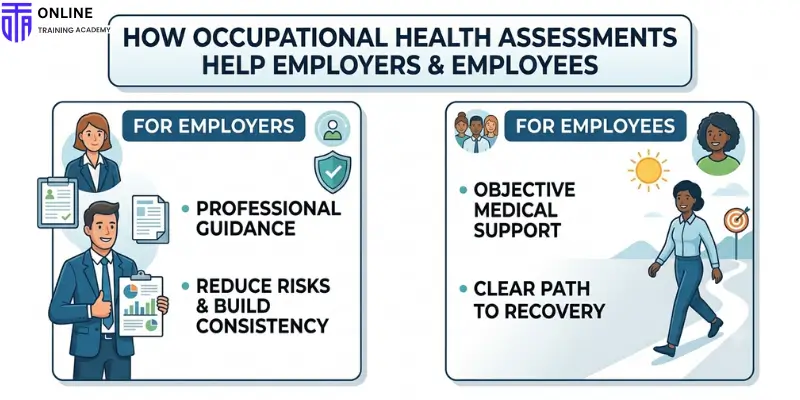
Occupational health assessments are often misunderstood because people focus only on the report. In reality, their value lies in helping both sides move from uncertainty to structured decision-making.
For employers, the assessment provides professional guidance. It helps them understand what is medically relevant to work, what support may be reasonable, and how to manage health-related cases more fairly and consistently. This reduces guesswork and makes decisions easier to defend.
For employees, the process can create clarity. It provides a chance to explain how health is affecting work in a more structured way. It can also support practical changes that might not happen otherwise, such as adjustments, phased return plans, or recognition that current duties are unrealistic.
When used well, occupational health does not create distance between employer and employee. It creates a clearer basis for support.
What Career Paths Exist in Occupational Health and Safety?
One reason this field remains attractive is that it offers several career directions rather than a single job route.
A person may begin in a junior administrative or coordination role and progress into advisory work. Others enter through technical, operational, or clinical backgrounds. Over time, careers may move into areas such as:
- Health and safety coordination
- Health and safety advisory work
- Occupational health nursing
- Safety auditing and compliance
- Risk management and investigation
- Workplace wellbeing and rehabilitation
- Consultancy, training, or senior leadership
This means the field suits both specialists and generalists. Some people enjoy site-based hazard management. Others prefer employee case work, policy, or strategic planning. The profession is wide enough to support different strengths.
Conclusion
A career in occupational health and safety is built around something that matters in every workplace—protecting people while helping work continue responsibly. It is a field that combines technical knowledge with human judgement, and structure with real-world complexity.
At the same time, occupational health assessments are not something employees need to fear. In most cases, they are there to create clarity. They help answer practical questions about fitness for work, support needs, and what happens next.
The real value of this field lies in that combination. It protects organisations, but it also supports individuals. It deals with systems, but never loses sight of people. And in modern workplaces, that makes it one of the most relevant careers—and one of the most important support functions—there is.
FAQs
Because it offers meaningful work, strong long-term demand, career progression, and the chance to improve both safety and wellbeing in real workplaces.
They are usually trained through a mix of formal qualifications, practical workplace experience, and ongoing professional development. The exact route depends on whether they work in safety, occupational health, or both.
Usually to get professional advice on how your health affects your work, whether support or adjustments are needed, or how a return to work should be managed.
You can expect a structured discussion about your health, your job, how your condition affects work, and what support may help you work safely.
They usually ask about your symptoms, treatment, job tasks, work difficulties, recovery progress, and whether adjustments may help.
It usually means you are not currently fit to do your role safely. This may lead to time off, workplace adjustments, a phased return, or further review depending on the situation.
No. Occupational health provides advice. Your employer makes employment decisions, usually using that advice as one part of the process.
Learn More





Get a FREE Course
- Learn useful skills online free
- Get CPD accredited certificate
- Add it to your CV today!