

Two organisations operate in the same industry with similar resources, yet one experiences repeated incidents while the other runs with stability and confidence. The difference is rarely equipment or budget. It is how seriously employer responsibilities are defined, applied, and maintained.
Workplace safety does not fail because rules are missing. It fails when responsibilities are unclear, inconsistent, or poorly enforced. In the UK, employers are legally required under the Health and Safety at Work etc. Act 1974 to protect employees and others affected by their work. This is not a passive duty. It requires active management, continuous oversight, and a structured approach to risk.
This guide breaks down the 10 essential responsibilities employers must follow, while also expanding on training, systems, and practical safety behaviours that make those responsibilities effective in real workplaces.
Table of Contents
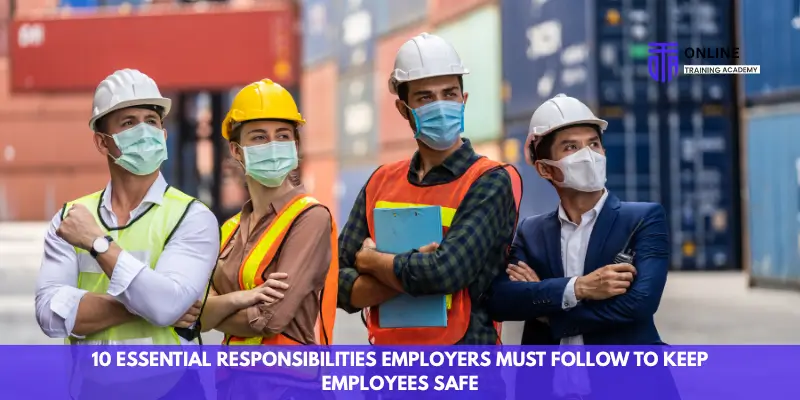
10 Essential Responsibilities Employers Must Follow to Keep Employees Safe
"Employers have a legal and moral duty to provide a safe and healthy workplace for their employees. This blog highlights the ten essential responsibilities employers must follow, including risk management, safety training, workplace policies, and hazard prevention, to protect employees and maintain a safe working environment."
What Employer Responsibility Really Means in Workplace Safety
Employer responsibility is often misunderstood as simply providing policies or equipment. In practice, it means building a system where risk is identified early, controlled effectively, and reviewed continuously.
This includes designing safe work processes, ensuring employees are competent, and maintaining an environment where safety is part of everyday decision-making. When responsibility is treated as a system rather than a checklist, safety becomes predictable rather than reactive.
Why Training Is Central to Workplace Safety
Training is not an add-on to safety. It is the mechanism that makes safety systems work.
Without proper training, employees may follow instructions incorrectly, misunderstand risks, or rely on assumptions. Effective training closes this gap by ensuring that employees understand not just what to do, but why it matters.
Well-structured training programmes strengthen awareness, improve behaviour, and reduce variability in how tasks are performed. Over time, this leads to fewer incidents and more consistent performance.
Key Benefits of Safety Training for Employees and Organisations
Training delivers value beyond compliance. It directly supports performance, development, and organisational stability.
Improved Skills and Practical Knowledge
Training enhances employees’ ability to perform tasks safely and efficiently. This includes understanding hazards, applying safe techniques, and responding appropriately to unexpected situations. As competence improves, errors reduce and productivity becomes more consistent.
Targeted Performance Improvement
Training can address specific weaknesses identified during performance evaluations. Instead of managing repeated issues, organisations can use training to correct underlying gaps in knowledge or behaviour, leading to long-term improvement.
Preparation for Higher Responsibilities
As employees progress into more senior roles, their responsibilities increase. Training helps them develop leadership awareness, decision-making ability, and a broader understanding of risk management, enabling them to operate effectively at a higher level.
Stronger Employee Engagement and Retention
When organisations invest in training, employees recognise that they are valued. This improves motivation, engagement, and commitment, all of which contribute to a stronger safety culture.
Support for Systems and Technology
Training ensures employees can use workplace systems, including digital tools and safety processes, correctly. This reduces errors, improves consistency, and helps organisations evaluate whether new systems are functioning as intended.
The 10 Essential Responsibilities Employers Must Follow
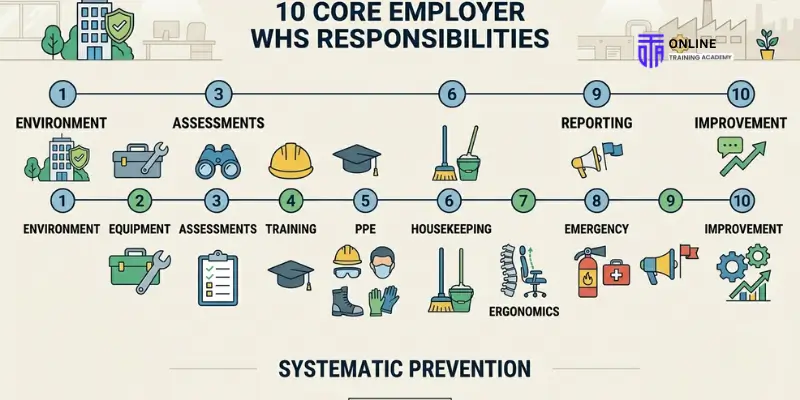
These responsibilities form the foundation of effective workplace health and safety management. They are not isolated actions. Each one supports the others, creating a system where risks are identified early, controlled properly, and reviewed continuously. When applied consistently, they move an organisation from reactive problem-solving to structured prevention.
1. Provide a Safe Working Environment
Employers must ensure that the workplace itself does not expose employees to unnecessary risk. This includes maintaining buildings, ensuring adequate lighting and ventilation, controlling temperature, and managing noise levels where required. A safe environment also means that walkways are clear, workspaces are properly designed, and hazards such as spills or damaged surfaces are addressed quickly.
In practice, the working environment sets the baseline for all other safety measures. Even well-trained employees are placed at risk if the physical environment is poorly maintained. A safe workplace reduces the likelihood of incidents before behaviour or procedures even come into play.
2. Ensure Safe Use of Equipment and Machinery
All equipment and machinery must be suitable for the task, properly maintained, and used only by competent individuals. Employers are responsible for ensuring that equipment is inspected regularly and that faults are identified and resolved without delay.
Training plays a critical role here. Employees should never be expected to use tools or machinery without proper instruction or certification where required. Misuse, even by experienced workers, remains one of the most common causes of workplace injuries. Clear guidance, supervision, and maintenance together ensure that equipment supports safe work rather than creating risk.
3. Conduct Regular Risk Assessments
Risk assessments are central to workplace safety in the UK. They provide a structured way to identify hazards, evaluate risks, and determine appropriate control measures. Employers must ensure that assessments are not treated as one-time documents but are regularly reviewed and updated.
Workplaces change over time. New processes, equipment, or layouts can introduce new risks. If assessments are not updated to reflect these changes, they quickly lose their effectiveness. A well-managed risk assessment process ensures that safety controls remain relevant and proportionate.
4. Provide Adequate Training and Information
Employees need clear, role-specific training to understand the risks associated with their work and how to manage them. This includes not only initial training but also refresher sessions and updates when procedures change.
Information must be communicated in a way that employees can understand and apply in real situations. Generic training is rarely effective. Instead, training should reflect actual tasks, environments, and risks. When employees understand both the “what” and the “why,” they are more likely to follow safe practices consistently.
5. Supply and Enforce Use of PPE
Personal protective equipment is a critical control measure when risks cannot be fully eliminated. Employers must provide appropriate PPE, ensure it is suitable for the task, and confirm that it is used correctly.
However, PPE should not be relied on as the primary control where higher-level solutions are available. It is most effective when combined with other measures such as safe systems of work and engineering controls. Employers must also ensure that employees understand the limitations of PPE, as incorrect use can create a false sense of security.
6. Maintain a Clean and Organised Workplace
Good housekeeping is one of the simplest yet most effective ways to reduce workplace risk. Cluttered or poorly organised environments increase the likelihood of slips, trips, and falls, which remain among the most common workplace incidents in the UK.
A clean and organised workplace also improves efficiency. Employees can move safely, locate equipment easily, and identify hazards more quickly. Maintaining order is not just about appearance. It directly supports safer working conditions.
7. Support Safe Manual Handling and Ergonomics
Employers must ensure that tasks are designed to minimise physical strain. This includes providing appropriate equipment for lifting, designing workstations to support correct posture, and training employees in safe handling techniques.
Poor ergonomics often leads to long-term health issues rather than immediate injury. Back pain, joint problems, and repetitive strain injuries can develop gradually, affecting both wellbeing and productivity. Addressing these risks early prevents long-term harm and reduces absence.
8. Establish Clear Emergency Procedures
Every workplace must be prepared for unexpected situations. Employers are responsible for developing clear emergency procedures, including evacuation plans, fire safety measures, and first aid arrangements.
Employees must know what to do, where to go, and who to contact in an emergency. Regular drills and clear communication ensure that responses are fast and effective. Without preparation, even minor incidents can escalate due to confusion or delay.
9. Encourage Hazard Reporting and Communication
A strong safety system depends on open and consistent communication. Employers must create an environment where employees feel confident reporting hazards, near misses, and concerns without fear of blame.
When reporting systems are weak, risks remain hidden until an incident occurs. Encouraging communication allows organisations to identify problems early and take corrective action. This shifts the focus from reacting to incidents to preventing them.
10. Continuously Review and Improve Safety Systems
Workplace safety is not static. Risks change as organisations grow, processes evolve, and new technologies are introduced. Employers must regularly review safety policies, procedures, and controls to ensure they remain effective.
This includes analysing incident data, gathering employee feedback, and conducting audits or inspections. Continuous improvement ensures that safety systems adapt to changing conditions rather than becoming outdated. Organisations that review and refine their approach are better equipped to manage risk over time.
Practical Safety Rules Employees Should Follow Daily
While employers hold primary responsibility, daily safety also depends on employee behaviour. Organisations should reinforce practical safety rules that guide everyday actions.
Employees should use tools correctly, report hazards immediately, and wear appropriate safety equipment at all times. Maintaining a tidy workspace, staying aware of surroundings, and avoiding shortcuts are essential behaviours that reduce risk.
Physical wellbeing also plays a role. Staying hydrated, taking regular breaks, and maintaining proper posture help prevent fatigue and long-term health issues. Employees should also stay informed about updated procedures and ask questions when something is unclear.
These behaviours, when consistently applied, support the wider safety system and reduce the likelihood of incidents.
Common Mistakes Employers Make in Safety Management
Many organisations fail not because they lack policies, but because of how those policies are applied.
A common mistake is treating safety as a compliance exercise rather than an operational priority. Another is relying too heavily on documentation without ensuring that procedures are followed in practice.
Inconsistent training, poor communication, and failure to act on reported hazards also weaken safety systems. Over time, these issues create gaps that increase risk and reduce effectiveness.
How Strong Safety Leadership Changes Outcomes

Leadership plays a critical role in workplace safety.
When leaders actively prioritise safety, employees are more likely to follow procedures and report issues. When leadership is disengaged, safety quickly becomes secondary to productivity.
Strong safety leadership ensures that responsibilities are clear, expectations are consistent, and actions align with policies. This creates a culture where safety is integrated into everyday work.
Conclusion
Workplace safety is not achieved through isolated actions. It is built through consistent responsibility, clear systems, and continuous improvement.
The ten responsibilities outlined here provide a framework for protecting employees and maintaining stable operations. When these responsibilities are applied effectively, risks are identified early, controlled properly, and prevented from escalating.
Organisations that treat safety as part of how work is done, rather than something separate, create environments where people can work with confidence and clarity.
That is what makes employer responsibility essential, not just for compliance, but for long-term performance and protection.
Learn More





Get a FREE Course
- Learn useful skills online free
- Get CPD accredited certificate
- Add it to your CV today!