
147 Students
The Lifeguard Training course introduces the knowledge and response skills involved in supervising aquatic environments, preventing incidents, and responding to emergencies. It provides learners with a foundation in lifeguard responsibilities, observation, rescue procedures, injury prevention, first aid, and emergency response. Learners explore lifeguard observation, safety and risk management, responsive and unresponsive victim rescue, injury prevention, first aid, respiratory emergencies, and …

The Lifeguard Training course introduces the knowledge and response skills involved in supervising aquatic environments, preventing incidents, and responding to emergencies. It provides learners with a foundation in lifeguard responsibilities, observation, rescue procedures, injury prevention, first aid, and emergency response.
Learners explore lifeguard observation, safety and risk management, responsive and unresponsive victim rescue, injury prevention, first aid, respiratory emergencies, and cardiac emergencies. The course is suitable for beginners, aspiring lifeguards, recreation staff, aquatic facility workers, swimming instructors, and learners interested in aquatic safety in Canada.
Online learning provides flexibility for learners balancing work, education, or other commitments. Structured materials allow learners to review lifeguarding concepts at a suitable pace while developing their understanding of aquatic safety and emergency response. Successful completion provides a certificate that can support continuing learning and career development.
This course suits learners interested in aquatic safety, recreation, emergency response, or lifeguarding-related work.
Lifeguards need to recognise risks early, maintain effective observation, and respond appropriately when an emergency occurs. This course introduces key areas of aquatic safety and emergency response.
Lifeguarding knowledge may support entry-level or related roles in aquatic recreation. Specific lifeguard positions generally require recognised in-person certifications and practical assessments, depending on the employer and jurisdiction.
The course is designed to introduce learners to lifeguarding concepts, aquatic safety, rescue awareness, and emergency response.
All of our courses, including this Lifeguard Training Course, are fully accredited, providing you with up-to-date skills and knowledge and helping you to become more competent and effective in your chosen field.
All of our courses are accredited by the CPD Quality Standards as conforming to universally accepted Continuing Professional Development (CPD) guidelines.

The Quality Licence Scheme (QLS) is a trusted endorsement framework that certifies high-quality, non-regulated training programmes across various sectors.

The Association of Healthcare Trainers (AoHT) promotes high-quality healthcare training, supporting providers to deliver relevant, industry-aligned education and improve professional standards.
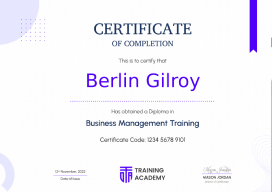
Once you’ve successfully completed your course, you will immediately be sent a digital certificate. Also, you can have your printed certificate delivered by post (shipping cost CA$9.99). All of our courses are fully accredited, providing you with up-to-date skills and knowledge and helping you to become more competent and effective in your chosen field.
The curriculum covers lifeguard responsibilities, observation, risk management, rescue response, injury prevention, first aid, and major aquatic emergencies. Each module develops knowledge relevant to maintaining safety and responding to incidents.
Explore the role and responsibilities of a lifeguard within an aquatic environment. Learners develop awareness of professional conduct, supervision, prevention, and maintaining a safe facility.
Focus on effective observation and surveillance in aquatic settings. Learners explore how careful monitoring can help identify hazards, distressed swimmers, and potential emergencies.
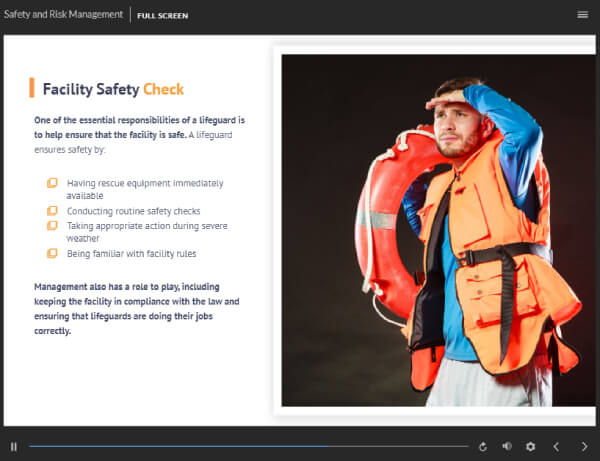
Examine common aquatic hazards and approaches to managing risk. Learners consider prevention strategies and how safe facility practices can reduce the likelihood of incidents.
Learn about responding to emergencies in an organised and timely manner. The section introduces response procedures and the importance of communication and appropriate action during incidents.
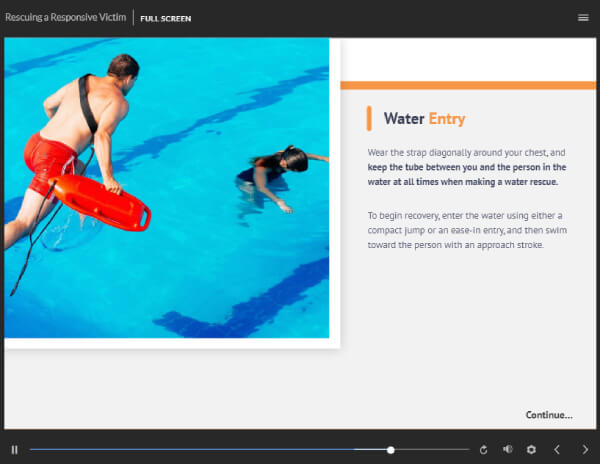
Explore rescue considerations when a person remains responsive during an aquatic emergency. Learners develop awareness of appropriate rescue approaches while considering their own safety.
Examine the response to an unresponsive person in an aquatic environment. Learners explore emergency rescue considerations and the importance of rapid, coordinated action.
Explore ways to reduce the likelihood of injuries in swimming pools and other aquatic environments. Learners consider prevention, hazard awareness, and safer behaviour.
Introduce first aid principles relevant to common aquatic incidents and injuries. Learners develop awareness of appropriate initial responses while awaiting further medical assistance.
Learn about respiratory emergencies and the signs that may require immediate attention. The section introduces appropriate emergency response considerations for breathing-related incidents.
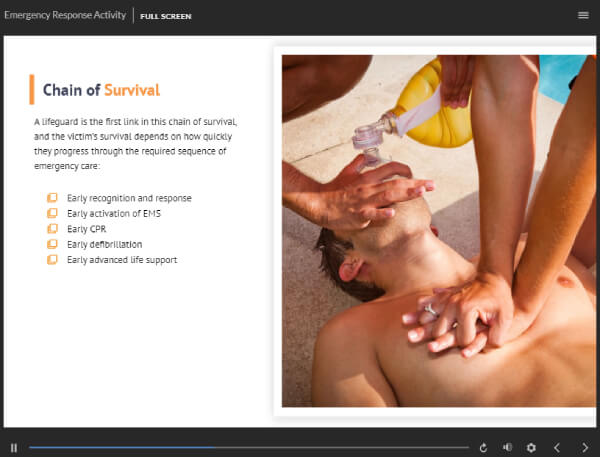
Finish by exploring cardiac emergencies and the importance of rapid response. Learners develop awareness of emergency procedures related to cardiac incidents and the role of appropriate lifesaving measures.
The usual pathway includes lifesaving training such as Bronze Cross, first aid with CPR, and National Lifeguard certification. Requirements can vary by province and employer.
For National Lifeguard training, common requirements include being at least 15 years old, holding Bronze Cross, and having an accepted Standard or Intermediate First Aid certification with CPR.
The minimum age for National Lifeguard training is generally 15 years, although employment requirements can differ depending on the province, facility, and position.
Lifeguards need strong swimming ability, fitness, observation, judgement, communication, emergency-response, and rescue skills. Canadian National Lifeguard training specifically develops judgement, knowledge, skills, and fitness for aquatic supervision.
Yes. National Lifeguard courses include physical and swimming requirements, and specific tests can depend on the certification option. Waterfront certification, for example, includes timed swimming and victim-rescue requirements.
National Lifeguard certification is generally valid for two years and can be renewed through the required recertification process.
| Module 01: Professional Lifeguard | |||
| Professional Lifeguard | 00:18:00 | ||
| Module 02: Lifeguard Observation | |||
| Lifeguard Observation | 00:16:00 | ||
| Module 03: Safety and Risk Management | |||
| Safety and Risk Management | 00:26:00 | ||
| Module 04: Emergency Response Activity | |||
| Emergency Response Activity | 00:12:00 | ||
| Module 05: Rescuing a Responsive Victim | |||
| Rescuing a Responsive Victim | 00:28:00 | ||
| Module 06: Rescuing an Unresponsive Victim | |||
| Rescuing an Unresponsive Victim | 00:35:00 | ||
| Module 07: Injury Prevention | |||
| Injury Prevention | 00:13:00 | ||
| Module 08: First Aid | |||
| First Aid | 00:19:00 | ||
| Module 09: Respiratory Emergencies | |||
| Respiratory Emergencies | 00:35:00 | ||
| Module 10: Cardiac Emergencies | |||
| Cardiac Emergencies | 00:15:00 | ||
$125 Original price was: $125.$20Current price is: $20. ex VAT
SAVE 84% - OFFER ENDS SOON
![]() |
01 Year of full Course access
Intermediate
Endorsed Certificate of Compleiton