

680 Students
Legal Advisor Training introduces learners to core legal concepts and knowledge relevant to legal support and common legal matters. The course covers legal terminology, the Canadian legal system, property law, wills and probate, contract and business law, family law, criminal law, tort law, human rights, and legal document organisation. It suits learners interested in legal services, administration, legal support, or …
Legal Advisor Training introduces learners to core legal concepts and knowledge relevant to legal support and common legal matters. The course covers legal terminology, the Canadian legal system, property law, wills and probate, contract and business law, family law, criminal law, tort law, human rights, and legal document organisation. It suits learners interested in legal services, administration, legal support, or further study.
The training builds familiarity with legal language, documents, and processes across several areas of law. Learners develop knowledge that can support roles in legal offices, business environments, government settings, and other workplaces where legal information is used.
Online learning offers flexibility around work, study, or other commitments. Learners can review course materials at their own pace. A certificate on completion provides evidence of learning for continued education and career development.
Please note: This Legal Advisor Training only gives you the theoretical knowledge that you need to excel in this field. This Course doesn’t entitle you to practise as a professional in this specific field.
This course suits learners who want a broad introduction to legal concepts before entering or progressing within legal support environments.
dAll of our courses, including this Legal Advisor Training, are fully accredited, providing you with up-to-date skills and knowledge and helping you to become more competent and effective in your chosen field.
All of our courses are accredited by the CPD Quality Standards as conforming to universally accepted Continuing Professional Development (CPD) guidelines.
The Quality Licence Scheme (QLS) is a trusted endorsement framework that certifies high-quality, non-regulated training programmes across various sectors.

The Association of Healthcare Trainers (AoHT) promotes high-quality healthcare training, supporting providers to deliver relevant, industry-aligned education and improve professional standards.
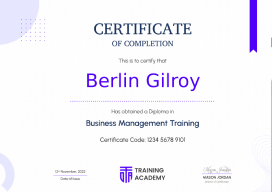
Once you’ve successfully completed your course, you will immediately be sent a digital certificate. Also, you can have your printed certificate delivered by post (shipping cost CA$9.99). All of our courses are fully accredited, providing you with up-to-date skills and knowledge and helping you to become more competent and effective in your chosen field.
The detailed curriculum outline of our Legal Advisor Training is as follows:
The opening module establishes what legal advisors do and how legal guidance fits within professional settings. Learners explore the responsibilities, boundaries, and communication involved in working with legal information.
Legal documents use language that can be unfamiliar to people outside the field. This section introduces commonly used legal terms and helps learners become more comfortable interpreting terminology encountered in legal workplaces.
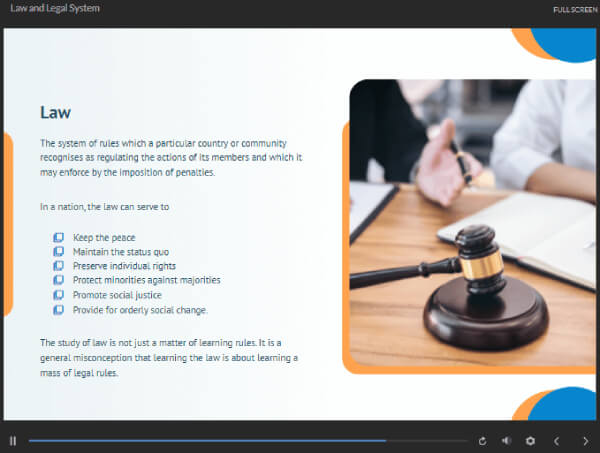
Learners are introduced to the structure of law and the systems through which legal matters are handled. The module develops an understanding of courts, legal rules, legislation, and the wider framework in which legal decisions are made.
Property matters can involve ownership, rights, transactions, and responsibilities. This module provides an introduction to important property law concepts and the types of legal issues that may arise around property.
This section examines what happens to a person’s assets and legal affairs after death. Learners explore wills, probate, estates, and the terminology used when dealing with these matters.
Contracts form a major part of commercial activity. Learners consider essential contract principles alongside business law concepts, including how agreements create responsibilities and why clear terms matter in business relationships.
Family law covers sensitive matters involving relationships and family responsibilities. The module introduces key concepts and helps learners understand the legal context surrounding common family-related issues.
Criminal law and tort law address different types of legal wrongdoing and consequences. Learners explore their basic distinctions and develop familiarity with concepts relating to offences, liability, harm, and remedies.
Human rights principles provide an important foundation for fair treatment and equality. This module explores fundamental rights and their relevance to individuals, workplaces, institutions, and legal decision-making.
Legal work often involves handling structured documents, correspondence, and records. The final module focuses on using Microsoft Word to organise legal work efficiently and present documents in a clear, orderly format.
This course provides foundational knowledge of legal concepts but does not qualify someone to practise as a lawyer or licensed legal advisor in Canada. Lawyer roles have specific education, articling, bar examination, and provincial or territorial licensing requirements.
The training covers legal terminology, the Canadian legal system, property law, wills and probate, contract and business law, family law, criminal and tort law, human rights, and organising legal documents using Microsoft Word.
Yes. The course introduces legal terminology and concepts from the fundamentals, making it suitable for learners without previous legal training who want to develop a general understanding of the subject.
Yes. Online training can provide a flexible way to study foundational legal topics around work or other commitments. However, an online certificate course should not be confused with a Canadian law degree or a programme that meets professional licensing requirements.
Legal knowledge can be useful in legal administration, contract administration, business support, compliance-related work, property services, and other roles involving legal documents or processes. Specific occupations may require additional qualifications or licensing.
No. A certificate course alone is not enough to become a lawyer in Canada. The requirements include recognised legal education, experiential training, bar admission requirements, and licensing by the relevant provincial or territorial law society.
| Legal Advisor Training | |||
| Module 01: Legal Advice and Advisor | 00:12:00 | ||
| Module 02: Legal Terminology | 00:20:00 | ||
| Module 03: Law and Legal System | 00:25:00 | ||
| Module 04: Property Law | 00:21:00 | ||
| Module 05: Wills, Probate, Estate Law | 00:16:00 | ||
| Module 06: Contract & Business Law | 00:54:00 | ||
| Module 07: Family Law | 00:21:00 | ||
| Module 08: Criminal and Tort Law | 00:27:00 | ||
| Module 09: Human Rights | 00:13:00 | ||
| Module 10: Organising Work in MS Word | 00:23:00 | ||
$125 Original price was: $125.$20Current price is: $20. ex VAT
SAVE 84% - OFFER ENDS SOON
![]() |
01 Year of full Course access
Level 3
Endorsed Certificate of Compleiton