957 Students
Human Resources plays a central role in every successful organisation by managing recruitment, employee development, workplace relations, and performance management. In Canada’s competitive job market, HR professionals are essential in ensuring businesses attract the right talent, maintain compliance, and build positive workplace cultures. This HR (Human Resource) course introduces learners to the core functions of HR within modern organisations. Designed …
Human Resources plays a central role in every successful organisation by managing recruitment, employee development, workplace relations, and performance management. In Canada’s competitive job market, HR professionals are essential in ensuring businesses attract the right talent, maintain compliance, and build positive workplace cultures. This HR (Human Resource) course introduces learners to the core functions of HR within modern organisations.
Designed for beginners and aspiring HR professionals, this course covers recruitment processes, employee relations, performance appraisal systems, communication skills, conflict management, and workplace wellbeing. Learners also explore how HR teams support training, motivation, health and safety, and organisational efficiency across different industries in Canada.
Study online at your own pace and build essential knowledge required to understand how HR departments operate in real workplace environments. This course supports learners aiming to enter administrative roles, recruitment, or people management careers in Canada.
Please note: This HR (Human Resource) Course only gives you the theoretical knowledge that you need to excel in this field. This Course doesn’t entitle you to practise as a professional in this specific field.
By the end of the HR (Human Resource) Course, learners will be able to:
All of our courses, including this HR (Human Resource) Course, are fully accredited, providing you with up-to-date skills and knowledge and helping you to become more competent and effective in your chosen field.
All of our courses are accredited by the CPD Quality Standards as conforming to universally accepted Continuing Professional Development (CPD) guidelines.
The Quality Licence Scheme (QLS) is a trusted endorsement framework that certifies high-quality, non-regulated training programmes across various sectors.

The Association of Healthcare Trainers (AoHT) promotes high-quality healthcare training, supporting providers to deliver relevant, industry-aligned education and improve professional standards.
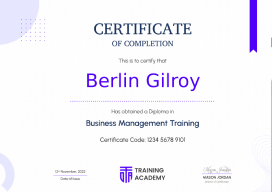
Once you’ve successfully completed your course, you will immediately be sent a digital certificate. Also, you can have your printed certificate delivered by post (shipping cost CA$9.99). All of our courses are fully accredited, providing you with up-to-date skills and knowledge and helping you to become more competent and effective in your chosen field.
Human Resources plays a key role in shaping how organisations manage people, performance, and workplace culture. This section explores how HR supports business operations through structured employee management, workforce planning, and organisational development.
Recruitment is a vital function that connects employers with suitable talent. Learners explore how recruitment agencies and internal HR teams identify, attract, and retain candidates in competitive employment markets.
Employment law plays an important role in ensuring fair hiring practices. Learners examine key recruitment regulations and compliance standards that guide ethical and lawful hiring processes in structured organisations.
Hiring involves multiple stages from job advertising to final onboarding. The content explains how candidates are screened, shortlisted, interviewed, and selected based on organisational requirements.
Negotiation is essential in HR for managing job offers, salaries, and workplace agreements. Focus is placed on achieving balanced outcomes that support both organisational goals and employee expectations.
Recruitment success is measured through performance indicators such as hiring efficiency, employee retention, and quality of hire. Learners understand how HR teams track and improve recruitment outcomes.
Employee growth is supported through structured training and skill development programmes. Organisations use these processes to improve performance and encourage continuous learning.
Managing candidate information effectively ensures a smooth recruitment cycle. This section focuses on tracking applications, maintaining records, and improving communication throughout the hiring process.
Interviewing is a structured method used to evaluate candidate suitability. Learners explore interview planning, questioning techniques, and evaluation methods used during selection.
Workplace meetings and feedback sessions are essential for performance improvement. HR professionals use these tools to guide employees, resolve concerns, and improve communication.
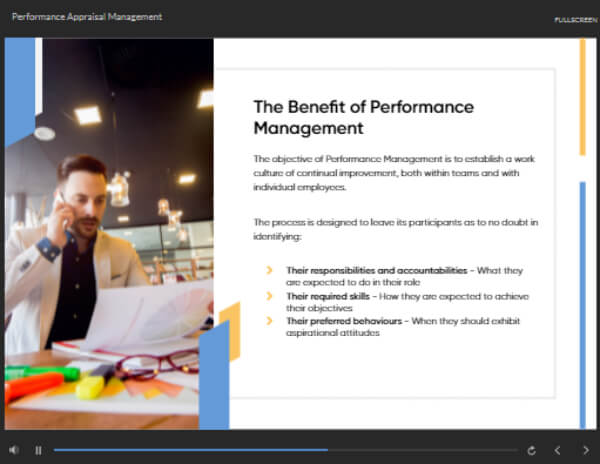
Employee performance is regularly reviewed through appraisal systems. This process helps organisations assess productivity, set goals, and identify areas for improvement.
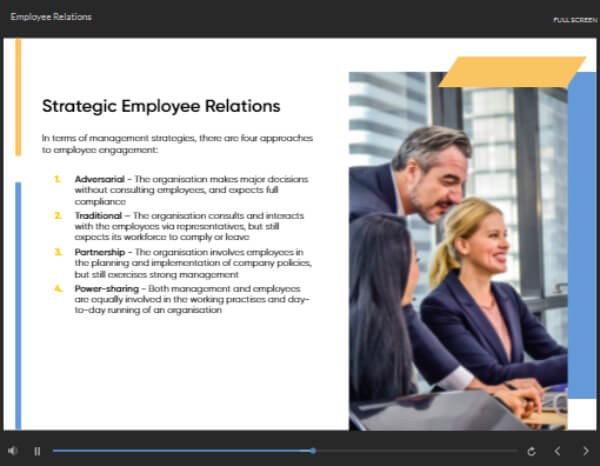
Healthy workplace relationships contribute to organisational success. Focus is placed on managing communication, resolving concerns, and maintaining positive employer–employee relations.
Employee motivation and wellbeing are supported through guidance and counselling practices. HR teams use these approaches to improve engagement and workplace satisfaction.
Workplace safety is a legal and organisational responsibility. Learners explore how HR contributes to maintaining safe environments and reducing workplace risks.
Organisations rely on accurate employee data for decision-making. This section covers record management, workforce statistics, and their role in HR planning.
Workplace disagreements can affect productivity if not managed properly. Learners explore structured approaches to resolving conflicts through communication and mediation.
Ending employment requires careful handling to ensure fairness and compliance. The process includes documentation, legal considerations, and professional conduct.
Efficient HR operations depend on strong organisational abilities. Planning, documentation, and task coordination are essential for managing HR responsibilities effectively.
Clear communication is essential in all HR functions. Emphasis is placed on listening, writing, and interpersonal interaction within workplace environments.
Workplace stress affects both employees and productivity. Strategies are explored to manage pressure and support mental wellbeing in professional settings.
Effective time management improves productivity and workflow efficiency. HR professionals prioritise tasks, meet deadlines, and manage multiple responsibilities in fast-paced environments.
You will learn about recruitment processes, candidate management, employee training and development, performance appraisal systems, conflict management, communication skills, and workplace wellbeing practices.
This course can support your knowledge and preparation for entry-level HR and administrative roles in Canada. It helps you understand workplace systems used in real HR departments.
Yes, the course includes detailed coverage of recruitment, candidate selection, interviewing techniques, and hiring processes used in modern organisations.
Yes, the course covers employee relations, workplace communication, conflict resolution strategies, and how HR professionals handle workplace issues effectively.
Yes, the course content is designed to align with common HR practices used in Canada, including workplace safety, employee management, and organisational standards.
Yes, it explains how employee performance is measured, reviewed, and improved through structured appraisal systems and feedback processes.
| Module 01: Introduction to Human Resources | |||
| Introduction to Human Resources | 00:17:00 | ||
| Module 02: An Overview of the Recruitment Industry | |||
| An Overview of the Recruitment Industry | 00:34:00 | ||
| Module 03: The UK Recruitment Legislation | |||
| The UK Recruitment Legislation | 00:34:00 | ||
| Module 04: The Recruitment Process | |||
| The Recruitment Process | 00:41:00 | ||
| Module 05: Negotiation Techniques | |||
| Negotiation Techniques | 00:16:00 | ||
| Module 06: Key Performance Indicators for the Recruitment Industry | |||
| Key Performance Indicators for the Recruitment Industry | 00:28:00 | ||
| Module 07: Employee Training and Development Process | |||
| Employee Training and Development Process | 00:22:00 | ||
| Module 08: Candidate Management | |||
| Candidate Management | 00:25:00 | ||
| Module 09: Candidate Interview Processes | |||
| Candidate Interview Processes | 00:32:00 | ||
| Module 10: Managing Meetings and Giving Feedback | |||
| Managing Meetings and Giving Feedback | 01:24:00 | ||
| Module 11: Performance Appraisal Management | |||
| Performance Appraisal Management | 00:19:00 | ||
| Module 12: Employee Relations | |||
| Employee Relations | 00:15:00 | ||
| Module 13: Motivation and Counselling | |||
| Motivation and Counselling | 00:19:00 | ||
| Module 14: Ensuring Health and Safety at the Workplace | |||
| Ensuring Health and Safety at the Workplace | 00:16:00 | ||
| Module 15: Employer Records and Statistics | |||
| Employer Records and Statistics | 00:11:00 | ||
| Module 16: Conflict Management | |||
| Conflict Management | 00:14:00 | ||
| Module 17: Employee Termination | |||
| Employee Termination | 00:15:00 | ||
| Module 18: Organisational Skills | |||
| Organisational Skills | 00:25:00 | ||
| Module 19: Communication Skills | |||
| Communication Skills | 00:25:00 | ||
| Module 20: Stress Management | |||
| Stress Management | 00:16:00 | ||
| Module 21: Time Management | |||
| Time Management | 00:40:00 | ||
$125 Original price was: $125.$20Current price is: $20. ex VAT
SAVE 84% - OFFER ENDS SOON
![]() |
01 Year of full Course access
Intermediate
Endorsed Certificate of Compleiton