624 Students
Fire Extinguisher Training – Level 3 develops advanced knowledge for workers, supervisors, fire wardens, safety personnel, and others involved in workplace fire prevention and emergency planning. Learners explore fire behaviour, fire growth, flashover and backdraft risks, combustible loads, extinguisher selection, maintenance, placement, and human behaviour during workplace fires. The course is relevant to workplace roles across Canada. The training helps …

Fire Extinguisher Training – Level 3 develops advanced knowledge for workers, supervisors, fire wardens, safety personnel, and others involved in workplace fire prevention and emergency planning. Learners explore fire behaviour, fire growth, flashover and backdraft risks, combustible loads, extinguisher selection, maintenance, placement, and human behaviour during workplace fires. The course is relevant to workplace roles across Canada.
The training helps learners make informed fire-safety decisions without encouraging unsafe firefighting. Learners examine communication under stress, human error, fire-safety policies, records, audits, risk zoning, extinguisher mapping, emergency-service coordination, and scenario-based decision-making. These topics support stronger workplace fire prevention, preparedness, and response planning.
Online, self-paced learning allows learners to study around work and other commitments. The course presents advanced fire-extinguisher and workplace safety concepts clearly and includes an assessment to check understanding. Successful completion can provide a certificate as a training record, while specific fire-safety requirements vary by province, territory, municipality, employer, and workplace.
This course develops a stronger understanding of workplace fire risks, extinguisher management, and emergency decision-making.
This course is suited to learners who have workplace responsibilities involving fire prevention, emergency planning, or safety coordination.
Once you’ve successfully completed your course, you will immediately be sent a digital certificate. Also, you can have your printed certificate delivered by post (shipping cost £3.99). All of our courses are fully accredited, providing you with up-to-date skills and knowledge and helping you to become more competent and effective in your chosen field. Our certifications have no expiry dates, although we do recommend that you renew them every 12 months.
Advanced fire-safety knowledge can help workplaces prepare for emergencies and make better-informed decisions before and during an incident.
The course can support knowledge relevant to roles where workplace fire safety forms part of broader responsibilities. Salaries vary by province, employer, experience, and job duties.
No advanced academic background is required, although workplace safety experience can be helpful.
All of our courses, including this Fire Extinguisher Training Level 3, are fully accredited, providing you with up-to-date skills and knowledge and helping you to become more competent and effective in your chosen field.
All of our courses are accredited by the CPD Quality Standards as conforming to universally accepted Continuing Professional Development (CPD) guidelines.

The Quality Licence Scheme (QLS) is a trusted endorsement framework that certifies high-quality, non-regulated training programmes across various sectors.

The Association of Healthcare Trainers (AoHT) promotes high-quality healthcare training, supporting providers to deliver relevant, industry-aligned education and improve professional standards.

The course is organised into six focused modules covering fire behaviour, extinguisher management, emergency communication, workplace responsibilities, decision-making, and prevention.
Explore how fires develop and spread in different workplace environments. Topics include the fire triangle, fire growth, flashover, backdraft, combustible loads, ventilation, airflow, and factors that can accelerate fire development.
Learn how workplace conditions influence extinguisher selection, positioning, and maintenance. The module covers maintenance schedules, regulatory markings, signage, safe storage, accessibility, and keeping equipment ready for emergency use.
Examine how people may respond during stressful fire emergencies. The content considers panic, hesitation, communication difficulties, coordination, human error, and the importance of clear information when supporting an emergency response.
Develop an understanding of workplace fire-safety responsibilities and organisational procedures. The module covers fire-safety policies, training responsibilities, records, audits, enforcement considerations, liability, and the importance of following applicable Canadian requirements.
Apply fire-safety knowledge to realistic workplace situations. Scenarios cover mixed fuel sources, restricted warehouse access, electrical fires, evacuation challenges, and reviewing decisions after an emergency situation.
Explore how extinguisher planning can form part of a wider workplace fire-safety strategy. Topics include risk zoning, extinguisher mapping, fire warden responsibilities, communication with emergency services, and incorporating fire-response procedures into workplace policies.
Review the main principles covered throughout the course, including fire behaviour, equipment management, human factors, emergency planning, and prevention. The conclusion reinforces the importance of prioritising life safety, raising the alarm, evacuating when required, and following workplace emergency procedures.
The course can be suitable for fire wardens, supervisors, workplace safety personnel, facilities staff, managers, and workers who have responsibilities involving fire prevention or emergency planning. The level of training required depends on the hazards and duties within the workplace.
You will learn about fire behaviour and development, extinguisher selection and maintenance, human responses during fires, workplace fire-safety policies, risk zoning, extinguisher mapping, emergency communication, and scenario-based decision-making.
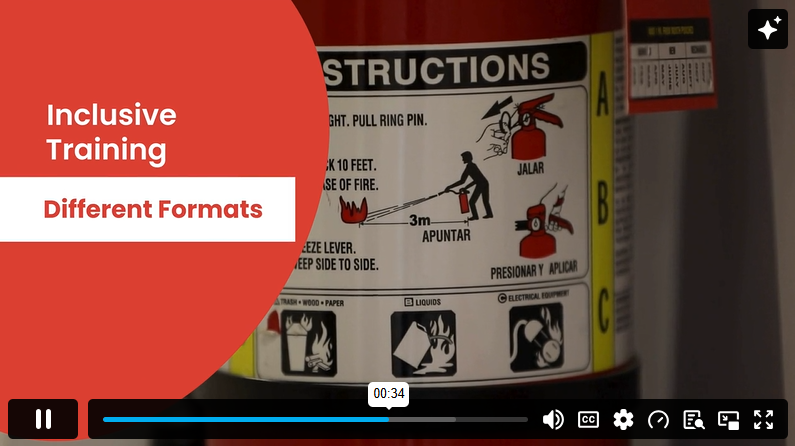
Common Canadian fire classifications include Class A for ordinary combustibles, Class B for flammable liquids, Class C for energized electrical equipment, Class D for combustible metals, and Class K for cooking media such as oils and fats. Extinguisher labels indicate which fire classes the equipment is designed to address.
The correct extinguisher depends on the type of fuel involved and the extinguisher’s rating. Using an unsuitable extinguisher can increase risk, so workplaces should assess their fire hazards and provide appropriately rated equipment.
You should not attempt to fight a fire if it is large or spreading, smoke is creating a serious hazard, you do not have a safe escape route, or you have not been appropriately trained. Life safety and evacuation should take priority. Portable extinguishers are intended for limited applications involving small fires.
This course provides knowledge-based training and does not automatically replace hands-on extinguisher practice. Canadian workplace guidance recognises that fire-protection training may include instruction, demonstrations, and hands-on training depending on workplace hazards and responsibilities.
| Module 01: Understanding Fire Behaviour and Development | |||
| Introduction | 00:01:00 | ||
| 1.1 Understanding Fire Behaviour and Development | 00:01:00 | ||
| 1.1.1 The Fire Triangle and Fire Growth | 00:01:00 | ||
| 1.1.2 Flashover and Backdraft Risks | 00:01:00 | ||
| 1.1.3 Combustible Loads and Layouts | 00:01:00 | ||
| 1.1.4 Airflow, Ventilation, and Fire Spread | 00:01:00 | ||
| Reading Materials | |||
| Understanding Fire Behaviour and Development | 00:00:00 | ||
| Module 02: Selecting and Maintaining Extinguishers | |||
| 2.1 Selecting and Maintaining Extinguishers-Hassan | 00:01:00 | ||
| 2.1.1 Extinguisher Suitability by Environment | 00:01:00 | ||
| 2.1.2. Maintenance Protocols and Schedules | 00:01:00 | ||
| 2.1.3 Regulatory Markings and Signage | 00:01:00 | ||
| 2.1.4. Safe Storage and Placement Practices | 00:01:00 | ||
| Reading Materials | |||
| Selecting and Maintaining Extinguishers | 00:00:00 | ||
| Module 03: Human Behaviour and Communication in Fires | |||
| 3.1. Human Behaviour and Communication in Fires | 00:01:00 | ||
| 3.1.1 Understanding Panic and Delay | 00:01:00 | ||
| 3.1.2. Communication Under Stress | 00:01:00 | ||
| 3.1.3. Coordinating with Colleagues | 00:01:00 | ||
| 3.1.4. Human Error and Misjudgement | 00:01:00 | ||
| Reading Materials | |||
| Human Behaviour and Communication in Fires | 00:00:00 | ||
| Module 04: Legal Duties and Fire Safety Policy | |||
| 4.1 Legal Duties and Fire Safety Policy | 00:01:00 | ||
| 4.1.1 The Regulatory Reform (Fire Safety) Order 2005 | 00:01:00 | ||
| 4.1.2 Organisational Training Responsibilities | 00:01:00 | ||
| 4.1.3. Fire Safety Records and Audits | 00:01:00 | ||
| 4.1.4 Enforcement, Fines, and Liability | 00:01:00 | ||
| Reading Materials | |||
| Legal Duties and Fire Safety Policy | 00:00:00 | ||
| Module 05: Theoretical Scenarios and Decision-Making | |||
| 5.1. Theoretical Scenarios and Decision-Making | 00:01:00 | ||
| 5.1.1. Office Fire with Mixed Fuel Sources | 00:01:00 | ||
| 5.1.2 Warehouse Scenario with Restricted Access | 00:01:00 | ||
| 5.1.3. Electrical Fire with Evacuation Challenges | 00:01:00 | ||
| 5.1.4 Post-Scenario Reflection and Analysis | 00:01:00 | ||
| Reading Materials | |||
| Theoretical Scenarios and Decision-Making | 00:00:00 | ||
| Module 06: Integrated Planning and Prevention | |||
| 6.1. Integrated Planning and Prevention | 00:01:00 | ||
| 6.1.1. Risk Zoning and Extinguisher Mapping | 00:01:00 | ||
| 6.1.2. Role of Fire Wardens in Strategy | 00:01:00 | ||
| 6.1.3. Liaising with Emergency Services | 00:01:00 | ||
| 6.1.4 Embedding Extinguisher Protocols in Policy | 00:01:00 | ||
| Reading Materials | |||
| Integrated Planning and Prevention | 00:00:00 | ||
| Conclusion | |||
| Conclusion | 00:01:00 | ||
$125 Original price was: $125.$20Current price is: $20. ex VAT
SAVE 84% - OFFER ENDS SOON
![]() |
01 Year of full Course access
Level 3
Endorsed Certificate of Compleiton