262 Students
Criminal investigations rely on careful analysis, evidence handling, investigative techniques, and an understanding of criminal behaviour. This Criminology: Criminal Investigation Training course introduces the principles of criminal investigations, forensic science, intelligence gathering, and crime scene procedures. Tailored for a Canadian audience, the course provides valuable knowledge for learners interested in criminology, investigations, and public safety. Suitable for beginners, security professionals, …
Criminal investigations rely on careful analysis, evidence handling, investigative techniques, and an understanding of criminal behaviour. This Criminology: Criminal Investigation Training course introduces the principles of criminal investigations, forensic science, intelligence gathering, and crime scene procedures. Tailored for a Canadian audience, the course provides valuable knowledge for learners interested in criminology, investigations, and public safety.
Suitable for beginners, security professionals, law students, and those interested in investigative careers, the course covers crime scene investigation, criminal intelligence, forensic psychology, victimology, cybercrime, surveillance, and investigative methods. These topics are relevant to security organisations, loss prevention, compliance, community safety, insurance investigations, and related sectors across Canada.
Study online at your own pace with the flexibility to fit learning around your schedule. Upon successful completion, you’ll receive a certificate that supports your continuing professional development. Enrol today and deepen your understanding of criminal investigation principles.
Please note: This Criminology: Criminal Investigation Training Course only gives you the theoretical knowledge that you need to excel in this field. This Course doesn’t entitle you to practise as a professional in this specific field.
This course is ideal for:
All of our courses, including this Criminology: Criminal Investigation Training Course, are fully accredited, providing you with up-to-date skills and knowledge and helping you to become more competent and effective in your chosen field.
All of our courses are accredited by the CPD Quality Standards as conforming to universally accepted Continuing Professional Development (CPD) guidelines.
The Quality Licence Scheme (QLS) is a trusted endorsement framework that certifies high-quality, non-regulated training programmes across various sectors.

The Association of Healthcare Trainers (AoHT) promotes high-quality healthcare training, supporting providers to deliver relevant, industry-aligned education and improve professional standards.

Once you’ve successfully completed your course, you will immediately be sent a digital certificate. Also, you can have your printed certificate delivered by post (shipping cost CA$9.99). All of our courses are fully accredited, providing you with up-to-date skills and knowledge and helping you to become more competent and effective in your chosen field.
The detailed curriculum outline of our Criminology: Criminal Investigation Training is as follows:
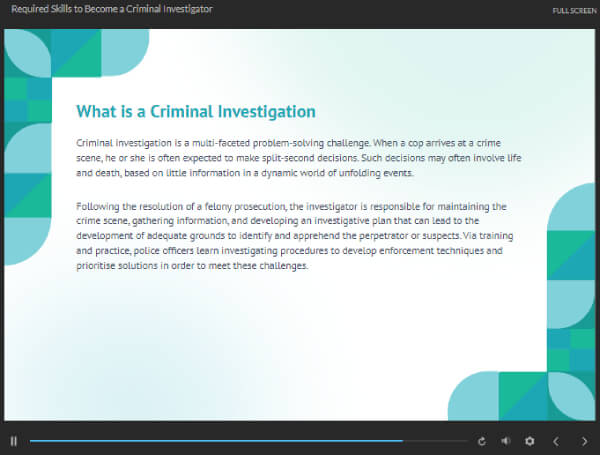
Begin by exploring the core competencies required for investigative work, including observation, analytical thinking, communication, ethics, and attention to detail.
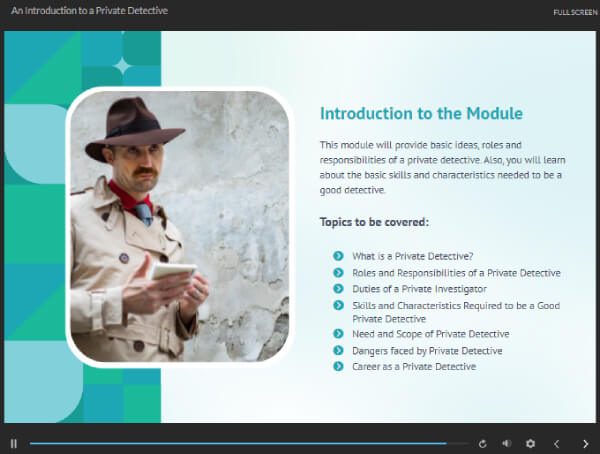
Discover the role of private detectives, the types of investigations they conduct, and the professional standards that guide their work.
Learn how criminal intelligence is gathered, analysed, and used to support investigations, identify patterns, and inform decision-making.
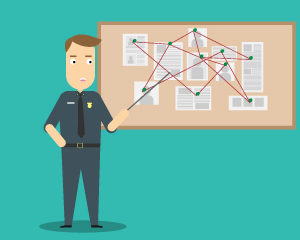
Explore the principles of crime scene management, including scene preservation, documentation, evidence recognition, and investigative procedures.
Proper evidence handling is essential for preserving integrity. This module explains the methods used to collect, label, package, and store physical evidence.
Examine the fundamentals of fingerprint identification, classification, collection methods, and its role in forensic investigations.
Discover how DNA evidence contributes to criminal investigations while learning about the principles, applications, and limitations of forensic DNA analysis.
Explore theories of crime and criminal behaviour while examining the psychological and social factors that may influence offending.
Investigate different categories of violent crime alongside the growing challenges of cybercrime and digital investigations.
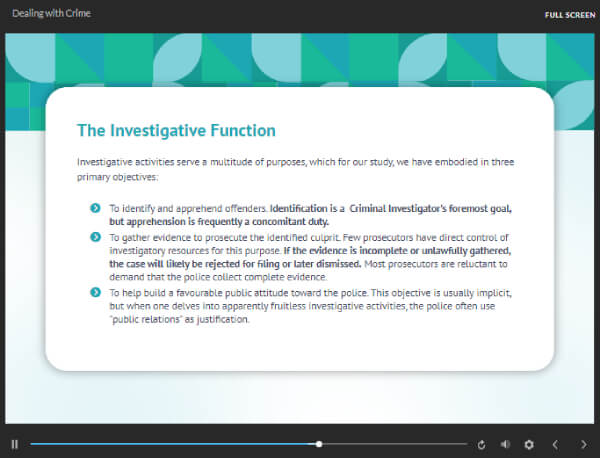
Learn about common forms of workplace theft, fraud, financial crime, and the investigative approaches used to identify suspicious activities.
Explore the principles of domestic investigations, including different investigation types, evidence gathering, and appropriate investigative procedures.
Gain insight into victim experiences, victimisation patterns, and the important role victimology plays within the criminal justice process.
Discover how investigative agencies respond to criminal incidents through structured investigative processes, evidence evaluation, and collaboration.
Explore surveillance concepts, tracing methods, and information-gathering techniques commonly used during lawful investigations.
Learn about the principles of investigative interviewing and interrogation, including communication strategies, ethical considerations, and evidence-based questioning approaches.
Gain a theoretical understanding of firearm types, terminology, operational principles, and the importance of firearm safety. This module is educational in nature and does not provide practical firearms training or certification.
Explore the role of firearms examination in forensic investigations, including the identification, documentation, and analysis of firearm-related evidence.
Examine how psychological principles support criminal investigations, offender assessment, witness evaluation, and behavioural analysis.
Complete the course by exploring the structure and functions of the criminal justice system in England and Wales. You’ll examine the roles of the police, courts, prisons, and probation services while gaining a broader understanding of how criminal cases progress through the justice process.
Yes. The course introduces criminal investigation concepts from the ground up, making it suitable for learners with little or no previous experience.
No. This course provides educational knowledge only and does not qualify learners for employment, professional licensing, or law enforcement positions. Additional education, training, and employer requirements may apply.
The course covers crime scene investigation, criminal intelligence, evidence collection, DNA analysis, criminology, cybercrime, victimology, surveillance, forensic psychology, and criminal justice principles.
The course includes an overview of the criminal justice system in England and Wales. While Canada’s justice system differs, many criminology and investigative concepts are broadly applicable.
Yes. This is a fully online, self-paced course, allowing you to study whenever it suits your schedule.
Yes. Upon successful completion, you’ll receive a certificate that supports your continuing professional development.
| Module 01: Required Skills to Become a Criminal Investigator | |||
| Required Skills to Become a Criminal Investigator | 00:19:00 | ||
| Module 02: An Introduction to a Private Detective | |||
| An Introduction to a Private Detective | 00:16:00 | ||
| Module 03: Criminal Intelligence | |||
| Criminal Intelligence | 00:17:00 | ||
| Module 04: Crime Scene Investigation | |||
| Crime Scene Investigation | 00:17:00 | ||
| Module 05: Collecting and Packaging Physical Evidence | |||
| Collecting and Packaging Physical Evidence | 00:42:00 | ||
| Module 06: Fingerprints: Your Personal Signature | |||
| Fingerprints: Your Personal Signature | 00:39:00 | ||
| Module 07: DNA Analysis | |||
| DNA Analysis | 00:35:00 | ||
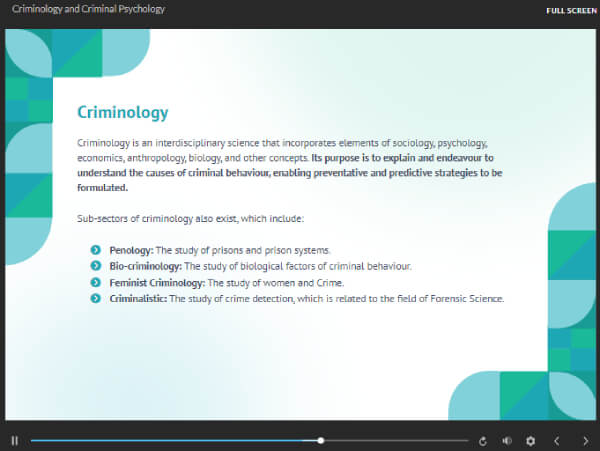
| Module 08: Criminology and Criminal Psychology | |||
| Criminology and Criminal Psychology | 00:13:00 | ||
| Module 09: Violent Crimes and Cyber Criminology | |||
| Violent Crimes and Cyber Criminology | 00:14:00 | ||
| Module 10: Business Theft and fraud | |||
| Business Theft and fraud | 00:12:00 | ||
| Module 11: Domestic Investigation and Types | |||
| Domestic Investigation and Types | 00:15:00 | ||
| Module 12: Victimology | |||
| Victimology | 00:11:00 | ||
| Module 13: Dealing with Crime | |||
| Dealing with Crime | 00:10:00 | ||
| Module 14: Tracing and Surveillance Techniques | |||
| Tracing and Surveillance Techniques | 00:13:00 | ||
| Module 15: Effective Interrogation Techniques | |||
| Effective Interrogation Techniques | 00:14:00 | ||
| Module 16: Basic Operations of Firearms | |||
| Basic Operations of Firearms | 00:10:00 | ||
| Module 17: Firearms Examination | |||
| Firearms Examination | 01:21:00 | ||
| Module 18: Forensic Psychology | |||
| Forensic Psychology | 00:12:00 | ||
| Module 19: The Criminal Justice System in England and Wales | |||
| The Criminal Justice System in England and Wales | 00:13:00 | ||
$125 Original price was: $125.$20Current price is: $20. ex VAT
SAVE 84% - OFFER ENDS SOON
![]() |
01 Year of full Course access
Level 3
Endorsed Certificate of Compleiton