
290 Students
Corporate Paralegal teaches you everything on the topic thoroughly from scratch so you can achieve a professional certificate for free to showcase your achievement in professional life. This Corporate Paralegal is a comprehensive, instructor-guided course, designed to provide a detailed understanding of the nature of the related sector and your key roles within it. To become successful in your profession, …
Child protection and safeguarding training is a professional course designed to help individuals understand how to identify, prevent, and respond to harm or abuse involving children. It builds essential awareness of safeguarding responsibilities, legal duties, and best practices required when working with children and young people in any setting.
This corporate law paralegal programme helps learners understand how legal professionals work, how common legal matters are handled, and why accuracy, confidentiality, communication, and ethical conduct matter in legal settings. The curriculum provides broad foundational knowledge relevant to corporate paralegals and legal administrative environments.
OTA provides flexible, self-paced learning with lifetime access, interactive modules, mobile-friendly study, tutor support, and an Instant Free CPD Certificate. Learners can also order a QLS Endorsed Certificate, subject to the applicable certification terms.
This programme develops foundational knowledge of legal concepts, terminology, and paralegal responsibilities.
Learners will explore legal systems, business law, professional conduct, and common legal matters.
This course is designed for learners interested in legal support and corporate legal environments.
It can also support professionals who regularly work with legal documentation or business matters:
Corporate legal work requires strong attention to legal terminology, documentation, communication, and professional responsibility.
This programme brings these core areas together in a structured learning experience.
Corporate and paralegal knowledge can support roles across law firms, corporate legal departments, government, and other organisations. Canadian Job Bank identifies paralegals and related occupations under NOC 42200 and reports a national wage range of CAD21.63–CAD52.19/hour, with a median of CAD$33.05/hour.
Annual figures are approximate calculations based on Canadian Job Bank hourly wage ranges multiplied by 2,080 working hours. Actual compensation varies by province, employer, experience, qualifications, and responsibilities.
No specific previous paralegal qualification is required, making the programme suitable for beginners and career changers.
dAll of our courses, including this Corporate Paralegal, are fully accredited, providing you with up-to-date skills and knowledge and helping you to become more competent and effective in your chosen field.
All of our courses are accredited by the CPD Quality Standards as conforming to universally accepted Continuing Professional Development (CPD) guidelines.

The Quality Licence Scheme (QLS) is a trusted endorsement framework that certifies high-quality, non-regulated training programmes across various sectors.

The Association of Healthcare Trainers (AoHT) promotes high-quality healthcare training, supporting providers to deliver relevant, industry-aligned education and improve professional standards.
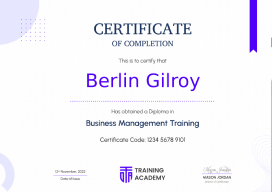
Once you’ve successfully completed your course, you will immediately be sent a digital certificate. Also, you can have your printed certificate delivered by post (shipping cost CA$9.99). All of our courses are fully accredited, providing you with up-to-date skills and knowledge and helping you to become more competent and effective in your chosen field.
This module introduces the role of a paralegal and explains how paralegals support lawyers, legal departments, and other professionals. Learners explore the general responsibilities, functions, and working environment associated with paralegal services.It establishes the foundation needed to understand later modules covering legal systems, documentation, professional conduct, and legal matters.
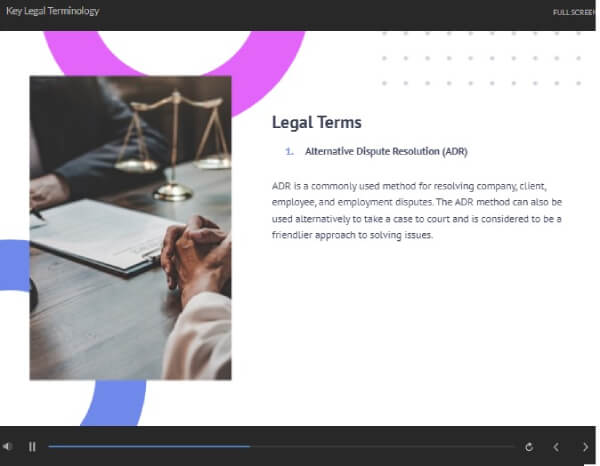
Learners are introduced to commonly used legal terminology and concepts. Developing familiarity with legal language is important for understanding documents, communicating with legal professionals, and interpreting legal information accurately.The module provides a useful vocabulary base for the wider course.
This module examines communication within legal environments, including professional written and verbal communication. Learners consider clarity, accuracy, confidentiality, active listening, and appropriate communication with clients, lawyers, colleagues, and other stakeholders.Strong communication is particularly important when handling sensitive legal information and documentation.
The module considers how paralegals interact with lawyers, clients, administrative staff, and other members of legal teams.It also helps learners understand professional expectations and workplace relationships within legal environments.
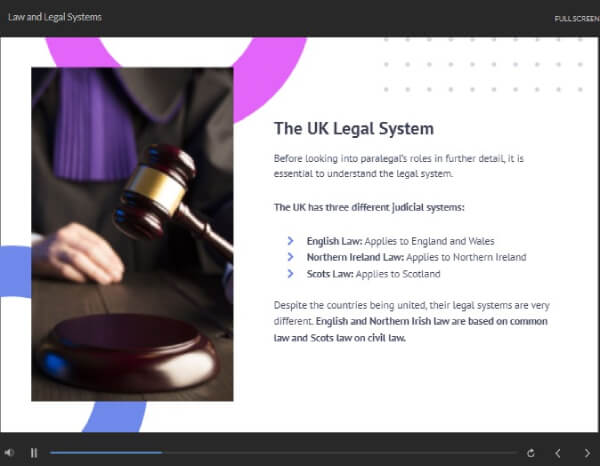
This module introduces the foundations of law and legal systems. Learners explore how legal rules operate, the role of legal institutions, and the broader framework within which legal professionals work.The content provides context for understanding the specific areas of law covered later in the course.
Learners examine fundamental concepts associated with contracts and business law. Topics introduce the purpose and structure of contracts and the legal considerations that can arise in business relationships.This module is particularly relevant to learners interested in corporate legal environments where business agreements and documentation are common.
This module provides an introduction to property law and related legal concepts. Learners explore fundamental principles associated with property ownership, rights, transactions, and legal documentation.It broadens learners’ understanding of legal matters that may arise in business and personal property contexts.
Learners explore the foundations of wills, probate, and estate law. The module introduces key concepts surrounding estate planning, the administration of estates, and legal processes following a person’s death.The content provides general educational knowledge and does not replace advice from a qualified legal professional.
This module introduces fundamental concepts within criminal law. Learners explore the nature of criminal offences, legal processes, and terminology relevant to criminal matters.It helps broaden general legal knowledge and supports a better understanding of the different areas of law that paralegal professionals may encounter.
Learners examine common legal matters that paralegals may encounter in professional environments. The module brings together knowledge from earlier topics and considers how legal support work can involve documentation, research, communication, and organisation.It reinforces the importance of accuracy and appropriate professional boundaries.
This module introduces fundamental human rights concepts and their relevance to legal and workplace environments. Learners explore why equality, dignity, fairness, and protection from discrimination are important considerations within professional settings.The topic provides broader context for understanding legal responsibilities and ethical workplace conduct.
Learners explore common sources of conflict and approaches to resolving disagreements. The module considers communication, negotiation, listening, and structured approaches to addressing disputes.These concepts can be valuable when working with clients, colleagues, legal professionals, and other stakeholders.
This module examines professional behaviour and ethical responsibilities within paralegal work. Learners explore concepts such as confidentiality, integrity, professional boundaries, accuracy, and responsible handling of information.Understanding ethical expectations is essential for anyone working in a legal environment.
The final module brings together key knowledge areas relevant to paralegal work. Learners review important legal concepts, professional expectations, workplace awareness, and approaches to managing common challenges.
A corporate paralegal supports lawyers and corporate legal teams with legal documentation, research, records, and other administrative and legal-support activities. Depending on the organisation, duties may involve corporate records, contracts, compliance-related documentation, and business transactions. The scope of permitted work depends on the role and applicable Canadian rules.
A corporate law paralegal is a legal support professional who assists with matters involving businesses and corporate organisations. Their work may include preparing and organising legal documents, conducting research, maintaining records, and supporting lawyers or in-house legal teams. Corporate legal work often requires strong organisation, accuracy, confidentiality, and communication.
Requirements vary according to the role and province. Job Bank states that paralegals in law firms typically require legal education and in-house training, while independent paralegals generally need relevant legal knowledge and experience or a community-college paralegal programme. Certain advanced legal services also require licensing.
Yes. This course begins with the fundamentals of paralegal work and legal terminology before progressing into areas such as contract and business law, property law, human rights, and professional ethics. It is designed to give beginners a structured introduction to the legal workplace.
Corporate paralegals and related professionals may work in law firms, corporate legal departments, government organisations, and other public or private-sector workplaces. Job Bank notes that paralegals and related occupations are employed by law firms and legal departments across the public and private sectors.
According to the Canadian Job Bank, corporate paralegal wages range nationally from CAD21.63toCAD52.19 per hour, with a median wage of CAD$33.05 per hour. This corresponds to an approximate annual range of CAD44,990toCAD108,555 when calculated over 2,080 hours. Actual earnings depend on location, employer, experience, and role.
| Corporate Paralegal | |||
| Module 01: Understanding the Concept of Paralegal | 00:25:00 | ||
| Module 02: Key Legal Terminology | 00:16:00 | ||
| Module 03: Effective Communication Skills for Paralegal | 00:39:00 | ||
| Module 04: The Legal Workplace & Professionals | 00:45:00 | ||
| Module 05: Law & Legal Systems | 00:33:00 | ||
| Module 06: Contract & Business Law | 00:54:00 | ||
| Module 07: Property Law | 00:19:00 | ||
| Module 08: Wills, Probate, Estate Law | 00:15:00 | ||
| Module 09: Criminal Law | 00:24:00 | ||
| Module 10: Common Paralegal Legal Matters | 00:35:00 | ||
| Module 11: Human Rights | 00:12:00 | ||
| Module 12: Conflict and Conflict Resolution | 00:18:00 | ||
| Module 13: Professional Conduct and Ethics of Paralegals | 00:25:00 | ||
| Module 14: Mandatory Knowledge Fields and Survival Tips for Paralegals | 00:12:00 | ||
$125 Original price was: $125.$20Current price is: $20. ex VAT
SAVE 84% - OFFER ENDS SOON
![]() |
01 Year of full Course access
Intermediate
Endorsed Certificate of Compleiton