219 Students
Understanding the human body is essential for anyone interested in healthcare, science, or medical-related careers across Canada. This Human Biology Diploma provides a comprehensive introduction to how the human body functions at cellular, system, and organ levels, helping learners build a strong foundation in biological sciences. Suitable for beginners and those exploring healthcare or science pathways, the course covers cells, …
Understanding the human body is essential for anyone interested in healthcare, science, or medical-related careers across Canada. This Human Biology Diploma provides a comprehensive introduction to how the human body functions at cellular, system, and organ levels, helping learners build a strong foundation in biological sciences.
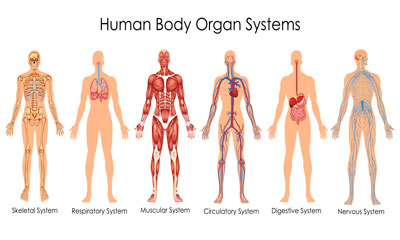
Suitable for beginners and those exploring healthcare or science pathways, the course covers cells, tissues, body systems, and key physiological processes. Learners will explore how different systems such as the nervous, cardiovascular, respiratory, and digestive systems work together to maintain health and balance in the human body.
Study online at your own pace and build knowledge that supports further study or career development in healthcare and science fields. Upon completion, you will receive a diploma certificate that reflects your achievement. Enrol today and take the first step toward understanding human biology in depth.
Please note: This Human Biology Diploma Course only gives you the theoretical knowledge that you need to excel in this field. This Course doesn’t entitle you to practise as a professional in this specific field.
This course is ideal for:
All of our courses, including this Human Biology Diploma Course, are fully accredited, providing you with up-to-date skills and knowledge and helping you to become more competent and effective in your chosen field.
All of our courses are accredited by the CPD Quality Standards as conforming to universally accepted Continuing Professional Development (CPD) guidelines.
The Quality Licence Scheme (QLS) is a trusted endorsement framework that certifies high-quality, non-regulated training programmes across various sectors.
The Association of Healthcare Trainers (AoHT) promotes high-quality healthcare training, supporting providers to deliver relevant, industry-aligned education and improve professional standards.
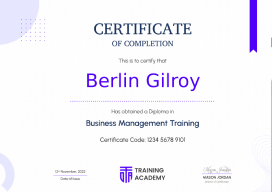
Once you’ve successfully completed your course, you will immediately be sent a digital certificate. Also, you can have your printed certificate delivered by post (shipping cost CA$9.99). All of our courses are fully accredited, providing you with up-to-date skills and knowledge and helping you to become more competent and effective in your chosen field.
The detailed curriculum outline of our Human Biology Diploma is as follows:
This module explores the chemical building blocks that make up all living organisms. Learners study essential biomolecules such as carbohydrates, proteins, lipids, and nucleic acids, and how they support life processes. It also explains how chemical reactions inside cells drive biological functions.
Focuses on the structure and function of the cell as the basic unit of life. This module examines organelles such as the nucleus, mitochondria, and ribosomes, explaining how each contributes to energy production, growth, and cellular maintenance.
Introduces the process of cell division, particularly mitosis, which allows growth, repair, and replacement of cells. Learners explore the stages of division and how genetic material is accurately copied and distributed.
This module explains how DNA replication ensures genetic continuity from one cell to another. It also covers metabolism, including how cells convert nutrients into energy required for survival and function.
Examines how cells organize into tissues with specialised roles. The module covers epithelial, connective, muscular, and nervous tissues, highlighting how each type supports the structure and function of organs.
Focuses on the skin as the body’s largest organ and first line of defence. It explains its layered structure, protective functions, role in temperature regulation, and sensory perception.
Explores the structure of bones, joints, and cartilage. Learners understand how the skeletal system provides support, enables movement, produces blood cells, and protects vital organs.
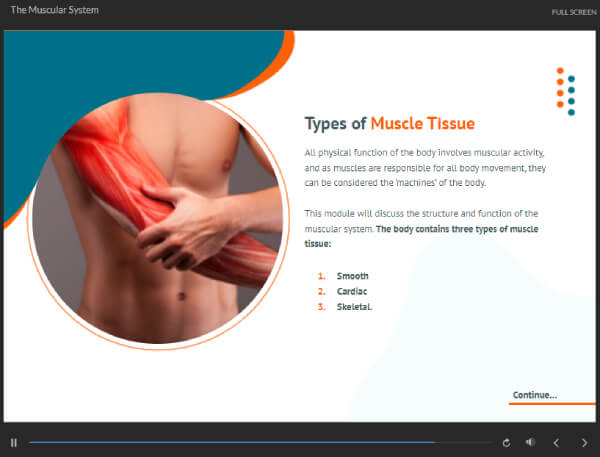
Covers the three types of muscle tissue—skeletal, smooth, and cardiac. The module explains how muscles contract and work with bones to produce movement and maintain posture.
Examines muscle fibres at a microscopic level, focusing on how actin and myosin interact during contraction. It explains how muscle strength and movement are generated.
Introduces the nervous system as the body’s communication network. Learners explore how neurons transmit electrical signals to control movement, sensation, and internal body functions.
Focuses on the structure and function of the brain, including major regions such as the cerebrum, cerebellum, and brainstem. It explains how the brain controls thinking, memory, and coordination.
Explores how the spinal cord connects the brain to the body. It explains how spinal nerves transmit sensory and motor signals, enabling reflexes and voluntary movement.
Covers involuntary functions controlled by the autonomic nervous system, such as heart rate and digestion. It also explains cranial nerves and their roles in sensory and motor control.
Explains how the eye captures light and converts it into electrical signals. The module describes visual processing from the retina to the brain and how vision is formed.
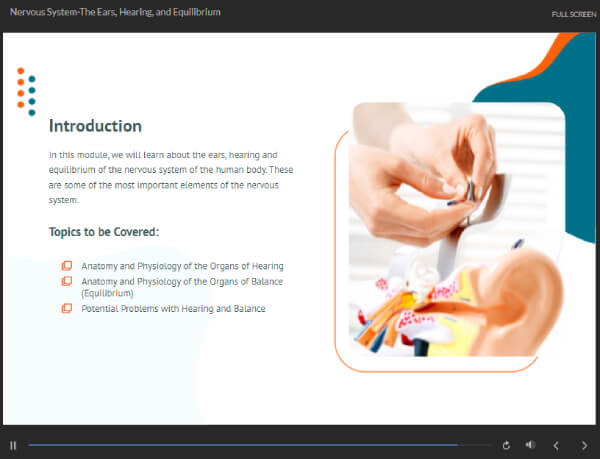
Focuses on how sound waves are detected and processed by the ear. It also explains the vestibular system responsible for balance and spatial orientation.
Explores how the brain encodes, stores, and retrieves information. It examines short-term and long-term memory and their role in learning and cognition.
Covers how the body detects external stimuli through the five senses. The module explains sensory receptors and how the brain interprets sensory input.
Explains the structure and function of the heart and blood vessels. It focuses on blood circulation, oxygen transport, and maintaining homeostasis in the body.
Examines the components of blood, including red blood cells, white blood cells, platelets, and plasma. It explains their roles in oxygen transport, immunity, and clotting.
Focuses on the lymphatic system and its role in maintaining fluid balance and immune defence. It explains how lymph nodes filter harmful substances from the body.
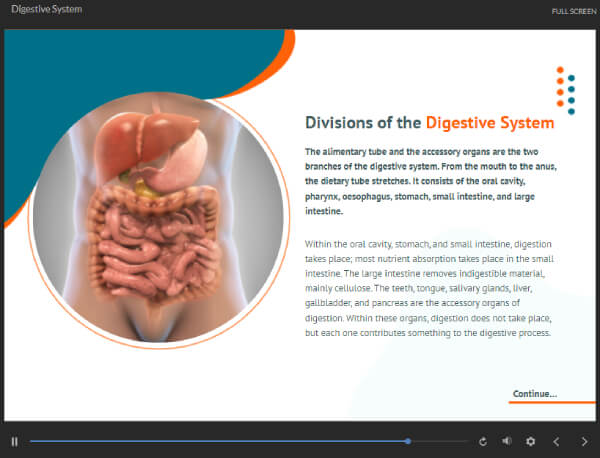
Explains how food is broken down into nutrients through mechanical and chemical digestion. It covers organs such as the stomach, intestines, liver, and pancreas.
Focuses on how oxygen is taken into the body and carbon dioxide is removed. It explains gas exchange in the lungs and the role of the respiratory tract.
Explores how the kidneys filter waste products from the blood. It explains urine formation and the body’s regulation of water and electrolyte balance.
Covers the structure and function of male reproductive organs. It explains sperm production, hormone regulation, and reproductive processes.
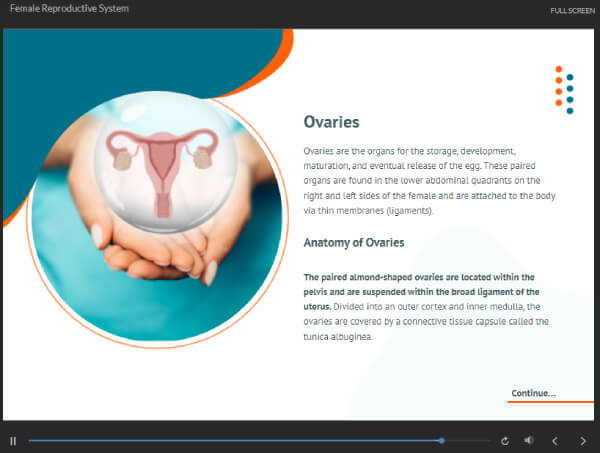
Explores the female reproductive system, including ovulation, menstrual cycle, and hormonal regulation. It also explains reproduction and pregnancy processes.
Yes, human biology is essential for understanding how the body works, making it a key foundation for nursing, healthcare support, and medical-related careers.
Topics include cells, tissues, skeletal system, nervous system, cardiovascular system, immune system, and other major organ systems.
Yes, this course is designed for beginners and does not require prior science knowledge.
It can support roles such as healthcare assistant, lab support worker, pharmacy assistant, and entry-level research positions.
Yes, learners receive a diploma certificate upon successful completion of the course.
Yes, it provides strong foundational knowledge that supports further studies in nursing and healthcare fields.
| Human Biology Diploma | |||
| Module 01: The Chemistry of Cells | |||
| The Chemistry of Cells | 00:27:00 | ||
| Module 02: Cells | |||
| Cells | 00:16:00 | ||
| Module 03: Cell Division | |||
| Cell Division | 00:19:00 | ||
| Module 04: Replication and Metabolism | |||
| Replication and Metabolism | 00:20:00 | ||
| Module 05: Human Tissues | |||
| Human Tissues | 00:25:00 | ||
| Module 06: Skin | |||
| Skin | 00:16:00 | ||
| Module 07: Human Skeletal System | |||
| Human Skeletal System | 00:21:00 | ||
| Module 08: The Muscular System | |||
| The Muscular System | 00:17:00 | ||
| Module 09: Skeletal Muscle Fibre | |||
| Skeletal Muscle Fibre | 00:22:00 | ||
| Module 10: Nervous System | |||
| Nervous System | 00:31:00 | ||
| Module 11: The Brain | |||
| The Brain | 00:23:00 | ||
| Module 12: Nervous System—Spinal Cord and Spinal Nerves | |||
| Nervous System—Spinal Cord and Spinal Nerves | 00:15:00 | ||
| Module 13: Nervous System - Autonomic Nervous System and Cranial Nerves | |||
| Nervous System – Autonomic Nervous System and Cranial Nerves | 00:31:00 | ||
| Module 14: Nervous System—The Eyes | |||
| Nervous System—The Eyes | 00:15:00 | ||
| Module 15: Nervous System—The Ears, Hearing, and Equilibrium | |||
| Nervous System-The Ears, Hearing, and Equilibrium | 00:14:00 | ||
| Module 16: Nervous System—Memory | |||
| Nervous System—Memory | 00:19:00 | ||
| Module 17: Sensory Systems | |||
| Sensory Systems | 00:23:00 | ||
| Module 18: Cardiovascular System | |||
| Cardiovascular System | 00:25:00 | ||
| Module 19: Blood | |||
| Blood | 00:27:00 | ||
| Module 20: Lymphatics | |||
| Lymphatics | 00:20:00 | ||
| Module 21: Immune System | |||
| Immune System | 00:26:00 | ||
| Module 22: Digestive System | |||
| Digestive System | 00:22:00 | ||
| Module 23: Respiratory System | |||
| Respiratory System | 00:16:00 | ||
| Module 24: Urinary System | |||
| Urinary System | 00:16:00 | ||
| Module 25: Male Reproductive System | |||
| Male Reproductive System | 00:32:00 | ||
| Module 26: Female Reproductive System | |||
| Female Reproductive SystemHuman Biology Diploma | 00:33:00 | ||
$125 Original price was: $125.$20Current price is: $20. ex VAT
SAVE 84% - OFFER ENDS SOON
![]() |
01 Year of full Course access
Intermediate
Endorsed Certificate of Compleiton