1596 Students
HACCP Awareness Course introduces learners to Hazard Analysis and Critical Control Points, a preventive approach to identifying and controlling food safety hazards. The course covers biological, chemical, and physical hazards, food safety requirements, HACCP planning, the seven principles, critical control points, critical limits, monitoring, corrective action, verification, and documentation. It is suitable for food handlers, kitchen staff, catering workers, food …
HACCP Awareness Course introduces learners to Hazard Analysis and Critical Control Points, a preventive approach to identifying and controlling food safety hazards. The course covers biological, chemical, and physical hazards, food safety requirements, HACCP planning, the seven principles, critical control points, critical limits, monitoring, corrective action, verification, and documentation. It is suitable for food handlers, kitchen staff, catering workers, food production employees, supervisors, and others involved in food safety in Canada.
The training helps learners recognise food safety risks at different stages of handling, preparation, production, storage, and service. It develops knowledge of HACCP systems and monitoring procedures that can support safer practices across Canadian restaurants, catering businesses, food manufacturing, retail, and other food operations.
Online, self-paced learning makes it easier to study around work and other commitments. Structured course materials and certification on successful completion provide a flexible way to strengthen food safety knowledge and support career development.
The course introduces the main HACCP concepts and shows how the seven principles contribute to effective food safety management.
The course is suitable for people involved in preparing, handling, producing, storing, or serving food in Canadian workplaces.
HACCP knowledge can help food businesses identify potential hazards and strengthen preventive food safety practices.
HACCP knowledge can complement roles in food preparation, production, quality control, and food safety. Salaries vary by province, employer, experience, qualifications, and responsibilities.
The course is designed as an accessible introduction to HACCP and does not require previous food safety qualifications.
All of our courses, including this HACCP Awareness Course, are fully accredited, providing you with up-to-date skills and knowledge and helping you to become more competent and effective in your chosen field.
All of our courses are accredited by the CPD Certification Service as conforming to universally accepted Continuing Professional Development (CPD) guidelines.

The Quality Licence Scheme (QLS) is a trusted endorsement framework that certifies high-quality, non-regulated training programmes across various sectors.

The Association of Healthcare Trainers (AoHT) promotes high-quality healthcare training, supporting providers to deliver relevant, industry-aligned education and improve professional standards.

Once you’ve successfully completed your course, you will immediately be sent a digital certificate. Also, you can have your printed certificate delivered by post (shipping cost £3.99). All of our courses are fully accredited, providing you with up-to-date skills and knowledge and helping you to become more competent and effective in your chosen field. Our certifications have no expiry dates, although we do recommend that you renew them every 12 months.
Start with the purpose of HACCP and its role as a preventive food safety system. Learners explore why identifying hazards before they cause harm is important across food preparation, production, storage, and service.
Food safety systems operate alongside applicable laws, regulations, and workplace procedures. This section introduces the relationship between HACCP and Canadian food safety requirements, including the importance of meeting applicable federal, provincial, territorial, and local requirements.
Food hazards can arise from biological, chemical, and physical sources. Learners examine common examples and consider how hazards can enter or develop within food handling and production processes.
A successful HACCP system starts with careful planning. Learners explore the information, people, processes, and preparation needed before a HACCP system can be developed and implemented.
Turn the planning stage into a structured food safety system. Learners look at the key elements involved in developing HACCP procedures and organising controls around identified food safety risks.
Hazard analysis is the starting point for identifying what could go wrong and where controls may be needed. Learners examine how hazards can be identified, evaluated, and considered at different stages of a food process.
Not every stage presents the same level of risk, which is why identifying critical control points matters. Learners explore how CCPs are determined and how controlling these points can help prevent or reduce food safety hazards.
Critical limits provide measurable boundaries for controlling identified hazards at CCPs. Learners develop an understanding of how appropriate limits can be established and why they need to be clear and measurable.
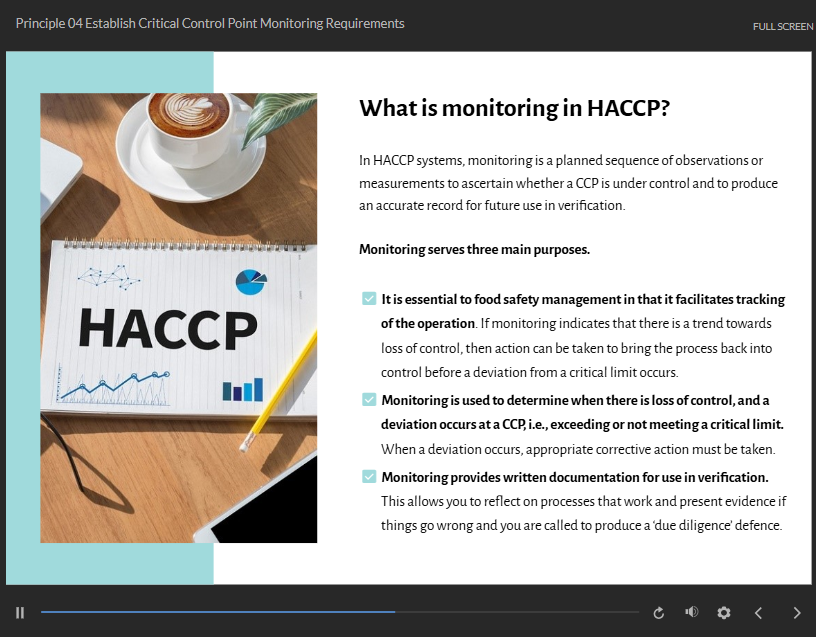
Monitoring helps confirm that critical control points remain within their required limits. Learners explore monitoring procedures, responsibilities, frequency, and the importance of maintaining reliable records.
When monitoring shows that a critical limit has not been met, appropriate action is needed. This module covers the purpose of corrective action and how problems can be addressed to protect food safety.
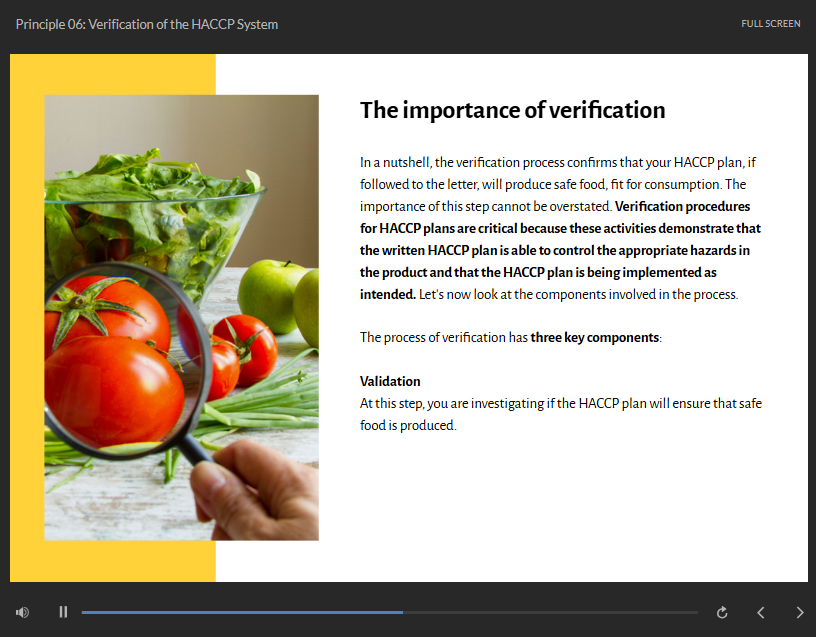
Verification checks whether the HACCP system is working as intended. Learners explore ways to review controls, procedures, monitoring records, and other evidence to confirm that the system remains effective.
Good records provide evidence that food safety controls are being followed. Learners examine the role of documentation, record keeping, and maintaining information that supports HACCP monitoring and verification.
Putting a HACCP system into practice requires clear responsibilities and consistent procedures. Learners consider how controls can be introduced, communicated, monitored, and maintained within food operations.
Not every food business uses an identical food safety management approach. The final module introduces alternatives and considers how different preventive systems may be used to manage food safety risks depending on the operation and applicable requirements.
It is suitable for food handlers, kitchen staff, catering employees, food production workers, restaurant employees, food retailers, supervisors, and others involved in food safety in Canada.
Yes. The course introduces HACCP from the basics and does not require previous HACCP experience. It can be suitable for learners starting work in food preparation, catering, manufacturing, or food retail.
No. HACCP is a specific preventive food safety management approach. General food safety training may cover broader topics such as personal hygiene, temperature control, cleaning, cross-contamination, and safe food handling.
Yes. HACCP knowledge can complement experience and other food safety training for roles in restaurants, catering, food processing, food manufacturing, retail, and quality assurance.
Yes. The course is designed for online, self-paced learning, allowing learners to study around work, family, and other commitments.
Yes. Learners receive certification after successful completion of the course, providing evidence of their HACCP awareness training for workplace learning and development.
| HACCP Training | |||
| Module 01: An Introduction to HACCP | 00:15:00 | ||
| Module 02: HACCP and Food Safety Legislation | 00:25:00 | ||
| Module 03: Food Safety Hazards | 01:00:00 | ||
| Module 04: Planning a HACCP System | 00:40:00 | ||
| Module 05: Creating the HACCP System | 00:20:00 | ||
| Module 06: Principle 1 – Hazard Analysis | 00:15:00 | ||
| Module 07: Principle 2 – Critical Control Points | 00:12:00 | ||
| Module 08: Principle 3 – Critical Limits | 00:20:00 | ||
| Module 09: Principle 4 – Monitoring Critical Control Points | 00:20:00 | ||
| Module 10: Principle 5 – Corrective Action | 00:25:00 | ||
| Module 11: Principle 6 – Verification of the HACCP System | 00:30:00 | ||
| Module 12: Principle 7 – Documentation | 00:16:00 | ||
| Module 13: Implementing the HACCP System | 00:12:00 | ||
| Module 14: HACCP Alternatives | 00:15:00 | ||
| Mock Exam | |||
| Mock Exam – HACCP Awareness Course | 00:20:00 | ||
| Final Exam | |||
| Final Exam – HACCP Awareness Course | 00:20:00 | ||
| Trust Pilot Review | |||
| Trust Pilot Review | 00:00:00 | ||
$125 Original price was: $125.$20Current price is: $20. ex VAT
SAVE 84% - OFFER ENDS SOON
![]() |
01 Year of full Course access
Intermediate
Endorsed Certificate of Compleiton