548 Students
Fire Extinguisher Training – Level 2 develops knowledge for workers, fire wardens, and others who may need to understand portable extinguisher use in workplace settings. Learners explore fire types, extinguisher selection, labelling, misuse, limitations, fire blankets, support equipment, and risks associated with early-stage fire response. It is suitable for workplace learners across Canada. The training helps learners assess when initial …

Fire Extinguisher Training – Level 2 develops knowledge for workers, fire wardens, and others who may need to understand portable extinguisher use in workplace settings. Learners explore fire types, extinguisher selection, labelling, misuse, limitations, fire blankets, support equipment, and risks associated with early-stage fire response. It is suitable for workplace learners across Canada.
The training helps learners assess when initial fire control may be appropriate and when evacuation should take priority. Learners explore the PASS technique, safe positioning, smoke hazards, alarm procedures, evacuation routes, emergency communication, and post-fire reporting. These topics support safer decisions during workplace fire emergencies.
Online, self-paced learning provides flexibility around work and other commitments. The course presents fire-extinguisher principles clearly and includes an assessment to check understanding. Successful completion can provide a certificate as a training record, while hands-on practice and workplace fire-safety requirements may vary by province, territory, employer, and applicable authority.
This course helps learners develop knowledge for safer fire-extinguisher awareness and emergency response.
The course is designed for workers who may have workplace fire safety or emergency response responsibilities.
Once you’ve successfully completed your course, you will immediately be sent a digital certificate. Also, you can have your printed certificate delivered by post (shipping cost £3.99). All of our courses are fully accredited, providing you with up-to-date skills and knowledge and helping you to become more competent and effective in your chosen field. Our certifications have no expiry dates, although we do recommend that you renew them every 12 months.
Understanding fire extinguishers is useful, but knowing when not to use one is equally important for workplace safety.
Fire extinguisher training can complement a range of workplace safety and site-based roles. Salary ranges vary by province, employer, experience, qualifications, and responsibilities.
The course is designed to be accessible to beginners and workers seeking additional fire safety knowledge.
All of our courses, including this Fire Extinguisher Training Level 2, are fully accredited, providing you with up-to-date skills and knowledge and helping you to become more competent and effective in your chosen field.
All of our courses are accredited by the CPD Quality Standards as conforming to universally accepted Continuing Professional Development (CPD) guidelines.

The Quality Licence Scheme (QLS) is a trusted endorsement framework that certifies high-quality, non-regulated training programmes across various sectors.

The Association of Healthcare Trainers (AoHT) promotes high-quality healthcare training, supporting providers to deliver relevant, industry-aligned education and improve professional standards.

The course contains five focused modules covering fire types, extinguisher selection, safe use, support equipment, emergency decisions, and assessment.
The introduction explains the purpose of fire extinguisher training and the importance of making safe decisions during an early-stage fire. Learners are introduced to the principles of fire classification, extinguisher selection, and personal safety.
This module examines different fire classifications and the types of extinguishers designed for particular fire risks. Learners explore extinguisher symbols, labels, colour identification, common misuse, limitations, and the importance of selecting appropriate equipment. Canadian learners should follow the classification and labelling requirements applicable to their workplace and jurisdiction.
Learners explore the PASS technique and the principles of using a portable extinguisher safely. The module covers positioning, assessing fire size, discharge limitations, coordination with other responders, and maintaining a safe route of retreat.
This module introduces fire blankets and other basic fire-response equipment. Learners consider appropriate uses for different situations, including certain kitchen and clothing fires, as well as the safe storage and maintenance of blankets and other support tools.
Learners develop knowledge for deciding whether a fire should be approached or whether immediate evacuation is safer. The module covers smoke hazards, raising the alarm, alerting others, evacuation planning, post-fire reporting, site checks, and communication with emergency services.
This module explains assessment expectations, including knowledge testing and scenario-based learning. Where practical training is provided, learners may practise extinguisher response under controlled conditions. Certification and renewal requirements depend on the training provider, employer, workplace, and applicable jurisdiction.
The conclusion reinforces the key principles covered throughout the course, including fire classification, extinguisher selection, safe response, fire blankets, evacuation, and emergency communication. Learners consolidate their understanding of when initial fire response may be appropriate and when personal safety requires immediate evacuation.
It can be suitable for fire wardens, workplace staff, construction workers, hospitality employees, facilities personnel, supervisors, and others with workplace fire safety responsibilities.
PASS is a commonly taught sequence for operating a portable fire extinguisher: Pull the pin, Aim at the base of the fire, Squeeze the handle, and Sweep across the fire.
Common extinguisher agents include water, foam, carbon dioxide, dry chemical or powder, and wet chemical. The appropriate type depends on the fire hazard and the equipment approved for the workplace.
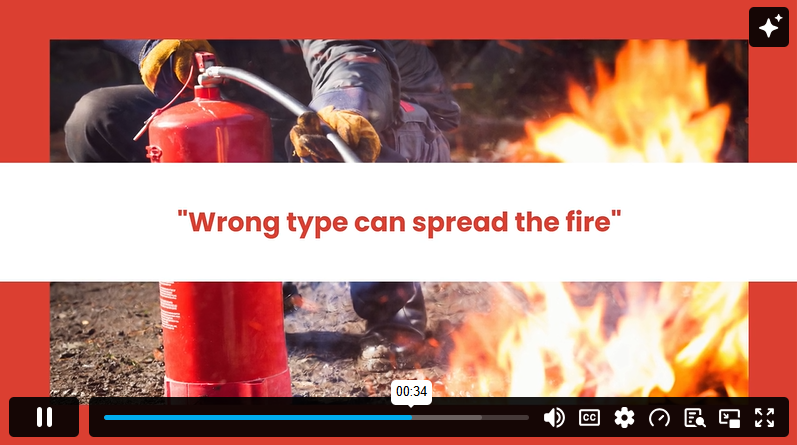
No. Using the wrong extinguisher can be ineffective or dangerous. The extinguisher must be suitable for the type of fire involved.
Do not attempt to fight a fire if it is spreading rapidly, producing dangerous smoke, blocking your escape route, or beyond the stage where a trained person can safely manage it. Raising the alarm and evacuating should take priority.
Fire blankets may be suitable for certain small fires, depending on the situation and the type of blanket. They should only be used according to workplace procedures and manufacturer guidance.
| Module 01: Understanding Fire Types and Their Extinguishers | |||
| 1. Introduction | 00:01:00 | ||
| 1.1. Understanding Fire Types and Their Extinguishers | 00:01:00 | ||
| 1.1.1. UK Fire Classifications | 00:01:00 | ||
| 1.1.2 Matching Extinguishers to Fire Classes | 00:01:00 | ||
| 1.1.3 Common Extinguisher Misuse | 00:01:00 | ||
| 1.1.4. Extinguisher Limitations and Risks | 00:01:00 | ||
| 1.1.5. Colour Coding of Extinguishers in the UK | 00:01:00 | ||
| 1.1.6. Understanding Extinguisher Symbols and Labelling | 00:01:00 | ||
| Reading Materials | |||
| Section 1: Understanding Fire Types and Their Extinguishers | 00:00:00 | ||
| Module 02: Using Fire Extinguishers Effectively | |||
| 2.1 Using Fire Extinguishers Effectively | 00:01:00 | ||
| 2.1.1 The PASS Technique in Detail | 00:01:00 | ||
| 2.1.2. Optimal Positioning and Distance | 00:01:00 | ||
| 2.1.3. Fire Size Assessment | 00:01:00 | ||
| 2.1.4 Duration and Discharge Management | 00:01:00 | ||
| 2.1.5. Coordinating with Other Responders | 00:01:00 | ||
| 2.1.6. Safe Retreat and Exit Procedures After Use | 00:01:00 | ||
| Reading Materials | |||
| Section 2: Using Fire Extinguishers Effectively | 00:00:00 | ||
| Module 03: Using Fire Blankets and Support Tools | |||
| 3.1. Using Fire Blankets and Support Tools | 00:01:00 | ||
| 3.1.1. Types of Fires Suitable for Fire Blankets | 00:01:00 | ||
| 3.1.2 Kitchen and Clothing Fire Scenarios | 00:01:00 | ||
| 3.1.3 Fire Buckets, Sand, and Their Use | 00:01:00 | ||
| 3.1.4. Integrating Multiple Tools Safely | 00:01:00 | ||
| 3.1.5. Maintenance and Storage of Fire Blankets | 00:01:00 | ||
| 3.1.6. Combining Fire Blankets with Extinguishers in Emergencies | 00:01:00 | ||
| Reading Materials | |||
| Section 3: Using Fire Blankets and Support Tools | 00:00:00 | ||
| Module 04: Safety Assessment and Response Decisions | |||
| 4.1 Safety Assessment and Response Decisions | 00:01:00 | ||
| 4.1.1 Recognising When Not to Engage | 00:01:00 | ||
| 4.1.2. Smoke Hazards and Inhalation Risk | 00:01:00 | ||
| 4.1.3 Raising the Alarm and Alerting Others | 00:01:00 | ||
| 4.1.4. Post-Fire Reporting and Site Check | 00:01:00 | ||
| Reading Materials | |||
| Section 4: Safety Assessment and Response Decisions | 00:00:00 | ||
| Conclusion | |||
| Conclusion (2) | 00:01:00 | ||
$125 Original price was: $125.$20Current price is: $20. ex VAT
SAVE 84% - OFFER ENDS SOON
![]() |
01 Year of full Course access
Level 2
Endorsed Certificate of Compleiton