586 Students
Crimes and misconducts are inevitable parts of human societies. That’s why the science of crime which is termed as Criminology has been evolved to explore and explain the motives and causes behind crimes and how to deal with different crimes. This Criminology, Profiling and Criminal Justice is designed to introduce you to Criminology and the world of crime to understand …
The Criminology, Profiling and Criminal Justice course explores how crime is studied, investigated, interpreted, and addressed within the criminal justice system. Learners examine crime classification, violent crime, crime scenes, criminal psychology, forensic science, victimology, and the principles behind offender profiling. The course is suitable for learners interested in criminology, criminal behaviour, investigative studies, law enforcement, or related fields.
The programme provides a broader understanding of criminal profiling, including profiling methods, behavioural investigative advice, metacognition, and the relationship between evidence, logic, and offender behaviour. It also helps learners understand criminology vs criminal justice: criminology focuses primarily on crime, its causes, patterns, and behaviour, while criminal justice examines the institutions and processes involved in responding to crime.
Study online at your own pace with flexible access, interactive modules, tutor support, lifetime learning access, and certification. This course can strengthen your understanding of criminal behaviour and improve your preparation for further education or justice-related career pathways in Canada. Enrol today and begin building your knowledge of criminology, profiling, and criminal justice.
This course develops foundational knowledge across criminology, criminal behaviour, profiling, and criminal justice.
By the end of the programme, learners can:
This course is suited to learners interested in crime, criminal behaviour, investigation, and justice.
It can support both personal study and further academic or professional development.
Understanding crime requires more than examining individual offences; it involves behaviour, evidence, victims, investigation, and justice processes.
This programme brings these connected areas together in one structured course.
Career outcomes depend on qualifications, experience, occupation, province, and employer. Salary figures below use Canadian Job Bank wage data where applicable.
Salary levels vary by province, employer, experience, credentials, and specific occupation. Some roles, particularly policing, corrections, regulated professions, and government positions, may require additional qualifications, screening, training, or employment-specific requirements.
No specific previous qualification is required to begin this beginner-friendly programme.
dAll of our courses, including this Criminology, Profiling and Criminal Justice, are fully accredited, providing you with up-to-date skills and knowledge and helping you to become more competent and effective in your chosen field.
All of our courses are accredited by the CPD Quality Standards as conforming to universally accepted Continuing Professional Development (CPD) guidelines.
The Quality Licence Scheme (QLS) is a trusted endorsement framework that certifies high-quality, non-regulated training programmes across various sectors.

The Association of Healthcare Trainers (AoHT) promotes high-quality healthcare training, supporting providers to deliver relevant, industry-aligned education and improve professional standards.
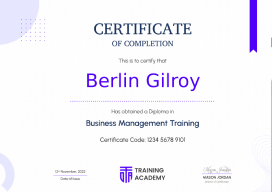
Once you’ve successfully completed your course, you will immediately be sent a digital certificate. Also, you can have your printed certificate delivered by post (shipping cost CA$9.99). All of our courses are fully accredited, providing you with up-to-date skills and knowledge and helping you to become more competent and effective in your chosen field.
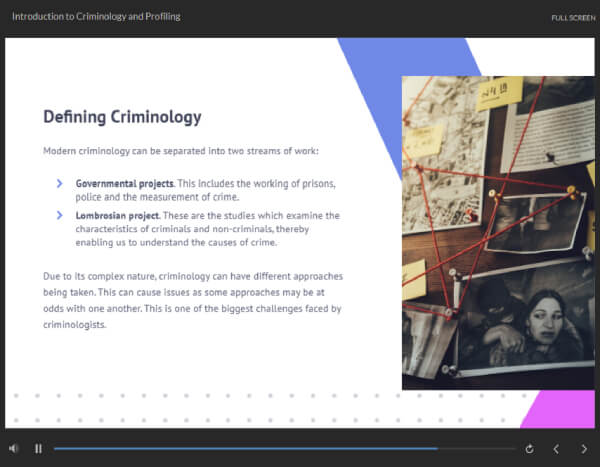
This introductory module establishes the foundations of criminology and profiling. Learners explore what criminology studies and how behavioural information can contribute to understanding crime and offenders. It also introduces key concepts that are developed throughout the course.
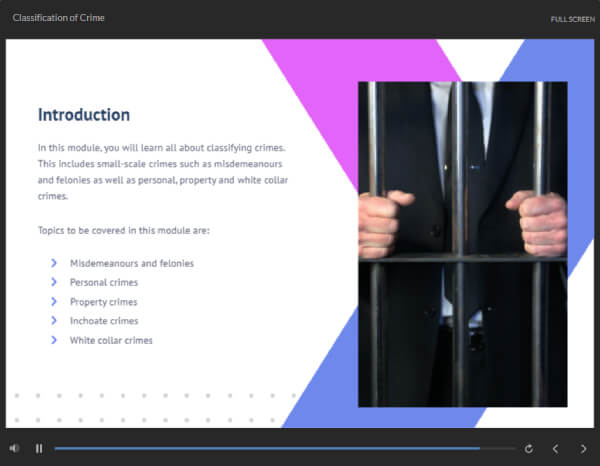
Explore the different ways crimes can be categorised and understood. Learners examine how classification can help researchers, investigators, and justice professionals identify patterns and distinguish between different forms of offending.
This module examines violent crime and the behavioural and situational factors associated with different violent offences. Learners develop a broader understanding of how violent crimes can be studied within criminological and investigative contexts.
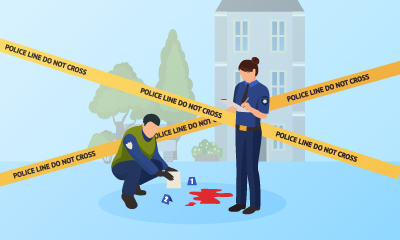
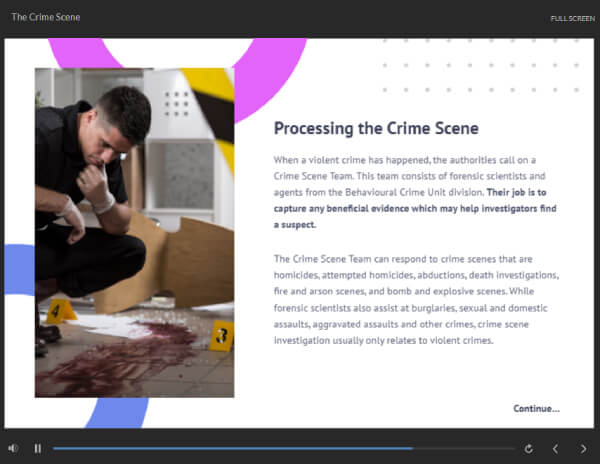
Learn about the importance of crime scenes in criminal investigations. The module introduces how observations, evidence, circumstances, and behavioural information can contribute to developing an understanding of what may have occurred.
This module considers broader responses to crime and the challenges involved in preventing, investigating, and addressing criminal behaviour. Learners explore how different professionals and institutions contribute to the response to crime.
Explore psychological perspectives on criminal behaviour and offending. Learners examine factors that may contribute to criminal behaviour while developing an awareness of the complexity of human behaviour and the limitations of simplistic explanations.
This module introduces the role of forensic science in criminal investigations. Learners explore how scientific methods and evidence can support investigative processes and contribute to the interpretation of information from crime scenes.
Learn about the major stages involved in developing an offender profile. The module examines how information can be collected, assessed, interpreted, and incorporated into an investigative framework.
This module takes a deeper look at the reasoning behind criminal profiling. Learners explore the roles of scientific thinking, logical analysis, and metacognition when interpreting behavioural information and forming investigative hypotheses.
Explore how offender profiling may be used as part of a broader investigative process. The module considers behavioural investigative advice and the importance of using profiling information carefully alongside available evidence.
This module examines victimology, the study of victims and their relationship to crime. Learners explore victim characteristics, circumstances, and contextual factors that can contribute to understanding offences and investigative patterns.
The final module introduces the structure and operation of the criminal justice system in England and Wales. It provides context on how different components of the justice system interact in responding to crime, from investigation through to legal and correctional processes.
Criminology vs criminal justice is a common area of interest for students. Criminology examines crime, criminal behaviour, its causes, patterns, and social impact. Criminal justice focuses on the systems and institutions that respond to crime, including policing, courts, corrections, and related processes.
Criminal profiling is an investigative approach that attempts to understand behavioural patterns associated with an unknown offender. It may consider information from the crime, victim, scene, and known behavioural evidence. Profiling should be viewed as an investigative aid rather than definitive proof of an individual’s identity.
Learners explore crime classification, violent crime, crime scenes, criminal psychology, forensic science, profiling methods, victimology, and criminal justice. This course also examines the relationship between science, logic, behavioural analysis, and investigative decision-making.
Criminology can provide a useful foundation for learners interested in criminal behaviour and psychology. This programme includes a dedicated module on criminal psychology alongside profiling, forensic science, violent crime, and victimology, giving learners a broader perspective on offending behaviour.
Yes. Online study can provide flexible access to criminology and profiling education from Canada. However, completing an online course does not automatically qualify someone for regulated or restricted occupations such as police officer, forensic psychologist, or certain government positions, which may have separate requirements.
Criminology-related knowledge can be relevant to areas such as corrections, policing, security, investigation, policy, research, victim services, and justice administration. Specific career requirements vary considerably, so learners should check the qualifications, screening, licensing, or education required for their chosen occupation.
| Module 1: Introduction to Criminology and Profiling | |||
| Introduction to Criminology and Profiling | 00:18:00 | ||
| Module 2: Classification of Crime | |||
| Classification of Crime | 00:13:00 | ||
| Module 3: Violent Crimes | |||
| Violent Crimes | 00:24:00 | ||
| Module 4: The Crime Scene | |||
| The Crime Scene | 00:25:00 | ||
| Module 5: Dealing with Crime | |||
| Dealing with Crime | 00:36:00 | ||
| Module 6: Understanding Criminal Psychology | |||
| Understanding Criminal Psychology | 00:26:00 | ||
| Module 7: Forensic Science | |||
| Forensic Science | 00:30:00 | ||
| Module 8: Phases of Profiling | |||
| Phases of Profiling | 00:28:00 | ||
| Module 9: Criminal Profiling: Science, Logic and Metacognition | |||
| Criminal Profiling Science, Logic and Metacognition | 00:23:00 | ||
| Module 10: Offender Profiling: Pragmatic Solution and Behavioural Investigative Advice | |||
| Offender Profiling Pragmatic Solution and Behavioural Investigative Advice | 00:17:00 | ||
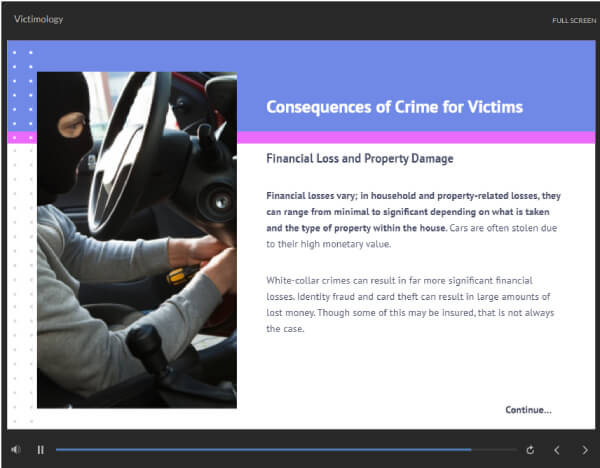
| Module 11: Victimology | |||
| Victimology | 00:20:00 | ||
| Module 12: The Criminal Justice System in England and Wales | |||
| The Criminal Justice System in England and Wales | 00:14:00 | ||
| Mock Exam | |||
| Mock Exam – Criminology, Profiling and Criminal Justice | 00:20:00 | ||
| Final Exam | |||
| Final Exam – Criminology, Profiling and Criminal Justice | 00:20:00 | ||
| Trust Pilot Review | |||
| Trust Pilot Review | 00:00:00 | ||
$199 Original price was: $199.$20Current price is: $20. ex VAT
SAVE 90% - OFFER ENDS SOON
![]() |
01 Year of full Course access
Intermediate
Endorsed Certificate of Compleiton